
Running a grocery store is not simple. It may look like a steady retail business, but behind the scenes, it is one of the fastest-moving financial environments. Thousands of small transactions happen every day. Prices change often. Inventory moves quickly. Suppliers deliver goods on tight schedules. These small actions build up fast and create a large data flow that must be tracked with care. Even a small delay in records can affect daily profit reports. Because of this, financial tracking becomes complex very fast. A small error in records can lead to bigger losses over time. This is where a grocery store accounting service plays a key role.
It helps store owners stay in control of money flow, stock value, and daily reporting. It also helps reduce stress for store owners who deal with nonstop sales activity. With proper systems, decisions become faster and clearer.
In this blog, we will explore why proper accounting support is important for high-volume grocery businesses and how it improves long-term financial health. We will also look at how better systems improve accuracy and reduce daily confusion in store finance work.
What You Will Learn From This Blog
In this blog, you will learn:
- Why grocery stores face complex financial challenges
- How high transaction volume impacts accounting accuracy
- The role of a grocery store accounting service in daily operations
- Common financial issues in grocery retail businesses
- How structured systems improve profit tracking
- Why outsourcing accounting can support long-term growth
- How expert support improves grocery accounting systems
This will help you understand how money moves inside a busy grocery store. You will also see how small changes in tracking can improve profit clarity.
You will also learn why manual systems often fail in high-volume retail setups. This makes it easier to see why structured accounting is needed.
Understanding the Complexity of Grocery Accounting in Modern Retail Businesses
Grocery stores deal with high-volume sales every hour. Unlike many other retail businesses, they handle hundreds or even thousands of small-ticket transactions daily. This creates a constant flow of data that must be recorded without delay. Each entry matters because it connects to inventory and profit tracking.
Each product has different pricing, discount rules, and supplier costs. On top of that, inventory changes constantly due to spoilage, returns, and fast movement of goods. This makes it hard to track true margins without proper systems in place.
This is why grocery accounting is more complex than standard retail accounting. It requires strong systems that can track real-time data and keep records accurate across all departments. It also needs regular updates to avoid mismatched numbers between sales and stock records.
Without proper systems, store owners often lose visibility into true profit margins. Over time, this can affect business planning and pricing decisions.
Why High-Volume Grocery Stores Need Specialized Accounting Support
A normal accounting setup is not enough for grocery businesses. High-volume stores need more detailed tracking and faster reporting. They deal with constant movement of goods and money, which needs real-time monitoring.
A grocery store accounting service is designed for this purpose. It focuses on retail-specific needs like:
- Daily sales reconciliation
- Inventory cost tracking
- Supplier payment management
- Waste and shrinkage control
- Discount and promotion tracking
These functions help keep financial data clean and updated. These areas are critical in grocery retail. Even small mistakes in one area can impact overall profit. A small error in pricing or stock count can grow into a larger financial gap.
Specialized support helps store owners see the real financial picture without delay. It also helps improve decision-making during busy store hours.
Financial Challenges Faced by Grocery Store Owners
Grocery store owners face many financial challenges every day. Some of the most common ones include:
High Transaction Volume
Every checkout adds data. Without proper systems, tracking becomes messy and time-consuming. This also increases the chance of missed entries in daily records.
Inventory Loss and Waste
Perishable goods expire quickly. If not tracked properly, this leads to hidden losses. Over time, these losses can reduce total profit without being noticed.
Supplier Payment Issues
Stores often work with multiple suppliers. Late or missed payments can affect supply flow. This can also lead to strained vendor relationships.
Price Changes and Discounts
Frequent promotions make it hard to track true profit margins. Without clear tracking, stores may not know which offers are actually profitable.
Cash Flow Gaps
Even profitable stores can face cash shortages due to timing differences in payments and receivables. This creates stress in managing daily operations.
A grocery store accounting service helps solve these problems by bringing structure and clarity to financial data. It also improves consistency in reporting.
Reducing Errors in Billing, Returns, and Supplier Transactions with Grocery Store Accounting Service
One of the biggest risks in grocery retail is human error. When staff handle hundreds of transactions daily, mistakes are likely. These small mistakes can grow into major mismatches in reports.
A proper grocery store accounting service reduces these errors through better systems and checks. It creates a clear process for recording every transaction.
It helps with:
- Accurate billing records
- Correct handling of customer returns
- Proper supplier invoice matching
- Daily reconciliation of cash and card sales
This improves overall control of daily store finance. With better tracking, store owners can quickly find and fix issues before they grow. This also improves trust in financial reports.
Benefits of Outsourcing Grocery Accounting for Long-Term Business Growth
Many grocery store owners choose to outsource their accounting work instead of managing it in-house. This decision offers several long-term benefits. It helps reduce pressure on internal teams.
Better Focus on Core Business
Owners can focus on store operations instead of financial paperwork. This improves customer service and store performance.
Cost Efficiency
Hiring a full in-house accounting team can be expensive. Outsourcing reduces overhead costs. It also removes the training and management burden.
Expert Financial Insight
Professionals understand grocery accounting systems and industry patterns. This leads to better financial planning.
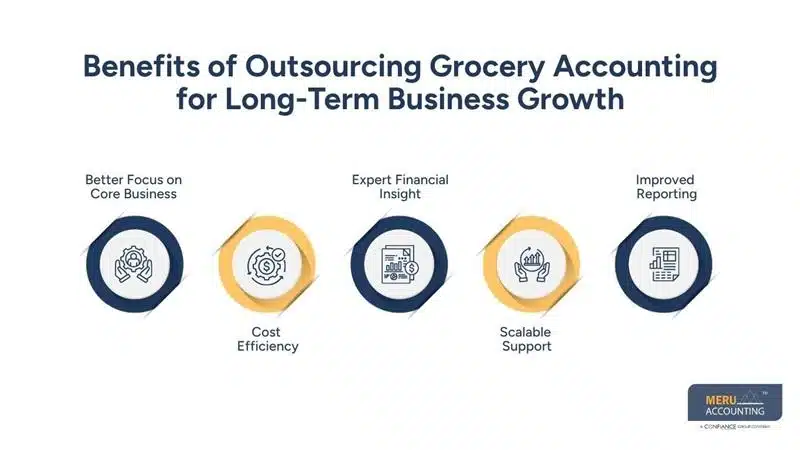
Scalable Support
As the store grows, accounting support can scale easily. This helps match business growth without disruption.
Improved Reporting
Clear reports help owners make better business decisions. This improves long-term stability.
A strong grocery store accounting service supports growth by making financial data simple and useful. It also helps reduce uncertainty in planning.
Meru Accounting's Grocery Store Accounting Service
Meru Accounting provides a structured approach to managing grocery store finances. Our grocery store accounting service is designed for high-volume retail businesses that need clear and reliable financial systems. It is built to handle fast-moving retail environments.
We offer:
- Daily bookkeeping support
- Sales and expense tracking
- Inventory cost monitoring
- Supplier and vendor account management
- Financial reporting for better decision-making
Each service is built to improve accuracy and speed. We help store owners reduce confusion in grocery accounting and stay updated with real-time financial data. This helps improve control over daily operations.
Our experience has contributed to long-term financial planning of grocery stores. With our structured process of working with grocery stores, we help grocery businesses improve accuracy and reduce financial stress.
Our Expert Insight
From industry experience, one clear fact stands out. Grocery stores that use structured accounting systems perform better in the long run. They also face fewer financial surprises.
Without a proper grocery store accounting service, owners often rely on manual tracking or disconnected systems. This leads to missed data and unclear profit margins. Over time, this weakens decision-making ability.
A strong system helps in:
- Identifying best-selling products
- Controlling waste and shrinkage
- Managing cash flow better
- Improving pricing strategies
- It gives a clearer view of store performance.
Good accounting is not just recordkeeping. It is a tool for better business decisions. It directly impacts growth and stability.
Key Takeaways
- Grocery stores handle high transaction volume daily
- Financial tracking is complex without structured systems
- A grocery store accounting service improves accuracy and control
- Grocery accounting needs industry-specific methods
- Outsourcing helps reduce cost and improve efficiency
- Proper accounting supports long-term business growth
- Real-time reporting helps owners make better decisions
FAQs
It is a financial management system designed for grocery stores. It helps track sales, expenses, inventory, and supplier payments in a structured way. It also helps store owners understand daily profit with more clarity.
Because grocery stores handle high daily transactions, fast inventory movement, and frequent price changes. This creates more data that must be tracked in real time.
It tracks waste, shrinkage, and errors in billing, helping owners identify and reduce hidden losses. It also improves accuracy in daily reporting.
Yes. Even small stores benefit from better accuracy, time savings, and improved financial control. It also helps them prepare for future growth.
Key reports include sales reports, inventory reports, profit and loss statements, and cash flow summaries. These reports help owners make better daily and long-term decisions.