A $100 online sale does not always mean your business earned $100. The order may include sales tax, payment fees, shipping costs, a refund, or other charges before the money reaches your bank account. That is where Ecommerce tax can get confusing. The number shown in your store, the amount deposited by a marketplace, and the figures in your books may all be different.
For online sellers, knowing how these numbers fit together matters when it is time to report income and claim business expenses. Your business structure, sales across different states, inventory, and sales channels can all affect how Ecommerce business taxes are handled. Understanding the basics can help you keep cleaner records and avoid common tax mistakes.
What You Will Learn From This Blog
- How ecommerce tax works for online sellers
- Which ecommerce business taxes may apply to your business
- How sales tax and economic nexus work
- Common tax deductions for online businesses
- How business structure can affect tax filing
- How good bookkeeping can make tax work easier
What Is Ecommerce Tax?
Ecommerce tax refers to the taxes that may apply to an online business and its sales. There is not one single federal “Ecommerce tax.” Instead, an online seller may have several tax duties based on its income, business structure, employees, location, and sales activity.
For example, a business may owe federal income tax on its taxable profit. It may also need to collect and send sales tax on certain sales to customers in states where it has a tax obligation. If it has employees, employment taxes may apply as well.
This is why Ecommerce business taxes should be looked at as a group of tax duties rather than one tax bill.
The IRS says the form of business you operate affects the taxes you pay and how you pay them. Common business taxes include income tax, estimated tax, self-employment tax, employment taxes, and excise tax.
How Do Ecommerce Business Taxes Work?
The basic process starts with your business income and expenses.
Suppose your online store has $200,000 in sales during the year. That does not automatically mean you have $200,000 of taxable profit. You may have costs for inventory, shipping, platform fees, advertising, software, packaging, and other business expenses.
Your books should show the money that came in, the costs you paid, and the amounts that need special treatment, such as sales tax collected from customers.
Payment reports also need to be checked against your books. For example, a payment platform may issue Form 1099-K showing gross payments. The IRS notes that the amount on Form 1099-K is not reduced for fees, refunds, shipping, or discounts, so sellers need their own records to determine the correct income and deductions.
That means Ecommerce tax reporting should not be based on one marketplace report alone. Your accounting records should tie together sales, refunds, fees, payouts, inventory, and expenses.
What Taxes Do Ecommerce Businesses Need to Pay?
The exact tax mix depends on the business, but several types of tax can come into play.
Federal Income Tax
Most profitable ecommerce businesses have federal income tax obligations. How that income is reported depends on the business structure.
A sole proprietor, for example, generally reports business income and expenses on Schedule C. Corporations use different tax returns.
Self-Employment Tax
Owners of certain businesses may also owe self-employment tax on their business earnings. This generally covers Social Security and Medicare taxes for eligible self-employed individuals.
State and Local Income Taxes
Depending on where the business operates, state or local income taxes may apply. The rules differ by state, so an online seller should not assume that federal tax rules cover every obligation.
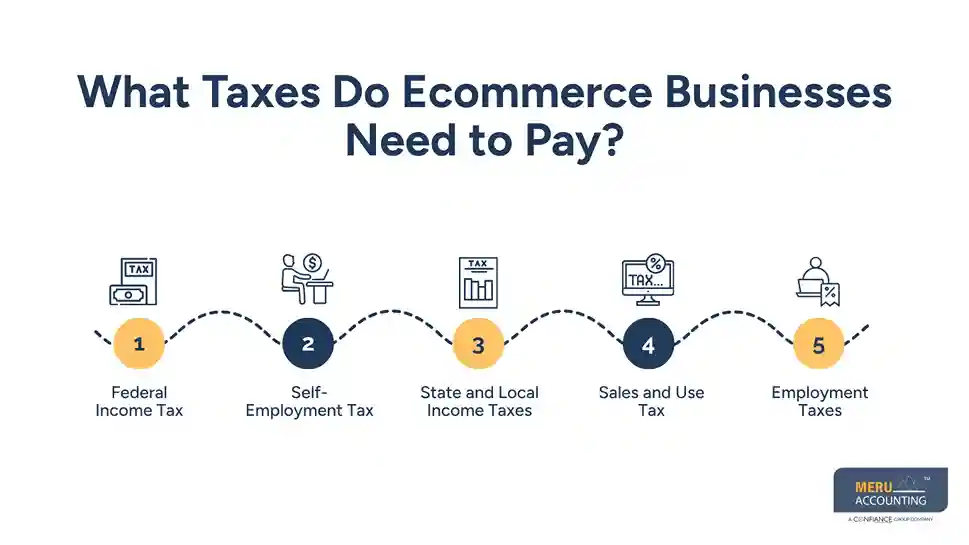
Sales and Use Tax
Sales tax is one of the biggest areas of concern for online sellers. If your business has a sales tax obligation in a state, you may need to register, collect the correct tax, file returns, and send the tax to the state.
Employment Taxes
If your ecommerce company has employees, payroll and employment taxes can also become part of your tax work. These can include federal withholding, Social Security and Medicare taxes, and federal unemployment tax.
Because Ecommerce business taxes depend on both business activity and location, online sellers should review their tax duties as they enter new markets or change how they operate.
How Sales Tax Works for Ecommerce Businesses
Sales tax can become complex because an online store may sell to customers in many states.
One key concept is economic nexus. A state may require a remote seller to register and collect sales tax after the seller reaches that state’s sales or transaction threshold. The rules and thresholds vary by state.
Physical presence can also create sales tax obligations. Inventory stored in a state, employees working there, or other business activities may affect your requirements.
Marketplace sales add another layer. Many states have marketplace facilitator laws that require platforms to collect and remit sales tax on certain sales made through their marketplaces. However, this does not always mean the seller has no filing or registration duties. State rules can still require marketplace sellers to register or file returns.
For example, an online seller may have:
- Direct sales through its own website
- Marketplace sales through Amazon or another platform
- Customers in several states
- Inventory stored in a third-party warehouse
- Different sales tax rules across states
These sales should be tracked separately enough to support accurate tax reporting.
Sales tax collected from customers should also be kept separate from normal business revenue in your books. It is generally money collected for the taxing authority, not income that belongs to the business.
optional anymore
on running the business
Common Ecommerce Tax Deductions
One major part of Ecommerce tax planning is knowing which business costs may be deductible. The exact treatment depends on the expense and the applicable tax rules, but common areas include:
Inventory and Cost of Goods Sold
For many online sellers, inventory is one of the highest costs. The tax treatment of inventory is different from simply deducting every purchase when the payment is made.
Your records should track purchases, beginning inventory, ending inventory, and cost of goods sold when applicable.
Advertising and Marketing
Costs for paid ads, email tools, content work, and other marketing activities may qualify as business expenses when they meet the applicable tax rules.
Shipping and Fulfillment
Postage, shipping supplies, fulfillment fees, and related costs can be important expense categories for online stores.
Ecommerce Software
Website tools, ecommerce platforms, accounting software, apps, and other software costs may also be deductible when they qualify as ordinary and necessary business expenses.
Payment and Marketplace Fees
Transaction fees, payment processing charges, and marketplace fees should be recorded correctly. These costs can be easy to miss when you only look at the amount deposited into your bank account.
Professional Services
Accounting, tax, legal, and other professional fees related to the business may also be deductible when they meet tax requirements.
The key is not just knowing that an expense exists. Your records should show what was purchased, why it was a business cost, and how it was paid.
Ecommerce Taxes for Different Business Structures
Your business structure can change how business income is reported and how some taxes are handled.
Sole Proprietorship
A sole proprietorship is often simple from a filing standpoint. Business income and expenses are generally reported on the owner’s individual return through Schedule C.
LLC
An LLC is a legal business structure created under state law. For federal tax purposes, an LLC may be treated in different ways depending on the number of owners and elections made.
Partnership
A partnership generally files an information return, while the partners report their share of business income according to the applicable rules.
S Corporation
An S corporation has its own filing requirements, and owners who work in the business may also have payroll considerations.
C Corporation
A C corporation generally files its own federal income tax return and pays tax under the corporate tax rules.
Choosing or changing a business structure can affect your Ecommerce business taxes, so it is worth reviewing the tax impact before making a change.
Ecommerce Tax Services From Meru Accounting
Ecommerce businesses can have very different accounting needs based on how they sell. Meru Accounting supports online sellers with the bookkeeping and CPA support needed to keep those records ready for tax work.
Our services include:
- Monthly ecommerce bookkeeping and reconciliation
- Sales, payout, and payment processor reconciliation
- Inventory and COGS tracking
- Marketplace fee, refund, and return tracking
- A/P and A/R support
- Expense classification and account cleanup
- Monthly financial reports
- Tax-ready books and records
- CPA support for ecommerce businesses
We can work with the software, sales channels, and accounting workflow already used by your business. This gives ecommerce owners a practical way to keep their books current without having to rebuild their process around a fixed system.
Our Expert Insight
One thing ecommerce owners often miss is that cash in the bank is not the same as taxable profit. A business may have strong cash flow while a large share of its money is tied up in unsold inventory. On the other hand, strong sales do not always mean the business has enough cash to cover its bills and tax payments.
That is why we pay close attention to inventory, COGS, returns, and sales when reviewing ecommerce business taxes. If these numbers do not line up, the issue may be in the books rather than the tax return itself. Reviewing these accounts before year-end can help catch errors while they are still easy to fix.
Key Takeaways
- Ecommerce tax is not one single tax. Online sellers may deal with income, sales, self-employment, employment, and other taxes.
- Your business structure affects how income is reported and which tax returns you file.
- Sales tax rules can vary by state, and economic nexus can create obligations even without a traditional physical store.
- Marketplace facilitator laws may shift sales tax collection to the platform, but sellers can still have state filing or registration duties.
- Inventory, refunds, shipping, platform fees, advertising, and software should be tracked correctly.
- Form 1099-K reports gross payments, so it should be checked against your books rather than treated as a direct measure of taxable profit.
- Clean bookkeeping makes Ecommerce business taxes easier to prepare and review.
FAQs
If you expect to owe enough federal tax during the year, you may need to make estimated tax payments. The timing and amount depend on your business income and tax situation.
You can, but keeping business and personal transactions separate makes your books and tax records much easier to manage. A dedicated business account also makes it easier to track income and expenses.
Selling in a new state can create new sales tax or other state tax obligations. The effect depends on your business activity and that state’s rules, so review the requirements before expanding.
No. The tax treatment depends on what you buy and how it is used. Inventory, equipment, software, advertising, and other purchases can have different rules.
Keep sales records, expense receipts, inventory records, payment processor reports, marketplace statements, refund records, and tax documents. Good records make it easier to support the numbers reported on your tax return.
optional anymore
on running the business