What happens when your first customer pays you? You make a sale, but that is only the start. You also need to record the income, match the payment to your bank account, track related costs, save the receipt, and know whether the money is actually available to spend. That is the practical side of how to do accounting for small businesses.
The process may look simple at first. Five invoices can be easy to track. Fifty invoices, payroll, unpaid bills, taxes, and several bank accounts are a different story. The right system gives you useful numbers before small bookkeeping issues turn into larger problems.
What You Will Learn From This Blog
- How to build an accounting system from the first transaction.
- Where bookkeeping fits into your daily business work.
- How to prepare your records for tax filing.
- When your accounting routine needs to change as sales grow.
- How accounting software can reduce manual work.
- How to create a routine you can keep using as the business gets bigger.
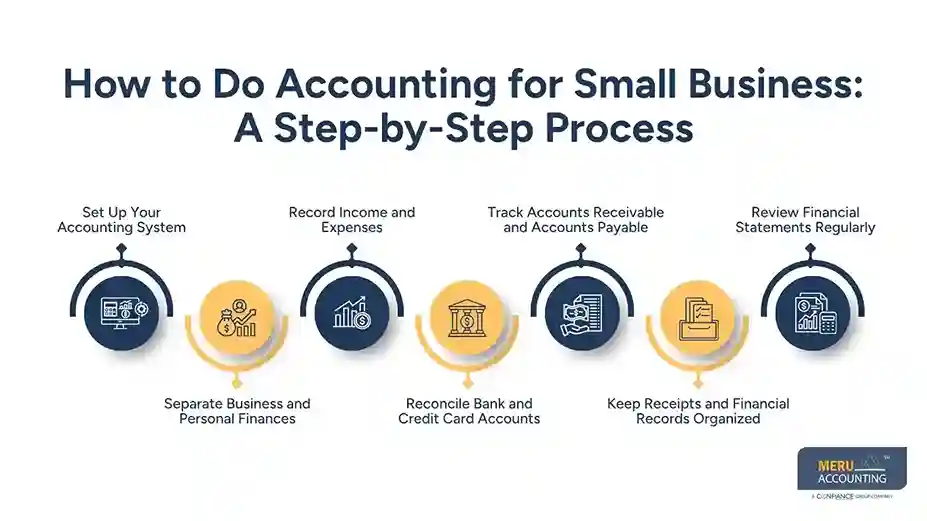
How to Do Accounting for Small Business: A Step-by-Step Process
Set Up Your Accounting System
Think of your accounting system as the place where every financial event gets a home. Sales, rent, software bills, loans, payroll, and owner transactions should not sit in random files or emails. Start with a chart of accounts that matches your business to understand how to do accounting for small businesses. The simpler the setup, the easier it is to keep your records consistent.
Separate Business and Personal Finances
A business lunch and your personal dinner may both appear on the same bank statement, but they do not belong in the same accounting category.
Open a separate business account and card where possible. This simple step makes small business accounting cleaner and makes it easier to see what the business actually earns and spends.
Record Income and Expenses
Do not wait for tax season to remember what happened six months ago. Record sales and expenses while the details are still clear.
For example, a $2,000 client payment should be recorded with the related invoice, while a $150 software charge should be posted to the correct expense account.
Reconcile Bank and Credit Card Accounts
Your accounting software may say you have $18,000 in cash. Your bank may say $17,650. Which number is right?
Reconciliation finds the reason for the difference. Compare your books with bank and card statements each month and check for missing payments, duplicate entries, fees, and uncleared transactions.
Track Accounts Receivable and Accounts Payable
Money you expect is not the same as money you have. Accounts receivable shows what customers owe you, while accounts payable shows what you owe vendors.
If three customers owe $8,000 in total, that amount may appear in your reports even though the cash is still sitting in their accounts.
Keep Receipts and Financial Records Organized
A receipt sitting in your email today can become difficult to find next year. Store receipts, invoices, bills, bank statements, payroll records, and other financial documents in an organized system.
The IRS requires records that support items reported on tax returns, so good recordkeeping is part of how to do accounting for small business, not an optional extra.
Review Financial Statements Regularly
A profit and loss statement can tell you whether sales increased, but it does not tell the whole story. Your balance sheet can show unpaid bills, customer balances, debt, and assets.
Review both reports each month. Ask simple questions: Are expenses rising faster than sales? Are customers paying on time? Is cash getting tighter?
How to Handle Taxes in Small Business Accounting
Track Deductible Expenses
Tax records should be built during the year, not recreated the night before filing. Record business expenses when they occur and keep the related proof.
A large purchase, travel cost, vehicle expense, or mixed-use expense may need special tax treatment. When the answer is unclear, check the current tax rules or ask a qualified tax professional.
Prepare for Estimated Tax Payments
Tax can become a cash-flow issue when there is no employer withholding tax from business income. Some business owners may need to make estimated payments during the year.
Include expected tax payments in your cash plan. A profitable month can still create a cash problem if tax money has already been spent.
Maintain Tax Records
Your tax file should tell a clear story. Income should connect to sales records, while expenses should connect to invoices, receipts, or other supporting documents.
Keep records for payroll, assets, loans, bank activity, and other items that affect your tax return. This makes year-end review much easier.
Prepare for Year-End Tax Filing
Do not begin year-end work with a pile of unreconciled transactions. First, close your books, review receivables and payables, check asset records, and confirm payroll entries.
Once the records are complete, your tax preparer has a much better starting point for the return.
How to Manage Accounting as Your Small Business Grows
Increase Bookkeeping Frequency
The accounting routine that worked with ten monthly transactions may fail when you have 300.
If transactions increase, move from occasional updates to weekly or daily bookkeeping. Smaller reviews are easier to handle than one large cleanup at year-end.
Manage Payroll and Employee Records
Hiring your first employee changes the accounting process. Now you may have wages, payroll taxes, benefits, reimbursements, and employee-related records to track.
Keep payroll entries matched with payroll reports and bank payments. Do not treat payroll as just another bank transaction.
Track Receivables and Payables
Growth can create a strange problem: more sales but less available cash. Why? Customers may take 30 or 60 days to pay while your suppliers expect payment sooner.
Review overdue invoices and upcoming bills regularly. This gives you a better picture of when cash is likely to move.
Monitor Cash Flow
Profit tells you about business performance. Cash flow tells you what money is available now and what is expected next.
List expected customer payments alongside payroll, rent, taxes, loans, and vendor bills. This simple view can show a cash gap before it becomes urgent.
How to Use Accounting Software For a Small Business
Choose Software That Fits
When learning how to do accounting for small businesses, don’t choose software only because another business uses it. Look at your own needs: invoices, bills, payroll, inventory, bank feeds, reports, and tax records.
A freelancer may need basic features. A growing company may need a much wider accounting setup.
Set up Your Chart of Accounts
Your software is only as useful as the categories behind it. Set up income and expense accounts that reflect how your business actually operates.
Avoid creating dozens of unnecessary categories. You want useful detail without making every transaction difficult to classify.
Connect Bank Accounts
Bank feeds can bring transactions into your software and reduce manual entry. They do not mean the work is finished.
Review imported transactions, match payments correctly, and check that the software has assigned the right category.
Review Automated Entries
Automation can repeat an error just as easily as it can repeat a correct entry.
Check recurring bills, bank rules, payment matches, and other automated postings. Pay closer attention to unusual or high-value transactions.
Control User Access
Your bookkeeper may need access to transactions, while another employee may only need to create invoices.
Set user permissions based on job duties. Keep strong passwords and protect financial records from unnecessary access.
optional anymore
on running the business
Common Small Business Accounting Mistakes to Avoid
Mixing Personal and Business Costs
One personal purchase may not seem important, but repeated mixed transactions can make your books difficult to understand.
Keep business and personal spending separate and record owner contributions or withdrawals correctly.
Ignoring Small Transactions
A $20 expense may seem too small to matter. Hundreds of such expenses can create a meaningful difference over a year.
Record business costs consistently rather than deciding which ones are “too small” to enter.
Waiting Until Tax Time
Tax season should be a review period, not the time when you rebuild your entire year.
Waiting can leave you with missing receipts, old invoices, incorrect categories, and unreconciled accounts.
Forgetting Unpaid Invoices
A $5,000 invoice may increase reported revenue, but it does not put $5,000 in your bank account today.
Review aged receivables and follow up on overdue balances so your records reflect what customers actually owe.
Not Reconciling Accounts
If you never compare your books with your bank statements, errors can stay hidden for months.
Make reconciliation a fixed part of your small business accounting routine rather than a task you do only when something looks wrong.
How to Build an Accounting Routine That Scales With Your Business
Review Transactions Weekly
Set aside time each week to record sales, purchases, payments, and other activity.
A 30-minute review can be far easier than sorting through months of transactions at once.
Check Receivables Weekly
Look at unpaid invoices every week. Which invoices are due soon? Which are overdue? Which customers have large outstanding balances?
This turns your receivables list into a cash planning tool.
Close Books Monthly
At month-end, reconcile accounts, review receivables and payables, check payroll, and run your main financial reports.
A monthly close gives you a clear point from which to ask what changed and why.
Review Taxes Quarterly
Look at income, expenses, payroll taxes, estimated payments, and major purchases during the year.
Tax needs vary by business and taxpayer, so use current IRS guidance or qualified tax advice when making tax decisions.
Review Reports Annually
At year-end, review the full picture rather than looking only at profit. Check cash, debt, assets, unpaid invoices, unpaid bills, and owner transactions.
This gives you cleaner records for tax filing and a better base for the next year’s plan.
Small Business Accounting Services From Meru Accounting
As your business grows, more transactions, invoices, expenses, and financial records need regular attention. Meru Accounting keeps these accounting tasks organized so you have current records for financial review and tax work.
- Meru Accounting handles bookkeeping for sales, expenses, payments, and other day-to-day financial transactions.
- Bank and credit card accounts are reconciled with the books to identify missing, duplicate, or unmatched transactions.
- Accounts receivable and accounts payable records are maintained to track customer balances and vendor bills.
- Financial reports are prepared to show revenue, expenses, profit, assets, liabilities, and cash position.
- Payroll-related accounting records are maintained and matched with the related financial transactions.
- Accounting work can be managed through platforms such as QuickBooks, Xero, Zoho Books, NetSuite, and Odoo.
The accounting process can be adjusted as transaction volume, reporting needs, and business activity change. With current and organized records, you have a clearer base for financial and tax review.
Our Expert Perspective
We often see accounting problems start with ordinary things: an invoice that was never followed up, a receipt that was misplaced, or a bank account that was not reconciled.
That is why how to do accounting for small business should be treated as a routine rather than a once-a-year task. When the records stay current, you can spot changes in sales, costs, cash, and unpaid balances while there is still time to act.
Key Takeaways
- Build how to do accounting for small business around a clear system that you can maintain consistently.
- Keep business and personal finances separate to maintain accurate financial records.
- Record income and expenses regularly while transaction details are still clear.
- Reconcile bank and credit card accounts each month to identify missing or incorrect entries.
- Monitor customer invoices and vendor bills to maintain control over receivables and payables.
- Keep tax records and supporting documents organized throughout the year.
- Review financial statements regularly instead of relying only on your bank balance.
- Increase bookkeeping frequency as your transaction volume and business activity grow.
- Use accounting software to manage records efficiently, while reviewing automated entries for accuracy.
- Make small business accounting a regular part of your financial management process.
FAQs
Set up a business bank account, choose an accounting system, record income and expenses, reconcile accounts, track invoices and bills, and review financial reports.
A small business should track sales, expenses, invoices, bills, bank transactions, credit card activity, payroll, taxes, assets, and liabilities.
Most small businesses should reconcile bank and credit card accounts at least once a month to find errors, missing entries, and unmatched transactions.
Keep organized records of income, expenses, receipts, invoices, payroll, assets, and other documents that support the amounts reported on tax returns.
Upgrade the process when transaction volume, employees, invoices, bills, payroll, or reporting needs become too difficult to manage with the existing system.
optional anymore
on running the business