As a business owner in England, income tax may be one of the biggest yearly expenses. Yet many business owners do not fully understand how much income tax they need to pay. Understanding how the tax bands work, and how much is income tax in England, you can plan your tax better.
This blog explains UK income tax in a clear and simple way. We look at the tax bands, examples for different salary levels, the difference between employee and self employed taxation, common mistakes people make, and legal methods to reduce your tax bill. By the end, you will have a full picture of how income tax works in England.
Understanding UK Income Tax Basics
UK income tax is a tax charged on the money you earn from various sources. This includes salary, business profits, rental income, interest, dividends, and some benefits. HM Revenue and Customs is the authority responsible for collecting the tax. The money raised supports public services. These include the National Health Service, public education, welfare support, fire services, police work, and national infrastructure.
It is a progressive tax system. This means that as income rises, the amount of tax you pay also rises. You only pay the higher rate on the portion of your income that falls in that band. This is why it is important to understand how the bands work rather than only looking at your total salary.
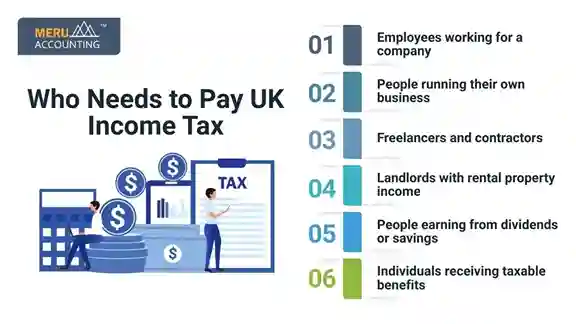
Who Needs to Pay UK Income Tax
You must pay income tax if you are a resident in the UK and you earn above the personal allowance. The UK income tax applies to:
- Employees working for a company
- People running their own business
- Freelancers and contractors
- Landlords with rental property income
- People earning from dividends or savings
- Individuals receiving taxable benefits
Some income is tax free, and some people qualify for reliefs. But once your total income crosses certain limits, income tax becomes due.
How much is Income Tax in England and how is it calculated?
Income tax is calculated by taking your total income, removing any tax free allowances, removing eligible reliefs, and then applying each tax band to the correct part of your income.
The key steps include:
- Add all taxable income
- Deduct personal allowance
- Deduct claims like pension contributions or allowable expenses
- Apply each tax rate band only to the income that falls within its range
Your final bill is simply the total of all these parts. Understanding this process makes it easy to estimate your yearly tax even before payroll or Self Assessment.
Income Tax Bands and Rates in England
Income tax bands for England, Wales, and Northern Ireland are set by the UK Government. These bands will help you understand how much is Income Tax in England. Scotland has different rates, so this guide focuses only on England.
Current Tax Bands for 2025-26
Tax Band | Income Range | Tax Rate |
Personal allowance | 0 to 12,570 | 0 percent |
Basic rate | 12,571 to 50,270 | 20 percent |
Higher rate | 50,271 to 125,140 | 40 percent |
Additional rate | Above 125,140 | 45 percent |
These rates apply only after your allowances are considered.
Personal Allowance
You do not pay any income tax on the first 12,570 of your income. This is your tax free allowance. However, once your income passes 100,000, the allowance reduces by one pound for every two pounds earned. This reduction continues until it becomes zero at 125,140. This creates what many call the hidden tax zone because the effective tax rate becomes much higher. Understanding this helps with tax planning and salary structuring.
Basic Rate
Income between 12,571 and 50,270 is taxed at 20 percent. Most workers fall into this group, making this the most common tax rate paid by earners in England.
Higher Rate
Income between 50,271 and 125,140 is taxed at 40 percent. People in this band often have more complex income sources such as bonuses, dividends, or rental income.
Additional Rate
Once income crosses 125,140, the tax rate rises to 45 percent. This is the highest rate of income tax in England. At this level, tax planning becomes even more important because a small change in income structure can bring significant savings.
UK Income Tax by Salary Levels
To understand how much is Income Tax in London, you must know the salary levels set by the government. Below are detailed examples showing how tax is calculated at different salary levels. These examples help you see exactly how the bands apply in real situations.
Salaries Under 12,570
If your income is below 12,570, you pay no income tax. Many part time workers, students, and seasonal workers fall into this level. Even though there is no tax, you may still need to submit returns if you have income from other sources.
Salaries 12,571 to 50,270 (Basic Rate Taxpayers)
Most people in England fall in this wage range. The basic rate of 20 percent applies to income above 12,570.
Example: Annual Salary of 30,000
Income Section | Amount | Rate | Tax |
Personal allowance | 12,570 | 0 percent | 0 |
Taxable income | 17,430 | 20 percent | 3,486 |
Total tax due = 3,486
This example shows that even though the salary is 30,000, the tax is charged only on the amount above 12,570.
Example: Annual Salary of 45,000
Income Section | Amount | Rate | Tax |
Personal allowance | 12,570 | 0 percent | 0 |
Taxable income | 32,430 | 20 percent | 6,486 |
Total tax due = 6,486
Workers in this range may also face National Insurance, which reduces take home pay further.
Salaries 50,271 to 125,140 (Higher Rate Taxpayers)
Once income enters the higher rate band, tax becomes more significant. The first 37,700 above the personal allowance is taxed at 20 percent, and the rest at 40 percent.
Example: Annual Salary of 70,000
Income Section | Amount | Rate | Tax |
Personal allowance | 12,570 | 0 percent | 0 |
Basic band | 37,700 | 20 percent | 7,540 |
Higher band | 19,730 | 40 percent | 7,892 |
Total tax = 15,432
This shows how income is split across bands.
Salaries Above 125,140 (Additional Rate Taxpayers)
At this point, your personal allowance is removed, and all income is taxable.
Example: Annual Salary of 150,000
Income Section | Amount | Rate | Tax |
Personal allowance | 0 | 0 percent | 0 |
Basic band | 37,700 | 20 percent | 7,540 |
Higher band | 74,870 | 40 percent | 29,948 |
Additional rate | 24,860 | 45 percent | 11,187 |
Total tax = 48,675
UK Income Tax in this band often needs tax planning to avoid overpayment.
Income Tax for Self Employed vs Employees
After knowing how much is Income Tax in England, you must also know that tax rules differ based on how you earn your income.
PAYE System for Employees
Employees have their tax deducted through PAYE. The employer calculates income tax and National Insurance each month. This makes life easier because you do not need to worry about tax returns unless you have extra income.
Key advantages:
- Automatic deductions
- No need to calculate tax manually
- No yearly surprise bills unless you have multiple income streams
Self Assessment for Self Employed Individuals
Self employed people must calculate and report income once every tax year. They file a Self Assessment return and pay taxes in two installments called payments on account.
Other responsibilities include:
- Keeping receipts
- Tracking business expenses
- Tracking sales and profit
- Paying Class 2 and Class 4 National Insurance
Because the self employed have more freedom to deduct expenses, their taxable income may be lower.
NIC Contributions and Effect on Net Income
National Insurance contributions reduce your take home pay. The impact differs for employees and self employed workers.
- Employees pay Class 1 NIC
- Self employed workers pay Class 2 and Class 4 NIC
These contributions help with state pension and other benefits.
Common Mistakes to Avoid
Not Claiming Allowances
Many people forget to claim:
- Marriage allowance
- Pension relief
- Work related expenses
- Allowances for blindness or disability
These reduce taxable income and can save a lot of money.
Misreporting Income
Income from rental property, freelance work, overseas earnings, and investments must all be reported. Mistakes can lead to penalties.
Late Filings and Penalties
Late filing charges and interest can grow quickly. Filing early helps you avoid last minute stress and surprise penalties from HMRC.
Tips to Reduce Your Income Tax Legally
After knowing how much is Income Tax in England, follow these simple tips to reduce it legally:
Using Allowances Effectively
Use all available allowances such as:
- Personal allowance
- Marriage allowance
- Savings allowance
- Dividend allowance
Small allowances still bring meaningful savings.
Tax Efficient Investments
Tax free and tax efficient accounts include:
- ISAs
- Pension contributions
- EIS and SEIS investments
These reduce tax while helping you grow wealth.
Employer Benefits and Salary Sacrifice Schemes
Salary sacrifice can reduce your taxable income. It is useful for pensions, bike to work schemes, and childcare benefits. This method saves both tax and NIC for many workers.
Why Choose Meru Accounting for Your Tax and Compliance Needs in England
After going through this blog, you might be familiar with how much is Income Tax in England. Meru Accounting offers complete outsourced accounting and tax support for individuals and businesses across the UK. Our team helps with payroll, tax returns, bookkeeping, Self Assessment, and full HMRC compliance.
We give friendly support, and accurate calculations so you never worry about hidden tax mistakes or missed deadlines. With our outsourced service, you save time, remove stress, and gain reliable financial clarity.
FAQs
- How Much Is Income Tax in England?
Income tax in England depends on your income level and the tax bands you fall into. You pay zero percent up to the personal allowance, twenty percent on basic rate income, forty percent on higher rate income, and forty five percent on additional rate income. - What is UK income tax and who needs to pay it?
UK income tax is a tax on earnings from work, business profits, rentals, and investments. Anyone who earns above the personal allowance must pay it unless specific exemptions apply. - When do I start paying income tax in England?
You start paying income tax once your annual income crosses the 12,570 personal allowance limit. Income above this figure is taxed based on the correct band. - Do employees and self employed individuals pay tax in the same way?
No. Employees pay tax through PAYE, while self employed individuals file a Self Assessment return and pay tax in installments. - How can I reduce my income tax bill legally?
You can reduce your tax by using allowances, claiming eligible expenses, increasing pension contributions, choosing salary sacrifice options, and using tax efficient investment accounts. - Do I need an accountant for my tax return?
While some people can handle simple returns on their own, an accountant is helpful if you have multiple income sources, higher rates of tax, rental income, or want to avoid costly mistake