In house accounting vs outsourcing – In their earliest days, many small business owners take care of their accounts themselves. For some, this can be a helpful way to familiarize themselves with the inner workings of their business. It also helps them to know the financial process. For many, it is a way to keep costs down until they find a firm footing.
But as the business grows, almost all will opt to hand over this task to someone else. They must decide who will be responsible for one of the most complex but important aspects of the business.
Assuming you are not one of them (very) few people who keep taking care of the accounts, there is one main decision you need to make: whether to have someone do this work in-house or to outsource it.
Each option has its own specific advantages and disadvantages. And determining which is best for you will depend on your own needs and the resources you have available.
What You Will Learn from This Blog
In this blog, you will learn:
- How to compare in house accounting vs outsourcing based on cost, quality, efficiency, and business needs.
- The advantages and disadvantages of in-house accounting and outsourced accounting services.
- Which accounting model is best suited for small, medium, and growing businesses?
- The essential accounting practices for small business, including budgeting, cash flow management, tax planning, and record-keeping.
- How choosing the right accounting approach can improve financial accuracy, compliance, and long-term business growth.
Weighing Up The Cost of In House Accounting vs Outsourcing
Cost is a major factor in any choice. When weighing in house accounting vs outsourcing, the expense of hiring a new employee becomes a key consideration. If you will take on such an expense, you need to know that you are getting enough in return to justify it.
For most small or medium-sized businesses, there is not sufficient work to warrant a full-time role. The average bookkeeper’s salary in Ireland is around €33,000 a year, while the average accountant’s salary comes in at roughly €50,000. This is almost enough to hire 2-3 full-time employees on minimum wage.
Then, there are employee overhead costs, such as insurance benefits, taxes. It increases the cost of hiring an employee by about 20%.
Weighing Up The Potential Quality
As you likely already know, bookkeeping and accounting are difficult tasks. They are complex processes that require various mathematical skills, an incredible eye for detail, and years of training to master.
Building your own in-house team has benefits, but deciding between that and external support is the essence of in house accounting vs outsourcing. We get a team of people who are not only good at their job but passionate too. But you can’t reap the rewards with just one person if you don’t have enough resources.
Hiring one person will never get you the same level of skills that you will receive from a whole team of experts. When they do not designate a specific person for finances, they have very little in-depth oversight.
Their mistakes are likely to go unnoticed. When you have access to a whole team of experts, you get a package of a great level of combined skill and much more oversight. So, being that the work carried out is of much higher quality.
Factoring Efficiency In To The Equation
Bringing someone in to manage your books can appeal for many reasons. Not least of these reasons is the ability to see that they are working solely for you. Many employers feel more comfortable having someone on-site at all times.
They link it with the vested interest in the success of that business. But apart from the costs associated, and the increased risk of mistakes, we can make an easy argument that this is a counterintuitive approach.
First, if work is limited, outsourcing may be smarter. This is a key part of evaluating in house accounting vs outsourcing. But regardless of the amount of work, assigning it all to one person leaves you in a vulnerable position.
Should they suddenly leave the role, you will be left scrambling to find someone with the right skills to come in and familiarise themselves with your accounts as quickly as possible. When outsourcing, you won’t have to worry about any of these issues. If one employee at the accounting firm is out or leaves suddenly, it hands one off to the next equally qualified expert.
It is understandable why people would feel more comfortable around someone with whom they have a more personal relationship, but ultimately, accounting firms need to strike a balance between quantity and quality of service, just like any other business, which means consistently providing the correct numbers on time, every time.
The Risk Of Employee Fraud
The final point is one that is not usually a major consideration for most people. Unfortunately, research how shown that between 22 & 28% of businesses are victims of employee fraud. Amongst this, fraud is most likely to affect small businesses. And the longer an employee has been with a company, the more likely they are to commit fraud. And also, the greater the size of the fraud will be.
The complexity of the process can make it easy for someone who knows what they’re doing to hide the fraud. Therefore, such fraud goes undetected for an average of 16 months. Such instances of fraud are far less common when we outsource the work.
Not only because expert oversight is increased, but also because their entire business would fall if they are involved in scams. It will depict them as inherently untrustworthy in executing their job.
Essential Accounting Practices for Small Businesses
Here are some essential accounting practices for small businesses:
Choosing the Right Accounting Method
- Cash-basis accounting logs money when cash is received.
- Accrual accounting records sales and costs when they occur.
- Cash-basis is easy and works for small firms.
- Accrual shows a full view of financial health.
- When deciding on accounting methods, small businesses should think about in house accounting vs outsourcing, as the method may influence how work is handled.
Regular Financial Reviews
- Check accounts often to catch mistakes early and fast.
- Monthly reviews keep daily records correct and updated.
- Quarterly checks show trends in profit and loss.
- Annual reviews help prepare taxes and plan ahead.
- Regular reviews reduce risk of theft or fraud.
- Frequent checks improve decisions and business planning.
Budgeting and Forecasting
- Track all spending to avoid overspending and shortfalls.
- Include fixed costs and bills in the budget.
- Budgeting helps plan for slow and busy months.
- Forecasts predict income and costs for smart choices.
- Planning ahead stops cash shortages during slow months.
- Budget checks allow changes to save or spend.
Tax Planning and Preparation
- Keep bills and receipts safe for tax time.
- Track deductions to cut taxes legally each year.
- Use software to log all money transactions correctly.
- Ask experts if taxes are hard to manage.
- Plan payments each quarter to avoid late fees.
- Update records to follow new laws and rules.
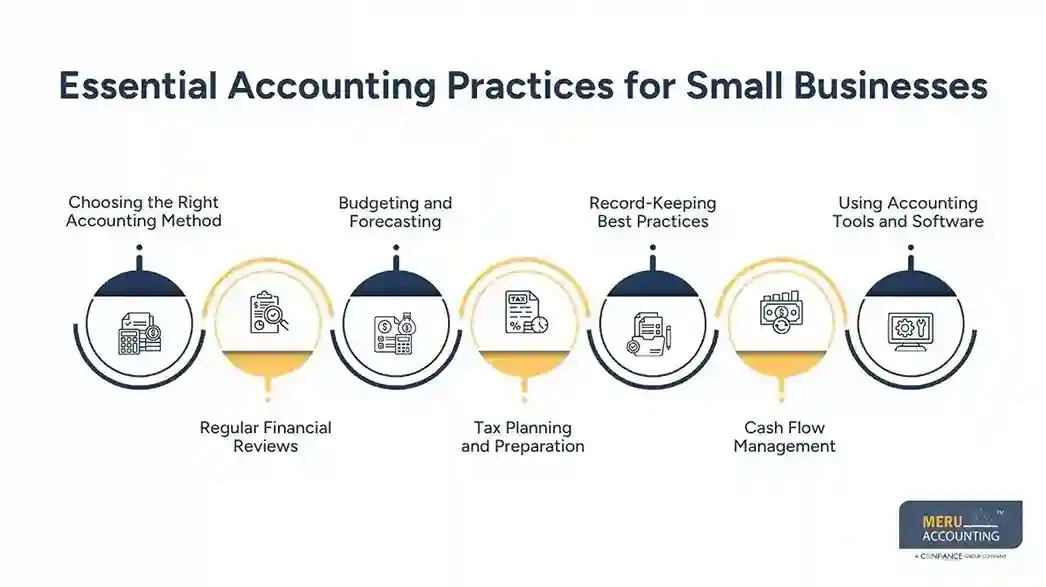
Record-Keeping Best Practices
- Keep all financial papers in one safe place.
- Separate business and personal accounts to avoid confusion.
- Mark documents clearly with date, type, and notes.
- Store digital backups to avoid lost or damaged files.
- Keep records for years for audits or review.
- Good records make loans, taxes, and reports easy.
Cash Flow Management
- Track all money coming in and going out.
- Watch overdue bills to keep cash flow stable.
- Keep cash reserves for sudden or big costs.
- Plan for busy and slow months in advance.
- Avoid waste to keep cash flow positive always.
- Use extra cash to grow the business smartly.
Using Accounting Tools and Software
- Using software can improve efficiency and reduce errors, whether you are managing in house accounting vs outsourcing.
- Tools track invoices, bills, payroll, and reports fast.
- Cloud software keeps data safe and easy to reach.
- Pick tools that suit the business size and needs.
- Good software gives insights for growth and planning.
- Bank links make transactions simple and accurate each time.
Choosing between in-house and outsourced accounting is key for any business. In-house teams know your company and focus on your needs. Outsourcing gives you more skills, saves time, and lowers mistakes or fraud.
Meru Accounting offers full accounting services made for your business. We keep records right, report on time, and manage finances well. Our certified team handles bookkeeping, taxes, cash flow, and budgets with care. Work with us to get expert help in in house accounting vs outsourcing, ensuring your business finances run smooth and grow steadily.
Our Expert Insight
Choosing between in house accounting vs outsourcing is not just about reducing costs—it is about finding the right financial support that aligns with your business stage and growth plans. While in-house accounting offers greater day-to-day control, outsourcing gives businesses access to experienced professionals, advanced technology, and scalable services without the overhead of hiring a full-time team. At Meru Accounting, we recommend assessing your workload, compliance requirements, and long-term goals before deciding. Combining strong accounting practices for small business with the right accounting model can improve accuracy, financial visibility, and business performance.
Key Takeaways
- Evaluate in house accounting vs outsourcing by comparing costs, expertise, efficiency, business continuity, and fraud risk.
- Outsourcing is often a cost-effective solution for small and growing businesses that need expert financial support without full-time hiring expenses.
- In-house accounting provides greater control but may require higher investment in salaries, training, and technology.
- Following strong accounting practices for small business—such as regular financial reviews, budgeting, tax planning, record-keeping, and cash flow management—supports better financial decisions.
- Selecting the right accounting approach helps improve compliance, reporting accuracy, and long-term business growth while allowing your business to scale efficiently.
FAQs
The right choice depends on your budget, business size, workload, and accounting needs. Small and growing businesses often benefit from outsourcing, while larger organizations with continuous financial operations may prefer an in-house accounting team.
For most small businesses, outsourcing is more cost-effective because it eliminates expenses such as salaries, employee benefits, training, and accounting software while providing access to experienced professionals.
In-house accounting offers direct control and dedicated staff, whereas outsourcing provides access to specialized expertise, scalable services, and lower operating costs. The best option depends on your business goals and financial requirements.
Yes. Both can deliver accurate financial records when managed properly, but outsourced accounting firms often have multiple experts reviewing financial data, helping improve accuracy, compliance, and reporting quality.
Yes. Many businesses begin with outsourced accounting to reduce costs and later build an in-house finance team as operations become more complex. Some companies also use a hybrid model that combines both approaches for greater flexibility.
optional anymore
on running the business