A product may sell well and still bring in less profit than expected. The reason could be higher material costs, excess waste, rising labor expenses, or a price that doesn’t cover the true cost of production. Industrial accounting helps uncover these issues by showing what it really costs to make and sell each product.
For growing industrial businesses, keeping track of production costs, inventory, and overhead becomes just as important as tracking sales. A clear accounting process helps owners spot rising expenses, set better prices, and make informed decisions about production and growth.
In this blog, we’ll look at the key methods, cost calculations, and financial reports involved in accounting for industrial businesses, along with practical ways to keep financial records accurate as operations expand.
What You Will Learn From This Blog
- What industrial accounting means and why it matters.
- The main costs and records that industrial firms need to track.
- Common cost methods used in industrial work.
- How to work out total and per-unit production costs.
- Key reports that help track costs, stock, and profit.
- How expert accounting support can help firms manage growth.
What Is Industrial Accounting?
Industrial accounting is the process of tracking, recording, and reviewing the costs and financial data linked to industrial work. It helps firms measure the cost of making goods and assess how well they use labor, stock, and other assets.
Unlike basic business accounting, it gives more focus to the cost of each stage of production. This can include raw goods, wages, factory rent, power, repairs, and machine use.
For example, a firm that makes metal parts needs to know more than how much it spent on raw steel. It must also track the labor used to shape the parts, the power used by machines, and the share of factory costs tied to each unit.
Good industrial accounting brings these costs into one clear view. It helps owners:
- Find the true cost of each product.
- Set prices that cover costs and leave room for profit.
- Track stock at each stage of work.
- Find waste and control high costs.
- Review profit by product or job.
- Plan cash needs and future output.
As a firm adds new products, staff, or sites, accounting for industrial businesses needs clear rules and sound cost records. This makes it easier to compare results and spot issues before they grow.
Key Components of Industrial Accounting
A sound cost system starts with the right data. Each cost must be placed in the right group so that reports show what it takes to make and sell a product.
1. Direct Material Costs
Direct material costs are the raw goods and parts used to make a product. For a furniture maker, this may include wood, screws, glue, and metal parts.
Firms need to track the amount bought, used, and left in stock. Poor records can lead to excess orders, stock shortages, or wrong product costs.
2. Direct Labor Costs
Direct labor is the pay given to staff who work on the goods being made. This may include machine staff, welders, packers, and other workers who take part in production.
Track work hours, pay rates, overtime, and output. This helps firms see how much labor each product or job needs.
3. Manufacturing Overhead
Manufacturing overhead covers factory costs that are not tied to one unit of goods. Common costs include:
- Factory rent and property costs.
- Power, water, and fuel.
- Machine repairs and upkeep.
- Depreciation of factory assets.
- Pay for plant managers and support staff.
- Safety and other factory costs.
These costs must be shared across products in a fair and steady way. The right method will depend on how the firm runs its plant.
4. Work-in-Process and Finished Goods
Not all goods are ready for sale at the end of a month. Some may be part-made, while others are done and held in stock.
Work-in-process (WIP) refers to goods that have entered production but are not yet complete. Finished goods are ready for sale or delivery.
Accurate stock records help firms report the right value of goods and avoid errors in cost of sales.
5. Operating Expenses and Capital Costs
Operating expenses cover the day-to-day costs of running a firm, such as office pay, sales costs, and admin costs.
Capital costs relate to assets that will serve the firm over time, such as machines, plant tools, and factory upgrades. These costs are not treated in the same way as daily expenses. Firms need to track asset costs and record wear and tear over the asset’s useful life.
Common Industrial Accounting Methods
Different firms need different cost methods. The best choice depends on the type of goods made, how work flows, and how costs can be traced.
1. Job Order Costing
Job order costing tracks costs for each job, batch, or order. It works well when firms make goods to meet set client needs.
For example, a firm that makes custom steel frames can track the raw goods, labor hours, and factory costs for each order. This helps it see if the price charged will cover the cost of the job.
2. Process Costing
Process costing is used when a firm makes large volumes of like goods through the same steps.
It is common in food, chemical, paper, and textile plants. Costs are tracked by stage or process, then shared across the units made.
This method helps firms work out the cost per unit when it is not easy to trace each cost to one item.
3. Activity-Based Costing (ABC)
Activity-based costing links overhead costs to the tasks that cause them. These may include machine setup, quality checks, order handling, or material moves.
ABC can give a clearer view of product costs when some goods need far more support than others. It can also help firms find tasks that add cost but little value.
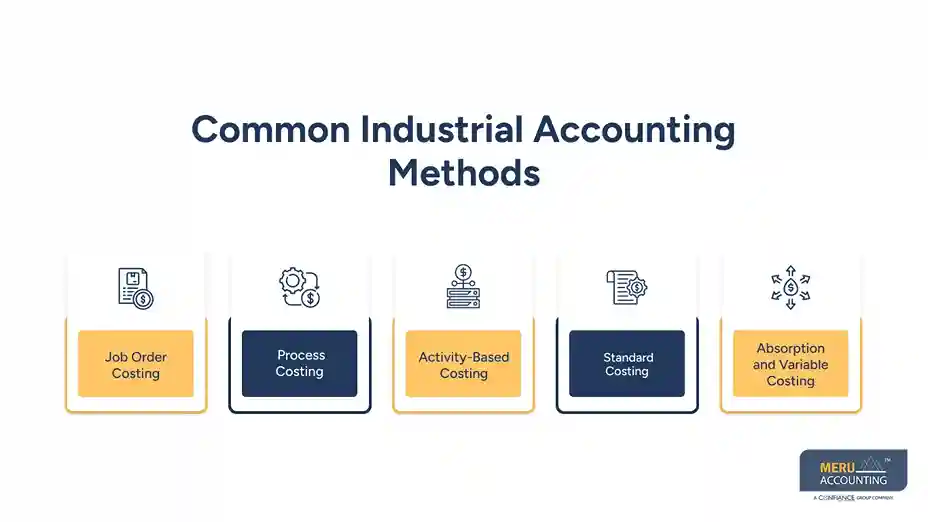
4. Standard Costing
Standard costing sets planned costs for raw goods, labor, and overhead. At the end of a set time, firms compare these costs with the actual amounts spent.
The gap is called a cost variance. For example, if steel costs more than the set rate, the firm can review supplier prices or buying terms.
5. Absorption and Variable Costing
Absorption costing includes both fixed and variable factory overhead in product costs. Variable costing includes only costs that change with output as product costs, while fixed factory costs are treated as period costs.
Each method serves a set need. Firms should use the right method for their reports and tax rules, and keep the same method over time unless a valid change is made.
How to Calculate Production Costs in Industrial Accounting
To set sound prices and check profit, firms must know the full cost of making their goods.
A basic formula is:
Total Production Cost = Direct Material + Direct Labor + Manufacturing Overhead
Let’s look at a simple case.
A plant makes 1,000 units in one month. Its costs are:
Cost Type | Amount |
Direct material | $20,000 |
Direct labor | $10,000 |
Factory overhead | $5,000 |
Total production cost | $35,000 |
To find the cost per unit:
Cost Per Unit = Total Production Cost ÷ Units Made
$35,000 ÷ 1,000 = $35 per unit
This means each unit costs $35 to make based on the costs in this example.
But this figure alone does not show the final profit. The firm must also review sales price, freight, sales costs, admin costs, and other expenses.
For firms that make goods in more than one stage, the cost of WIP and finished goods must also be tracked. This helps ensure that costs are placed in the right period.
Accurate industrial accounting makes this review more useful. It helps managers see which costs are rising, which products earn a fair return, and where they may need to act.
optional anymore
on running the business
Key Financial Reports for Industrial Businesses
Financial reports help owners review results and make plans. For accounting for industrial businesses, some reports need extra detail on stock, production, and cost trends.
1. Manufacturing Cost Statement
This report shows the cost of goods made during a set period. It may include raw material used, direct labor, factory overhead, and changes in WIP.
It helps owners see how much it costs to run production and make goods.
2. Income Statement
The income statement shows sales, cost of goods sold, gross profit, operating costs, and net profit.
It helps firms see if sales are high enough to cover the cost of goods and other business costs.
3. Balance Sheet
The balance sheet shows what a firm owns and owes at a set date. For an industrial firm, this may include raw material, WIP, finished goods, plant, machines, loans, and unpaid bills.
It gives owners a view of the firm’s assets, debt, and net worth.
4. Cash Flow Statement
A cash flow statement tracks cash from day-to-day work, asset purchases, and loans or other funding.
A firm may show a profit but still face a cash gap if buyers pay late or too much cash is tied up in stock. This report helps owners plan for bills, wages, and future needs.
5. Inventory and Cost Variance Reports
Stock reports show the amount and value of goods on hand. Cost variance reports compare planned costs with actual costs.
Together, these reports help managers spot stock loss, high input costs, and gaps in the production plan.
Accounting for Industrial Businesses: How Meru Accounting Can Help
As an industrial firm grows, its finance work can become harder to manage with a small in-house team. More vendors, staff, stock, and sales can add to the daily load. If records fall behind, owners may not have the data they need to make sound choices.
Meru Accounting offers outsourced accounting support to help industrial firms keep their books clear and up to date.
Our team can help with:
- Day-to-Day Bookkeeping: Record sales, bills, costs, and other daily entries.
- Bank and Card Reconciliation: Match book records with bank and card records to find errors and missing items.
- Accounts Payable: Track vendor bills, due dates, and payments.
- Accounts Receivable: Track open invoices and customer payments.
- Month-End Close: Review entries and reconcile key accounts before reports are made.
- Financial Reporting: Prepare clear reports to help owners review costs, cash flow, and business results.
- Catch-Up and Cleanup: Bring past-due books up to date and fix errors in old records.
- Payroll Accounting Support: Help keep payroll entries and wage costs in line with the books.
We can work with your team and current process to support the level of help your firm needs. Whether you need help with monthly books or a team to handle a wider set of tasks, our aim is to keep records clear and ready for review.
With expert help in accounting for industrial businesses, owners can spend less time on routine bookkeeping and more time on staff, output, sales, and growth.
Our Expert Insight: Why Production Data Must Match the Books
A product with strong sales isn’t always a profitable one. Some products require more machine time, extra labor, frequent setup changes, or added quality checks. If these costs aren’t considered, businesses may overestimate their profit margins.
We recommend reviewing product-level margins at regular intervals, not just total sales and production costs. Compare the selling price with all costs involved in making and delivering each product. This can help identify products that need a price change, a better production process, or a closer look at their costs.
Our advice: Before accepting large orders or increasing production, check whether the expected margin justifies the resources required to fulfill them.
Key Takeaways
- Industrial accounting tracks the cost of making goods and helps firms review profit.
- Direct material, labor, and factory overhead form the base of production cost.
- Job order, process, ABC, and standard costing suit different types of work.
- Cost per unit helps firms set prices and review product returns.
- Stock, production, and finance records must agree at month-end.
- Clear reports and sound cost checks help firms manage growth.
- Expert support can help keep books up to date as work and costs rise.
FAQs
Raw materials are moved from inventory to work-in-process when used in production. Their cost becomes part of finished goods once production is complete.
Normal downtime costs are generally included in factory overhead. Abnormal downtime costs are usually recorded as period expenses.
Common causes include changes in material prices, excess material use, overtime, low output, and higher factory overhead.
Scrap increases production costs by reducing usable materials. Tracking scrap helps businesses measure waste and identify production issues.
Keep purchase invoices, inventory records, production logs, labor timesheets, payroll records, and cost allocation reports to support financial statements and inventory values.
optional anymore
on running the business