A 3PL can grow its sales and still see its ROI slip. A new client may bring in more revenue, but higher carrier rates, warehouse costs, labor, and service fees can quickly narrow the margin. Logistics accounting services help 3PL owners see what each client and service is really costing, so growth can be measured by profit—not just revenue.
The challenge is that 3PL finances can get complex as shipment volume and client accounts grow. When costs, invoices, payments, and client charges aren’t tracked well, it becomes harder to spot weak margins or know which accounts are worth expanding. With accurate financial records and timely reports, 3PL owners can make better calls on pricing, costs, collections, and growth.
What You Will Learn From This Blog
- Why sound books matter to 3PL firms
- How logistics accounting services can help raise ROI
- What to look for in accounting tools
- Which key numbers a 3PL should track
- When outsourced accounting may make sense
- How better books can help with growth and cash flow
Why Accounting Is Critical for 3PL Companies
For a 3PL, strong revenue doesn’t always mean strong profit. Two clients can generate the same amount of sales but have very different costs. One may require more carrier fees, warehouse space, labor, claims support, or administrative work. Logistics accounting services help 3PL owners see how these costs affect the profitability of each client and service.
That information matters when you’re deciding where to grow. A high-volume account may not be as profitable as it looks once all related costs are included. The same applies to new shipping lanes, services, or pricing deals. Accurate books and timely financial reports give you a better basis for reviewing revenue, expenses, margins, accounts receivable, and operating costs.
Cash flow is just as important. A 3PL may report a profit but still have cash tied up in unpaid customer invoices while carrier bills, payroll, rent, and other expenses are due. Logistics accounting services help you keep track of what you’ve billed, what you’ve collected, what you owe, and what cash is available. That makes it easier to manage day-to-day operations and make informed decisions about growth.
7 Ways Logistics Accounting Services Can Improve 3PL ROI
See Which Customers Are Actually Profitable
A large customer isn’t always a highly profitable customer. One account may generate strong revenue but require more carrier spend, warehouse labor, claims support, or administrative work than expected.
Logistics accounting services can help you review revenue and costs by customer, job, or service when your accounting system supports that level of detail. This gives you a clearer picture of which accounts are delivering healthy margins and which may need a pricing review.
That insight can also improve contract decisions. Before renewing or expanding an account, you can look beyond sales and consider the actual cost of serving it.
Get Paid Faster and Protect Cash Flow
A 3PL can have plenty of work on the books and still face a cash shortage when customers take too long to pay. Carrier invoices, payroll, rent, and other operating expenses don’t wait for receivables to come in.
Logistics accounting services can help keep invoicing, accounts receivable, payment records, and aging reports up to date. When overdue balances are easy to spot, your team can follow up sooner and see which customers are consistently slow to pay.
Better control over receivables can also reduce the amount of cash tied up in unpaid invoices.
Keep Rising Costs From Eating Into Margins
Transportation costs can change quickly, but pricing doesn’t always change at the same pace. Carrier rates, fuel, warehouse costs, labor, software, and other operating expenses can gradually reduce margins without an obvious drop in sales.
Logistics accounting services give you a better way to monitor these costs over time. Comparing current expenses with prior periods, budgets, and customer pricing can reveal where costs are rising faster than revenue.
That makes it easier to review rates, control overhead, and address cost increases before they have a larger effect on profit.
Turn Financial Reports Into Management Tools
Financial reports are only useful when they help you answer business questions. A P&L can show whether revenue is covering expenses. A balance sheet can show what the company owns and owes. A cash flow statement can show why cash is increasing or declining.
Logistics accounting services can support the bookkeeping and month-end work behind these reports, including account reconciliations and financial review. More reliable reports give you a stronger basis for decisions about pricing, staffing, equipment, technology, and expansion.
Instead of waiting until year-end to see how the business performed, you can use financial data throughout the year.
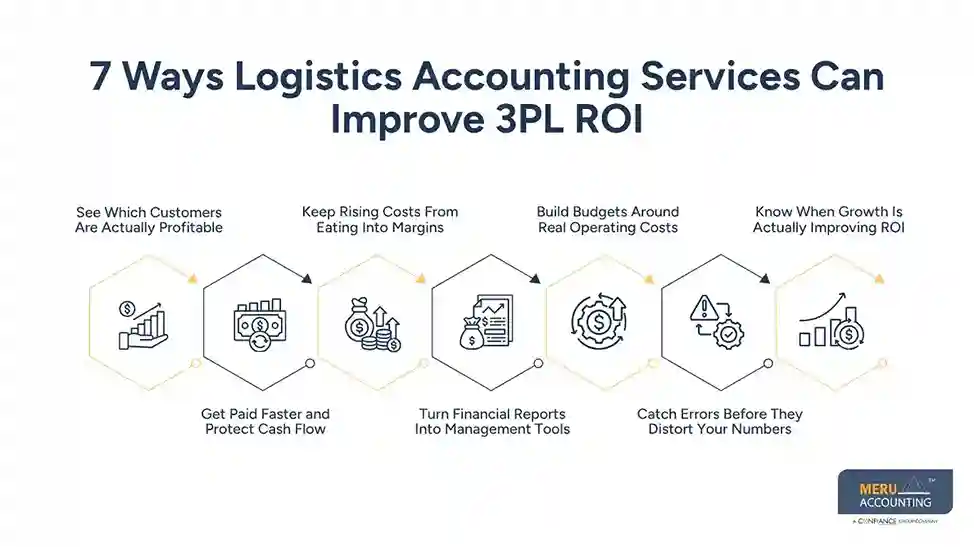
Build Budgets Around Real Operating Costs
A 3PL’s costs can change as shipment volume, customer demand, staffing needs, and carrier rates change. A budget built on outdated numbers may give management a false sense of what the business can afford.
Using logistics accounting services, you can build budgets and forecasts from actual financial results. Past spending can help you estimate future costs for labor, freight, rent, technology, and other major areas.
The goal isn’t to create a complicated forecast. It’s to have a realistic financial plan that can be compared with actual results and updated when business conditions change.
Catch Errors Before They Distort Your Numbers
A duplicate expense or missed transaction may not seem serious on its own. But repeated errors can distort expenses, account balances, and profit reports over time.
Regular bookkeeping and reconciliation through logistics accounting services can help identify missing transactions, duplicate entries, incorrect account coding, and differences between bank or credit card activity and the books.
Keeping the records accurate throughout the year also makes tax preparation and financial reviews easier. You spend less time trying to reconstruct what happened months after the transaction occurred.
Know When Growth Is Actually Improving ROI
More customers, more shipments, and higher revenue can make a 3PL look successful. But growth also brings higher staffing costs, technology expenses, warehouse needs, carrier payments, and working-capital demands.
Logistics accounting services can help you look at the financial impact behind that growth. You can compare customer profitability, service margins, operating expenses, and receivables to see whether additional volume is producing a worthwhile return.
optional anymore
on running the business
How Accounting Software for Logistics Company Operations Supports Better Financial Control
The right tech can make day-to-day books much easier to manage. When a 3PL looks for accounting software for logistics company use, it should look past basic income and cost entry.
A good tool should make it easy to track sales, bills, bank data, client charges, and reports. It should also work well with other tools used by the firm. This may include load, billing, payroll, or payment tools.
The best accounting software for logistics company needs can vary by firm size and work type. A small 3PL may need a simple setup with strong bank feeds and reports. A larger firm may need more links, user roles, job or class tracking, and deeper reports.
Still, software is not a full fix on its own. Accounting software for logistics company use can help cut manual work, but the data still needs to be set up, checked, and reviewed.
That is why many firms use both tech and expert help. Accounting software for logistics company use can speed up tasks, while skilled accounting work can help make sure the data is right and the reports are useful.
What Should 3PLs Track to Measure ROI?
A 3PL should track more than total sales. Key numbers can show where profit is won or lost.
Revenue and Margin
Track total sales, gross profit, and net profit. Where possible, also review these numbers by client, service, or job type.
Customer Profit
A high-value client is not always a high-profit client. Review the cost to serve each key account so you can see its true value.
Accounts Receivable
Track open invoices, aging, and days to collect. Slow pay can hurt cash even when sales look strong.
Operating Costs
Review freight, carrier costs, labor, rent, tech, and other key costs. Look for costs that rise faster than sales.
Cash Flow
Profit and cash are not the same. Watch cash in, cash out, and the amount tied up in unpaid bills.
Cost Per Job or Load
Where the data allows it, compare the cost of each load, job, or service with the amount billed. This can help flag weak rates or high-cost work.
Meru Accounting’s Logistics Accounting Services for 3PL Companies
3PL accounting has its own moving parts. Customer invoices may need to be matched with shipment activity, while carrier bills, accessorial charges, warehouse costs, fuel expenses, and other service-related costs flow in at different times. At Meru Accounting, our logistics accounting services are designed around these day-to-day 3PL accounting requirements.
Where We Support 3PL Accounting
Customer and shipment-related accounting
- Customer invoicing and payment tracking
- Accounts receivable and aging
- Reviewing customer charges and billing adjustments
- Tracking freight and service-related expenses
- Reconciling customer receipts with recorded invoices
Carrier, vendor, and operating costs
- Carrier and freight vendor bills
- Accessorial and transportation-related expenses
- Warehouse and fulfillment costs
- Accounts payable tracking
- Bank and credit card reconciliation
Month-end reporting
- Month-end close
- P&L and balance sheet reporting
- Cash flow reporting
- Review of freight, labor, warehouse, and operating expenses
- Budget and forecast support
Accounting systems and cleanup
- QuickBooks, Xero, and Zoho Books support
- Financial record cleanup
- Tax-ready books
- Accounting workflow support based on the 3PL’s existing systems
With 12+ years of accounting experience across 20+ industries, Meru understands that 3PL accounting needs to follow the way revenue and costs actually move through the business. That includes keeping customer billing, carrier costs, operating expenses, payments, and month-end records properly aligned.
Our Expert Insight
When reviewing a 3PL’s numbers, we don’t look at revenue alone. We look at whether the costs tied to that revenue are moving in the same direction. If sales increase 15% but freight, labor, or other operating costs rise much faster, the business may be growing without improving its margins.
We also compare current results with prior months instead of judging performance from one P&L. A drop in margin, a growing A/R balance, or a steady increase in operating costs can point to a problem that isn’t obvious from total sales.
That kind of review turns logistics accounting services into more than routine bookkeeping. It helps identify financial trends early, while there’s still time to address them.
Key Takeaways
- Logistics accounting services can give 3PL owners a better view of profit and cash.
- Client-level cost and profit data can help support better rate and contract choices.
- Good accounts receivable work can help reduce slow pay and cash strain.
- Monthly reports can show cost trends before they hurt margins.
- The right accounting software for logistics company needs can cut manual work and improve data flow.
- Software still needs good setup, review, and sound accounting work.
- The best ROI comes from growth that adds profit, not just sales.
FAQs
A 3PL should review its P&L, balance sheet, cash flow statement, and A/R aging each month. Comparing them with prior periods can reveal changes that need attention.
Compare the revenue from each customer with the costs required to serve that account. This gives a more useful view of profitability than revenue alone.
Bank and credit card accounts should generally be reconciled monthly. Regular reconciliation helps catch missing, duplicate, or incorrectly recorded transactions.
Look for reliable bank feeds, invoicing, reconciliation, financial reporting, and integrations with other systems. The software should also fit the company’s size and workflow.
Outsourcing may make sense when bookkeeping is falling behind, reporting is delayed, or accounting work is taking time away from operations. It can also provide ongoing support without adding a full-time accounting employee.
optional anymore
on running the business