A payroll run can look simple until pay rates change, overtime adds up, or a new employee joins mid-cycle. Each change needs to be tracked and checked before payday. For growing businesses, managed payroll services can help keep these moving parts under control without adding more work to the in-house team.
By handing off routine payroll tasks to an experienced team, businesses can spend less time on pay calculations, records, and tax work. This also gives finance teams more room to focus on budgets, reports, and other business needs.
But what does a managed payroll service cover, and how can it make payroll easier to manage? Let’s take a closer look.
What You Will Learn From This Blog
- What managed payroll support covers and how it works.
- Why in-house payroll can become hard to manage.
- How an outsourced team can make payroll tasks easier.
- Which payroll tasks a business can hand over.
- When to look for managed payroll outsourcing providers.
- What to check before you choose a payroll partner.
What Are Managed Payroll Services?
Managed payroll services are third-party services that help a business run its payroll. The service team takes on agreed tasks, such as wage checks, pay runs, tax support, payslips, and payroll reports. The exact scope can vary by provider and service plan.
Unlike basic payroll software, which gives a business tools to run its own pay cycle, a managed service adds hands-on support. A payroll team can review data, check pay inputs, flag issues, and help keep each pay run on track.
For example, a firm with 50 staff may need to track hours, overtime, paid time off, tax withholdings, and benefit costs each pay period. An outsourced team can help check these items, run the agreed steps, and share reports for review.
The business still needs to provide correct staff data, approve pay runs, and meet its legal duties as an employer. A service partner helps with the work, but does not take away the employer’s duty to follow tax and labor laws.
optional anymore
on running the business
Why Do Businesses Struggle to Manage Payroll In-House?
Running payroll in-house may seem simple when a firm has only a few staff. But as the team grows, the work can take more time and needs closer checks.
1. Time-Consuming Payroll Tasks
Payroll involves more than a pay run. Staff hours, leave, new hires, exits, pay changes, and bonus data must all be checked. When these tasks are done by hand, they can take time away from core work.
2. Frequent Payroll Errors and Corrections
A missed work hour, wrong pay rate, or poor data entry can lead to an incorrect paycheck. The team then has to review the issue, fix the record, and process an extra payment or pay change. These fixes can take more time and affect staff trust.
3. Changing Payroll Tax Rules
Payroll tax rules can change at the federal, state, and local level. Firms that hire staff in more than one state may need to track more than one set of tax rules. Missing a filing date or using an old tax rate can lead to fines and extra work.
4. Managing Different Employee Types
A firm may have full-time staff, part-time staff, hourly workers, salaried staff, and contract workers. Each group may have a different pay setup. The team must know which pay rules apply and keep the right records for each worker.
How Managed Payroll Services Simplify Payroll Operations
The main value of managed payroll services is that they give firms a clear way to handle routine pay tasks. A skilled team can help reduce manual work, keep data in order, and make each pay cycle easier to track.
1. Streamline Payroll Processing and Salary Payments
A managed payroll team can help gather pay data, review work hours, check pay rates, and prepare each pay run. With set dates and clear steps, the firm can avoid last-minute work and reduce delays.
The team can also help process direct deposits and prepare payslips, based on the agreed service scope. This helps staff get clear pay details and gives the finance team a set record of each pay cycle.
2. Improve Payroll Accuracy and Reduce Manual Errors
Payroll errors often start with poor data or manual entry. A service team can use review steps to check hours, pay rates, bonuses, and deductions before the pay run is final.
For example, if an employee gets a new hourly rate, the change must be made in the right pay period. A review can help spot an old rate before it leads to a wrong paycheck. Clear checks also make it easier to find and fix errors.
3. Manage Payroll Taxes and Required Filings
Payroll tax work can be hard to track, especially for firms with staff in many states. A payroll partner can help work out tax withholdings, prepare tax reports, and support tax deposits and filings, where these tasks are part of the service.
Businesses should confirm who will file returns, make tax payments, and review tax notices. The employer must still check that all tax duties are met, even when it uses an outside team.
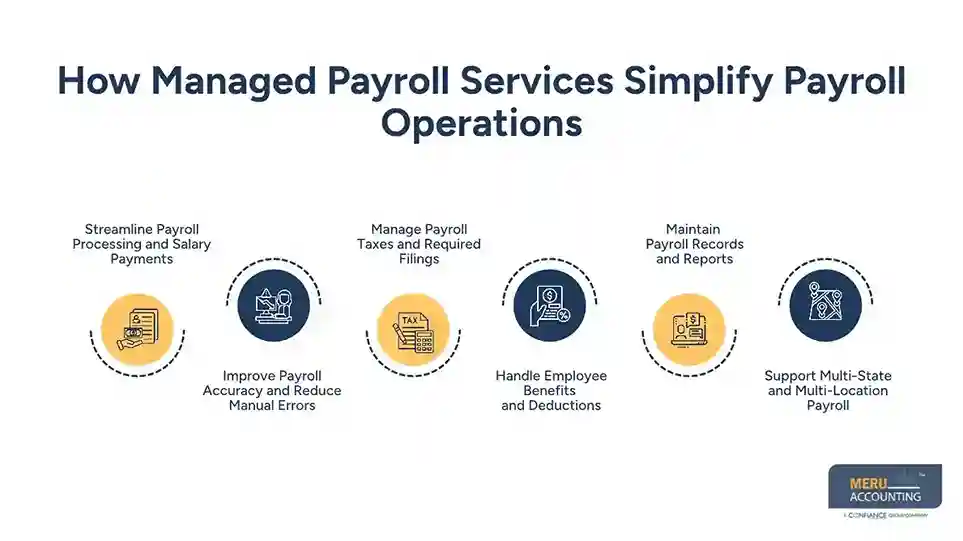
4. Handle Employee Benefits and Deductions
Payroll may need to account for health plan costs, retirement plan funds, wage garnishments, and other staff deductions. These items must be set up and tracked with care.
Managed payroll support can help record the right amounts and apply changes when staff join or leave a plan. This can help keep pay records in line with benefit data and reduce the need for manual fixes.
5. Maintain Payroll Records and Reports
Clear payroll records help firms review labor costs, check pay trends, and answer staff questions. A payroll team can help keep pay data, tax records, payslips, and reports in order.
Reports may show gross pay, net pay, tax costs, overtime, and benefit costs. Business owners can use these details to plan labor spend and see how payroll costs change over time.
6. Support Multi-State and Multi-Location Payroll
Firms with staff in more than one state may need to deal with varied tax rates, local rules, and work site data. A managed team can help track these needs and keep payroll records split by state or site.
This support is useful for firms with remote staff, field teams, or more than one office. Before hiring a provider, check its skill in the states where your staff work.
What Payroll Tasks Can You Outsource to a Managed Payroll Provider?
A business can outsource some or most of its payroll work. The scope depends on its needs and the provider’s skills. Common tasks include:
- Employee data setup: Add new hires, update pay rates, and record staff details.
- Time and attendance checks: Review work hours, overtime, and paid time off.
- Gross-to-net pay checks: Work out gross pay, taxes, deductions, and net pay.
- Pay run support: Prepare payroll data and process pay based on approved records.
- Tax support: Help with tax withholdings, reports, deposits, and filings.
- Payslip support: Prepare and share pay details with staff.
- Benefits and deductions: Track plan costs, retirement funds, and other deductions.
- Payroll reports: Share pay summaries, tax reports, and labor cost data.
- Year-end payroll support: Help prepare W-2 forms and other year-end records.
Before you sign a service deal, ask for a clear list of tasks the provider will handle. Also check which tasks stay with your team, such as staff data updates and pay run approval.
When Should a Business Consider Outsourcing Payroll?
There is no fixed staff count at which a firm must outsource payroll. The need often comes from the time, risk, and skill needed to run pay each period.
A business may want to review its payroll setup when:
- Payroll takes too much time from the finance or HR team.
- Pay errors keep leading to staff queries or extra work.
- The firm hires staff in new states or work sites.
- Tax filings and due dates are hard to track.
- The business lacks in-house staff with payroll skills.
- The team needs better pay reports and clear records.
- Growth makes the current payroll setup hard to scale.
Some firms may only need help with tax work or pay run checks. Others may need full support for each pay cycle. The best choice is the one that fills the gaps in the current setup without adding work or cost the firm does not need.
Managed Payroll Services by Meru Accounting
Payroll doesn’t end with employee payments. Wage entries, tax deductions, benefit costs, and payroll liabilities must also be recorded and matched with the books. This is where accounting expertise makes a difference.
At Meru Accounting, we bring hands-on accounting experience to payroll-related work. Our team supports businesses with the financial records and reporting behind their payroll, helping keep payroll data in line with their books.
Our Payroll and Related Accounting Support Includes:
- Payroll Accounting: Record wages, employer taxes, benefits, and other payroll costs in the right accounts.
- Payroll Reconciliation: Match payroll reports with bank transactions and ledger entries to find missing or incorrect amounts.
- Payroll Data Review: Check payroll records and related entries for gaps, wrong figures, or duplicate postings.
- Payroll Reporting: Prepare payroll cost summaries and reports to support month-end reviews and financial planning.
- Ongoing Bookkeeping Support: Maintain related financial records and keep payroll entries aligned with the company’s books.
With experience across multiple industries and accounting needs, we can tailor our support to your business size, reporting needs, and existing processes. You get access to experienced accounting professionals without the cost of building a full in-house accounting team in the US.
Our Expert Insight
One area businesses should pay close attention to is payroll cut-off at month-end. The date a business pays its employees isn’t always the same as the period in which those wages were earned.
For example, if employees work during the last week of March but receive their pay in April, those wages still belong to March expenses. Recording them only when the payment goes out can understate March labor costs and overstate April expenses.
We recommend reviewing unpaid wages at each month-end and recording accrued payroll where needed. Businesses should also check that overtime, bonuses, and employer payroll taxes are assigned to the right period. This gives owners a more accurate view of monthly profit and helps prevent large swings in labor costs between reporting periods.
Key Takeaways
- Managed payroll services help businesses handle routine payroll work with support from an outside team.
- Outsourcing can reduce manual tasks and help limit common pay errors.
- Payroll support may include pay runs, tax work, deductions, reports, and record-keeping.
- Employers remain responsible for meeting their payroll tax and labor law duties.
- The right provider should have clear service terms, strong data controls, and the skills to meet your payroll needs.
- Businesses should review their payroll workload and costs before choosing to outsource.
FAQs
The provider should review and correct the error and help process any required adjustments. Responsibility for corrections should be clear in the service agreement.
Yes. Providers can process these payments based on approved hours, pay rates, and commission records supplied by the business.
Under federal law, employers generally must keep payroll records for at least three years and wage calculation records for at least two years. Some state laws may require longer retention.
The provider uses each employee’s work location and tax details to apply the relevant state and local payroll rules.
Yes. Payroll data can often sync through a direct integration or file export, depending on the systems used and the provider’s setup.
optional anymore
on running the business