
A management accounting service plays a key role in how global businesses track costs, plan budgets, and make financial decisions across regions. For companies operating in multiple countries, financial data often comes from different systems, currencies, and reporting rules.
This creates gaps that need structured financial control, as raw data on its own does not provide clear direction for decision-making. Outsourced firms now play a major role in delivering structured financial reporting that is accurate and consistent across borders.
These firms convert raw financial data into meaningful insights that support planning and performance review. Alongside this, accounts receivable management services are often integrated into the reporting process, helping businesses maintain stable cash flow while scaling operations internationally.
What You Will Learn From This Blog
- How a management accounting service works in global businesses
- Why outsourcing improves financial accuracy and reporting speed
- How accounts receivable management services support cash flow control
- Key benefits of outsourcing financial reporting functions
- Common challenges faced by international companies
- Real industry examples from SaaS and ecommerce companies
- How firms like Meru Accounting deliver structured financial support
What is a Management Accounting Service and Why Does it Matter for Global Companies
A management accounting service helps global companies bring structure and clarity to financial reporting across multiple countries. It ensures that financial data from different regions follows a consistent format, so leaders can compare performance without confusion caused by local accounting rules or variations in reporting systems.
This uniform structure becomes essential for businesses operating at scale, where even small inconsistencies can affect overall financial understanding.
With a strong financial reporting system in place, decision-making becomes more accurate and data-driven. Companies receive timely financial reports that support key actions such as pricing strategy, budgeting, and investment planning.
Alongside this, accounts receivable management services play an important role in tracking incoming payments and maintaining healthy cash flow across regions, reducing delays that can disrupt operations.
A well-structured reporting approach also improves cost visibility by breaking down expenses across departments, helping businesses clearly see where money is being used and where adjustments are needed.
In addition, standardized reporting ensures that all global teams speak the same financial language, which improves coordination between headquarters and local offices and supports more aligned financial planning.
How Management Accounting Service Drives Efficient Financial Management In Global Businesses
Real-Time Financial Tracking
A structured financial system allows global businesses to track expenses and revenue in near real time, reducing delays in identifying financial issues. Faster visibility into financial movements enables leadership to respond quickly when costs shift or revenue patterns change across regions.
Better Budget Control
Companies using a management accounting service can compare planned budgets with actual spending, which helps reduce overspending and improve financial discipline. Clear budget tracking ensures every department stays aligned with approved financial plans and financial goals.
Improved Cash Flow Stability
When combined with accounts receivable management services, businesses gain better control over payment cycles and outstanding invoices. Stronger oversight of receivables strengthens liquidity and reduces pressure caused by delayed customer payments across different markets.
Performance Monitoring Across Regions
A standardized reporting system allows companies to evaluate performance by region, product, or department using consistent metrics. Consistent measurement makes the identification of strong and weak business areas more accurate without confusion in financial data.
Risk Reduction In Financial Operations
Structured reporting reduces financial errors, fraud risks, and reporting mismatches across global teams. Clear visibility into financial data strengthens internal controls and improves overall financial reliability across international operations.
Cost Optimization And Expense Control
Detailed financial breakdowns across departments reveal unnecessary spending patterns and inefficiencies. Clear cost allocation allows leadership to adjust operational strategies and improve overall financial discipline across global units.
Strategic Decision Support For Expansion
Accurate financial insights support expansion planning by highlighting profitable markets and underperforming regions. Data-backed evaluations reduce uncertainty while entering new geographies or launching new product lines.
Enhanced Financial Forecasting Accuracy
Historical financial data combined with structured reporting improves forecasting quality. Better projections help businesses plan investments, hiring, and resource allocation with greater confidence across different market conditions.
Key Benefits of Outsourcing Management Accounting Service For International Businesses
Access To Skilled Financial Experts
Outsourced providers offer experienced professionals who specialize in structured financial reporting, ensuring accuracy and compliance with global standards. Deep domain expertise strengthens financial decision-making across regions and reduces reporting errors.
Cost Efficiency In Operations
Instead of building large in-house teams, companies use outsourced models to reduce overhead costs. Lower staffing and infrastructure expenses allow businesses to allocate resources toward growth and expansion activities.
Strong Cash Flow Control
Through integrated accounts receivable management services, businesses maintain better control over incoming payments and reduce overdue invoices. Improved receivable tracking strengthens liquidity and supports stable financial operations across markets.
Faster Reporting Cycles
Outsourced teams deliver a management accounting service with faster reporting cycles due to dedicated systems and structured workflows. Timely reports allow leadership to act quickly on financial insights and adjust strategies without delay.
Scalability For Growing Businesses
As companies expand, outsourced providers easily adjust reporting systems without internal restructuring. Flexible service models support growth across new regions, products, and business units without disrupting financial consistency.
The Strategic Role of Management Accounting in Cross-Border Business Operations
Aligning Global Financial Goals
A management accounting service ensures that all regional teams work toward the same financial objectives. Unified financial targets reduce confusion across departments and help leadership maintain consistent performance measurement across global operations.
Currency And Tax Coordination
Global businesses use structured reporting frameworks to manage multi-currency transactions and tax differences across regions. Standardized financial systems reduce reporting errors caused by exchange rate changes and varying tax rules.
Support For Expansion Decisions
Financial insights from structured reporting help businesses decide when and where to expand operations. Clear visibility into profitability across regions supports safer investment choices and reduces financial uncertainty.
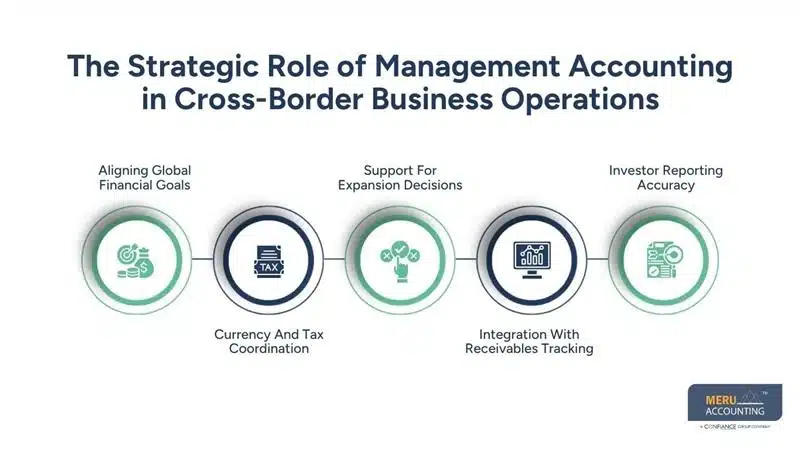
Integration With Receivables Tracking
Strong accounts receivable management services ensure that global revenue streams remain stable and predictable. Better tracking of outstanding payments improves cash flow control and reduces delays in fund collection.
Investor Reporting Accuracy
Structured financial reporting improves investor confidence by providing clear and consistent financial statements. Reliable data presentation strengthens trust and supports better communication with stakeholders across markets.
Key Performance Indicators (KPIs) Used in Advanced Management Accounting Service
Revenue Growth Tracking
A management accounting service monitors revenue trends across products and markets. Regular tracking helps identify high-performing segments and supports better sales strategy planning across different regions.
Operating Margin Analysis
Operating margin analysis evaluates how efficiently a company converts revenue into profit. Strong margin visibility helps leadership control costs and improve overall financial performance across business units.
Accounts Receivable Turnover
With accounts receivable management services, companies track how quickly customers pay invoices. Faster collection cycles improve liquidity and reduce working capital pressure across global operations.
Cost Per Unit Analysis
A structured financial reporting system helps identify production or service delivery costs per unit. Clear unit-level cost insights support better pricing decisions and improved profit control across offerings.
Cash Flow Stability Metrics
Cash flow stability metrics ensure that incoming and outgoing cash remain balanced over time. Consistent monitoring helps prevent liquidity gaps and supports smoother financial planning across business cycles.
Common Financial Challenges Faced by Global Businesses and How Outsourced Firms Solve Them
Delayed Financial Reporting
Global firms often face delays due to scattered financial systems and manual processes. Outsourced teams streamline reporting through structured systems that improve data flow and speed.
Inconsistent Accounting Standards
Different countries follow varied accounting rules, creating gaps in consolidated reporting. Standardized reporting frameworks help align financial data across regions for clearer comparison.
High Outstanding Receivables
Weak collection processes can impact cash flow and create liquidity pressure. Accounts receivable management services track invoices and improve payment follow-ups.
Lack Of Financial Visibility
Limited visibility into financial performance slows down decision-making for leadership teams. Centralized dashboards provide clear insights across departments and global operations.
Resource Limitations In Finance Teams
A management accounting service reduces workload on internal finance teams by handling complex reporting tasks. External experts bring structured processes, allowing in-house teams to focus on planning and strategy.
Industry Use Cases: SaaS, Ecommerce, and Global Enterprises
SaaS Subscription Revenue Tracking
A structured financial reporting system helps SaaS companies track recurring revenue and churn rates. Consistent tracking supports better forecasting and improves visibility into subscription-based income.
E-commerce Sales And Returns Management
E-commerce businesses use accounts receivable management services to monitor payments and refunds across multiple channels. Better tracking of transactions improves cash flow control and reduces reconciliation errors.
Global Manufacturing Cost Control
A management accounting service helps manufacturers track raw material costs and production efficiency. Clear cost monitoring supports better budgeting and improves control over operational expenses.
Multi-Market Financial Reporting
Global enterprises rely on consolidated reporting systems to combine financial data from different regions. Unified reporting improves accuracy and helps leadership compare performance across markets.
Investor-Ready Reporting Systems
Startups and large firms use structured financial outputs to prepare reports for investors. Accurate and consistent reporting strengthens transparency and supports funding discussions.
How Meru Accounting Provides Reliable Management Accounting Service
Meru Accounting provides structured financial solutions designed for global businesses that require accuracy and consistency in reporting. We focuses on building clear financial systems that support better visibility across regions and business units.
Through a well-defined financial reporting approach, financial data is organized, analyzed, and presented in a way that supports decision-making across regions. This ensures leadership teams can rely on consistent insights for planning and performance evaluation.
Clients also benefit from integrated accounts receivable management services, which focus on improving cash flow tracking and reducing payment delays. Strong receivables control helps businesses maintain liquidity and reduce financial pressure across operations.
Meru Accounting follows a process-driven model that combines technology and expert review. Each output is aligned with international reporting standards to maintain accuracy and reliability in global financial reporting.
The firm also customizes reporting workflows based on industry needs, including SaaS, ecommerce, real estate, and professional services. This flexibility helps businesses maintain financial clarity while expanding into new markets and scaling operations globally.
Key Takeaways
- A management accounting service helps global businesses manage financial data across regions
- Outsourced firms improve accuracy, speed, and consistency in reporting
- Accounts receivable management services strengthen cash flow control
- KPIs help measure financial health and operational performance
- Outsourcing reduces cost and improves scalability
- Industry-specific reporting improves decision-making quality
FAQs
A management accounting service is a financial process that helps businesses analyze costs, revenue, and performance for better decision-making.
This process supports structured reporting and helps leaders understand financial data more clearly.
Global companies need to manage financial data across different countries and ensure consistency in reporting.
Clear and standardized financial information helps improve comparison and decision-making across regions.
Accounts receivable management services help businesses track unpaid invoices and improve cash flow stability.
Better tracking reduces delays in payments and supports stronger working capital control.
Outsourcing financial reporting improves accuracy, reduces delays, and provides expert financial support.
External teams bring structured processes that help maintain consistency in reporting quality.
SaaS, e-commerce, manufacturing, and global enterprises widely use structured financial reporting for control and performance tracking.
These industries rely on accurate data to manage growth, costs, and financial planning effectively.