
A production line stops. A shipment leaves the warehouse. A machine is repaired. A supplier invoice arrives two days later. Each event changes a manufacturer’s financial records. This is where manufacturing and accounting software becomes useful. It connects financial data with the transactions that create those numbers, from material purchases and labor costs to inventory and finished goods.
But having all the data in one system does not mean the books and the tax return will always show the same result. A manufacturer may record depreciation one way for financial reporting and another way for tax. Certain production costs may also need to be included in inventory for tax purposes. These differences must be found, measured, and documented before the tax return is prepared.
That is the role of book-to-tax reconciliation. Rather than treating it as a final-year spreadsheet task, manufacturers can build it into their regular accounting process.
What You Will Learn From This Blog
- How manufacturing and accounting software connects production activity with financial records.
- Why book-to-tax reconciliation can be complex for manufacturing businesses.
- How inventory, depreciation, accruals, and production costs can create tax differences.
- Which features matter when choosing accounting software for manufacturers.
- How finance teams can create a clearer reconciliation process.
- How better records can make year-end tax review easier.
What is Manufacturing and Accounting Software?
Financial Data in One Place
Think about a manufacturer buying $50,000 of raw material. The purchase is not simply an expense. Part of that material may still be in storage, some may enter production, and some may become part of finished goods.
Manufacturing and accounting software connects these movements with the related financial entries, giving the finance team a fuller view of what happened to the cost.
Inventory and Cost Tracking
A manufacturer needs to know more than how much inventory is on hand. The business also needs to know what that inventory cost and where the cost came from.
Accounting software for manufacturers can track raw materials, work in process, finished goods, and cost of goods sold while keeping related accounting data available for review.
Production Data and Accounting
Production does not happen inside the general ledger. Workers use materials, machines consume resources, and production time adds labor cost.
When production records and accounting data are linked, finance teams can trace these costs instead of relying on disconnected spreadsheets.
General Ledger Integration
The general ledger remains central to financial reporting and tax preparation. Sales, purchases, payroll, inventory adjustments, and other entries eventually affect ledger accounts.
Manufacturing and accounting software can connect these transactions to the relevant accounts and cost centers, giving reviewers a clearer starting point.
Reporting For Finance Teams
A controller may need to answer a simple question: “Why did manufacturing cost rise this month?”
The answer could sit across purchase records, labor costs, inventory changes, and production data. Accounting software for manufacturers can bring these records into reports that make such questions easier to investigate.
Data Audit Trails
Numbers change during an accounting period. A journal may be corrected, an inventory entry may be adjusted, or an asset may be reclassified.
An audit trail records these changes and gives reviewers a way to trace what happened rather than relying on memory or an old spreadsheet.
Why Book-to-Tax Reconciliation Matters For Manufacturers
Book Income and Tax Income Can Differ
The number shown on a financial statement is not automatically the number used for tax. Financial reporting and tax reporting can follow different rules for timing, deductions, depreciation, and other items.
The IRS requires businesses to use an accounting method that clearly reflects income, while tax rules can prescribe specific treatment for certain items.
Inventory Can Change Taxable Income
Here is a simple example: a factory buys materials in December but has not used all of them by year-end. The amount may remain in inventory instead of becoming part of current-period cost of goods sold.
That matters because inventory valuation can affect the amount of income reported for tax purposes.
Depreciation May Differ
A manufacturer may use manufacturing and accounting software to record depreciation on a $200,000 machine for its financial statements based on its accounting policy. Tax depreciation may follow a different method or recovery period.
The result is a difference that needs to be tracked rather than treated as an error.
Deductions Need Review
An expense recorded in manufacturing and accounting software does not automatically mean the same amount can be deducted for tax.
Some costs may be subject to timing rules, capitalization rules, limits, or other requirements. A reconciliation identifies these items before they flow into the final tax calculation.
Better Tax Return Support
A tax preparer should be able to trace an adjustment back to the financial records and supporting documents.
Manufacturing and accounting software can provide the underlying transaction data, while reconciliation work explains why the tax amount differs from the book amount.
Fewer Unexplained Differences
A difference is not necessarily a problem. An unexplained difference is.
A clear reconciliation tells the reviewer what changed, why it changed, and whether the difference is expected to reverse in a later period.
How Manufacturing and Accounting Software Supports Book-to-Tax Reconciliation
One Source For Book Data
Instead of collecting figures from separate files, finance teams can begin with financial data already recorded in the accounting system. Manufacturing and accounting software can bring together sales, purchases, payroll, inventory, and production-related entries needed for reconciliation.
Account-Level Mapping
Suppose a manufacturer has separate accounts for repairs, machinery, factory supplies, and production overhead.
Accounting software for manufacturers can keep these categories distinct, making it easier to identify accounts that need tax review.
Inventory Reconciliation
Manufacturing and accounting software can connect inventory records with financial data, making it easier for the finance team to compare inventory reports with the general ledger and investigate differences.
This becomes especially useful when a business has several plants, warehouses, or production lines.
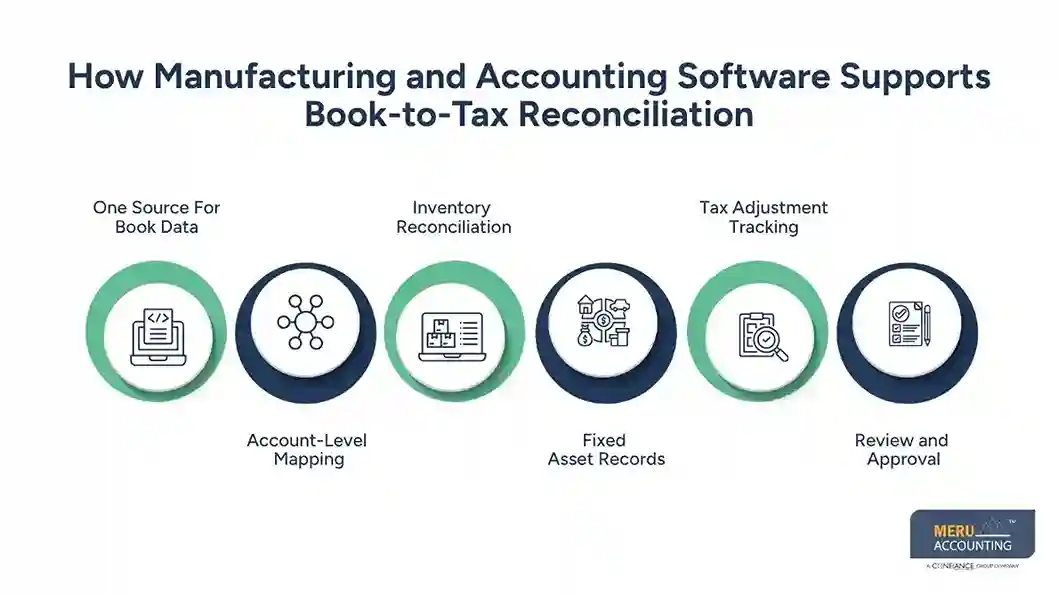
Fixed Asset Records
Machines, tools, vehicles, and production equipment can represent large amounts on a manufacturer’s balance sheet.
A fixed asset module can track purchase cost, placement-in-service dates, depreciation, and disposal data needed when book and tax depreciation differ.
Tax Adjustment Tracking
A reconciliation should explain an adjustment rather than only show its final amount.
Manufacturing and accounting software provides the book-side figures, while tax workpapers can record the tax treatment, difference, reason, and supporting evidence.
Review and Approval
A completed reconciliation should not move straight from the preparer’s screen to the tax return.
Accounting software for manufacturers can provide reports and source records for review, while an accountant or tax professional checks whether the proposed treatment fits the applicable rules.
Key Book-to-Tax Differences in Manufacturing Accounting
Inventory Cost Differences
Inventory tracked through manufacturing and accounting software can contain more than the purchase price of raw materials. Depending on the applicable rules, production-related direct and indirect costs may also need to be included.
The IRS states that the uniform capitalization rules under Section 263A can require certain costs to be capitalized into inventory.
Depreciation Differences
The same machine can have one depreciation schedule for books and another for tax.
This difference may change taxable income in the current year while reversing over later periods.
Accrued Expenses
A manufacturer may record an expense before paying it. Whether the amount is deductible for tax in that same period depends on the applicable tax rules.
That makes accrued expenses another area worth checking during reconciliation.
Warranty and Other Reserves
Manufacturers may estimate future warranty costs, returns, or similar obligations for financial reporting.
Tax treatment may follow different timing rules, so these estimates should be separately reviewed instead of automatically treated as tax deductions.
Capitalized Costs
A cost tracked through manufacturing and accounting software that appears as a current expense in the books may need to be capitalized for tax. In other cases, tax rules may allow treatment that differs from financial reporting.
The accounting entry alone does not determine the tax result.
Permanent Differences
Some differences never reverse. For example, a particular book expense may not qualify for a tax deduction under the applicable rules.
Keeping permanent differences separate from temporary differences makes the reconciliation easier to understand in later years.
optional anymore
on running the business
Essential Features of Accounting Software For Manufacturers
Inventory Management
The system should show quantities, values, locations, and movement of inventory.
For accounting software for manufacturers, this is important because inventory data feeds into cost of goods sold and year-end financial reporting.
Cost Accounting
Manufacturers need to see where production costs arise.
A cost accounting module can classify direct material, direct labor, and manufacturing overhead so finance teams can review product and production costs with greater detail.
General Ledger
The general ledger should provide account balances and transaction-level details.
Manufacturing and accounting software should make it possible to move from a reported balance to the entries behind that balance.
Fixed Asset Management
A factory may own machinery that stays in use for many years.
A fixed asset system can maintain purchase details, depreciation, disposals, and other records needed for book and tax analysis.
Reporting and Export
Tax work often requires information beyond a standard income statement.
The system should allow finance teams to filter transactions, review account activity, and export useful reports for reconciliation and tax preparation.
Access and Audit Controls
Not every employee needs access to every financial function.
Manufacturing and accounting software should allow user permissions and maintain records of key changes, giving management better control over financial data.
Best Practices For Accurate Book-to-Tax Reconciliation
Start With a Clean Trial Balance
Do not begin reconciliation by searching randomly through spreadsheets.
Start with the final trial balance in manufacturing and accounting software, review unusual balances, check major journal entries, and resolve suspense items before preparing tax adjustments.
Reconcile Inventory First
For manufacturers, inventory deserves early attention because it can directly affect cost of goods sold.
Compare inventory subledgers with the general ledger and review differences in raw materials, work in process, finished goods, and related accounts.
Separate Temporary and Permanent Items
A temporary difference may reverse in a future period. A permanent difference generally does not.
Keeping these categories separate gives the tax team a better record for future reconciliations.
Keep Tax Workpapers
A good workpaper in manufacturing and accounting software should answer four basic questions: What is the book amount? What is the tax amount? Why are they different? What evidence supports the adjustment?
Review Section 263A Rules
Manufacturers should determine whether the uniform capitalization rules apply to their business and which costs must be included in inventory.
The IRS provides specific guidance on Section 263A and related inventory rules, including exceptions that may apply to certain taxpayers.
Review Changes in Accounting Methods
Changing an accounting method can affect tax reporting. Some changes may require IRS consent or specific procedures.
The IRS states that Form 3115 may be required for certain accounting method changes.
Why Choose Meru Accounting For Manufacturing Accounting Services
Manufacturing Accounting Review
Meru Accounting provides accounting services for manufacturers that need organized financial data across production and finance, including records maintained through manufacturing and accounting software.
The review can cover account balances, inventory records, expenses, fixed assets, and other data used in year-end reporting.
Book-to-Tax Reconciliation
Meru Accounting provides book-to-tax reconciliation services that compare financial records with tax reporting requirements.
The process can cover inventory, depreciation, accruals, expenses, capitalization, and other differences identified during review.
Inventory Accounting
We provide inventory accounting services covering raw materials, work in process, finished goods, and related production costs recorded through manufacturing and accounting software.
Clear inventory data gives finance teams a better base for financial reporting and tax review.
Software-Based Accounting
Meru Accounting works with platforms including QuickBooks, Xero, Zoho Books, NetSuite, and Odoo.
The right setup can make it easier to classify transactions, prepare reports, and trace financial data during reconciliation.
Tax-Ready Records
Tax preparation starts with financial records. At Meru Accounting, we provide accounting records that can be organized for review by tax professionals.
Tax treatment still needs to be checked against the rules and facts that apply to each manufacturer.
Our Expert Perspective
Book-to-tax reconciliation is often treated as something to finish after the books are closed. For a manufacturer, that can create avoidable pressure because inventory, production costs, assets, and accruals may all need review at the same time.
A better approach is to build the process into regular accounting work. With manufacturing and accounting software, account mapping, inventory checks, and clear workpapers can be maintained throughout the year instead of rebuilt at tax time.
The key point is simple: software records the numbers, but accounting judgment explains them.
Key Takeaways
- Manufacturing and accounting software connects production activity with financial records.
- Book income and taxable income can differ because financial and tax rules may treat the same item differently.
- Inventory deserves close attention because its valuation can affect cost of goods sold and taxable income.
- Depreciation, accruals, reserves, capitalization, and permanent differences can all require tax review.
- Section 263A may require certain production costs to be included in inventory when applicable.
- Accounting software for manufacturers can provide the reports and transaction records needed for reconciliation.
- A reconciliation should explain each major difference instead of only showing a final adjustment.
- Tax professionals should review significant tax positions before filing.
FAQs
Book-to-tax reconciliation compares amounts in the financial records with amounts used to calculate taxable income.
Differences can arise from inventory, depreciation, accrued expenses, capitalization, and other book and tax rules.
It brings financial, inventory, production, and asset data together so differences can be found and reviewed.
It should track areas such as inventory, production costs, fixed assets, general ledger entries, and financial reports.
No. Software records and reports the data, while the applicable tax rules and qualified tax professionals determine the treatment.
optional anymore
on running the business