
Meru Accounting

Manufacturing CPA: 7 Ways Inventory Accounting Can Improve Your Business

Contents
Want to learn more?

Subscribe for business tips, tax updates, financial fundamental and more


    Manufacturing CPA: 7 Ways Inventory Accounting Can Improve Your Business

    A product can look profitable on paper until you add the costs that came with making it. Material prices change, labor hours run over, stock sits on the shelf, and overhead gets spread across production. By the time the books are closed, the margin you expected may not be the margin you earned. This is one reason a manufacturing CPA needs to look beyond basic bookkeeping and understand how inventory moves through the business.

    For manufacturers, inventory is tied to much more than stock counts. It affects product costs, gross profit, cash flow, and financial reports. A CPA for manufacturing companies can help connect those pieces, so owners can see where money is tied up and where costs may be eating into profit.

    In this blog, we’ll look at seven ways better inventory accounting can help a manufacturing business control costs, improve cash flow, and make better decisions—and where manufacturing CPA services can fit into that process.

    What You Will Learn From This Blog

    • What a manufacturing CPA does for a plant or shop
    • Why sound inventory accounting matters
    • Seven ways inventory accounting can help your business
    • Common ways to value and track stock
    • How a CPA for manufacturing companies can support cost and stock work
    • Common inventory and accounting errors to watch for
    • What to look for in manufacturing CPA services

    What is a Manufacturing CPA?

    A manufacturing CPA is a CPA who works with the needs of firms that make, build, or process goods. Manufacturing books can be more complex than books for firms that only sell goods or offer a service. The books may need to track raw goods, work in process, finished goods, labor, plant costs, and the cost of goods sold.

    A manufacturing CPA can help set up clear ways to record and review these costs. The work may also cover month-end close, account review, cost reports, cash flow review, tax-ready books, and help with key finance tasks.

    The goal is not just to keep the books in order. A good CPA helps make sure the numbers can be used to spot waste, plan cash needs, and check the true cost of making a product.

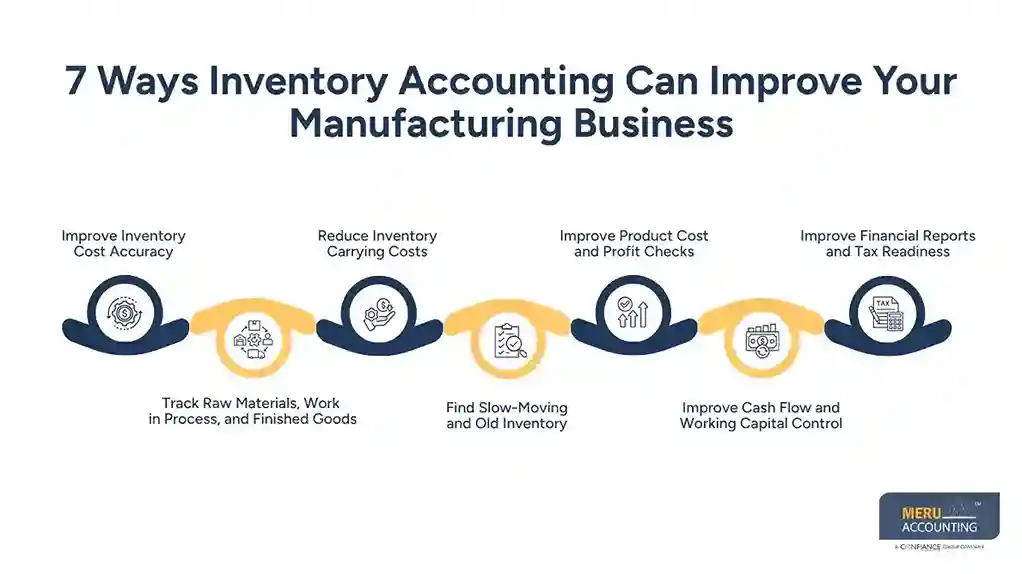
    7 Ways Inventory Accounting Can Improve Your Manufacturing Business

    1. Improve Inventory Cost Accuracy

    The first gain is better cost data. A plant may buy the same type of raw good at more than one price. Freight, labor, and other plant costs may also change over time. If the cost data is not kept up to date, product margins may look better or worse than they are.

    A manufacturing CPA can help set clear rules for how costs are tracked and placed into the right accounts. This gives owners a better view of what stock costs and how those costs affect profit.

    Better cost data also helps when a firm sets prices. If the cost of a key input rises but the sale price stays the same, the margin may shrink. Timely books can help the owner see that change sooner.

    2. Track Raw Materials, Work in Process, and Finished Goods

    Manufacturing stock is not all at one stage. Raw goods may be in storage, some may be on the plant floor, and other goods may be ready to ship.

    Each stage has a role in the books. A CPA for manufacturing companies can help build a clear flow from raw goods to work in process and then to finished goods. This can make it easier to check stock levels and spot gaps between plant data and book data.

    When these stages are clear, the finance team can also better track the cost tied to each part of the process.

    3. Reduce Inventory Carrying Costs

    Stock takes cash to buy, store, move, and manage. Too much stock can leave cash tied up for months. It may also raise storage, insurance, and handling costs.

    Inventory reports can help show which items move fast and which ones sit for too long. A manufacturing CPA can review these trends with other financial data to help owners see where cash is tied up.

    This does not mean that every firm should hold less stock. Some firms need safety stock to keep a line running. The goal is to have enough stock to meet demand without tying up more cash than the business needs.

    4. Find Slow-Moving and Old Inventory

    Old stock can be easy to miss when the plant is busy. A part may sit on a shelf for months, or a finished item may no longer match what buyers want.

    A sound review can flag items that have had little or no use. This gives the owner a chance to take action before the stock becomes a higher cost.

    Manufacturing CPA services may include reports that help track stock age, stock turns, and items that need review. These reports can help management ask the right questions about buys, demand, and production plans.
    Manufacturing CPA: 7 Ways Inventory Accounting Can Improve Your Business

    5. Improve Product Cost and Profit Checks

    Sales alone do not show which products make money. A product may have strong sales but a low margin if its material, labor, or plant costs are high.

    A manufacturing CPA can help match product costs with sales data so owners can review gross margin by product, job, or line where the data supports it.

    This can be useful when a firm needs to decide whether to raise a price, change a process, drop a product, or find a lower-cost input. It can also help owners see if a cost change on the plant floor is having a real effect on profit.

    6. Improve Cash Flow and Working Capital Control

    Inventory is part of working capital. When too much cash is tied up in stock, less cash may be on hand for payroll, vendor bills, new tools, or other needs.

    Good inventory accounting gives the finance team a better view of how much cash is tied to stock and how that amount changes over time.

    A CPA for manufacturing companies can bring inventory data into cash flow review. This can help management spot cash needs before they become urgent. It can also help link stock buys with sales plans and payment cycles.

    7. Improve Financial Reports and Tax Readiness

    Inventory affects key financial reports. Errors in stock records can flow into cost of goods sold, gross profit, assets, and other parts of the books.

    A manufacturing CPA can help review inventory records as part of the month-end close and year-end work. Clear records can also make it easier to support tax work and answer questions about costs.

    This does not mean that inventory accounting is only a tax task. In fact, the best use of good stock data is often the insight it gives the owner during the year.


    Good financial management isn't
    optional anymore
    Meru Accounting handles the accuracy, so you can focus
    on running the business

    Inventory Accounting Methods Used by Manufacturing Companies

    Manufacturers may use different methods to track and value inventory based on their needs, systems, and accounting rules.

    Standard costing uses set cost rates for materials, labor, and other costs. Actual results can then be compared with the set rates to find variances.

    Actual costing tracks costs based on the actual amount paid or incurred. This can give a direct view of cost, though it may need more detailed records.

    FIFO assigns costs based on the first goods bought being treated as the first goods sold. Other methods may also be used when allowed and suitable for the business.

    The right method depends on the firm’s books, products, systems, and reporting needs. A CPA for manufacturing companies can help review the method in use and make sure it is applied in a clear and consistent way.

    How a Manufacturing CPA Helps Manage Inventory Accounting

    Inventory accounting works best when the plant, sales team, and finance team use the same basic data. A manufacturing CPA can help bring these areas together.

    Support may include:

    • Reviewing inventory accounts and balances
    • Checking stock records against the general ledger
    • Reviewing raw material, WIP, and finished goods data
    • Tracking cost changes and key variances
    • Helping with month-end and year-end close
    • Reviewing inventory aging and slow-moving stock
    • Preparing clear management reports
    • Helping keep books ready for tax work
    • Working with QuickBooks, Xero, or other client systems

    A manufacturing CPA can also help set review steps that fit the firm’s size and plant setup. The goal is to build a process that the team can use each month, not one that only works at year-end.

    Common Manufacturing Accounting Mistakes to Avoid

    Some inventory errors start with small gaps in daily records. Common issues include:

    • Failing to update material costs
    • Mixing raw goods with finished stock
    • Not tracking work in process with care
    • Leaving old stock on the books at the wrong value
    • Posting plant costs to the wrong account
    • Failing to check physical counts against book records
    • Using cost rates that no longer match the plant
    • Waiting until year-end to review inventory issues

    These issues can make reports less useful and may lead owners to act on numbers that do not show the full picture.

    Meru Accounting’s Manufacturing CPA Services

    At Meru Accounting, we support manufacturers with accounting work built around their books, workflow, and reporting needs. Our manufacturing CPA services are designed to help keep financial data clear, current, and useful for day-to-day business decisions.

    Our manufacturing CPA services include:

    • Manufacturing bookkeeping and account reconciliation
    • Inventory and cost account review
    • Raw material, WIP, and finished goods tracking support
    • Accounts payable and accounts receivable support
    • Bank and credit card reconciliation
    • Monthly financial reports
    • Cost and margin reporting support
    • Catch-up and cleanup work
    • Tax-ready books and records

    We work with the systems and processes already used by the client where possible. Our goal is to give owners and management a clean view of costs, cash, inventory, and financial results without adding needless steps to the workflow.

    Our Expert Insight

    A manufacturing business can have accurate inventory counts and still have inaccurate product costs. One area we pay close attention to is the gap between standard costs and actual costs. If material prices, labor rates, scrap, or machine time change but standard costs stay the same, product margins can look better than they really are.

    That is why we recommend reviewing major cost variances as part of the monthly close—not just checking whether inventory balances match the ledger. Large or repeated variances can point to pricing issues, waste, changes in supplier costs, or production processes that need a closer look.

    For a manufacturing CPA, this review can turn inventory accounting into a management tool. The goal is not simply to report what inventory is worth. It is to help explain why costs changed and what those changes mean for the business.

    Key Takeaways

    • Inventory accounting affects cost, profit, cash flow, and financial reports.
    • Raw materials, WIP, and finished goods need clear records.
    • Good inventory data can help find old stock and high carrying costs.
    • Product cost data can support better pricing and margin checks.
    • A CPA for manufacturing companies can help build a sound review process.
    • The right manufacturing CPA services should fit the firm’s systems and plant workflow.
    • Regular review is more useful than waiting for year-end to find inventory issues.

    FAQs

    It depends on the company’s size, inventory complexity, and accounting needs. Monthly support, tax work, and advisory services may have separate costs.

    It depends on the products, production process, inventory system, and reporting needs. A CPA can help select and apply an appropriate method.

    Manufacturers typically account for raw materials, direct labor, and manufacturing overhead when determining inventory costs.

    Inventory variances are differences between expected and actual costs. They can help identify changes in material prices, labor costs, waste, or production efficiency.

    Yes. A manufacturing CPA can help review work-in-process costs and records to support accurate inventory and financial reporting.

    Good financial management isn't
    optional anymore
    Meru Accounting handles the accuracy, so you can focus
    on running the business