NetSuite for hospitality gives hotels, restaurants and hospitality groups a central system to manage financial records, stock, purchasing, revenue and business operations. As hospitality businesses expand across multiple locations, managing daily transactions and financial data through separate systems can become difficult. Different teams may use different tools for bookings, payments, payroll, stock and accounts, which can lead to delays and gaps in reports.
An integrated enterprise resource planning (ERP) system brings key business data into one place. NetSuite offers financial management, inventory control, procurement, reporting and system integration features that suit the needs of hospitality businesses. With the right setup, hotel and restaurant owners can track income, review costs and make decisions based on current financial data.
This blog examines how NetSuite for hospitality addresses the operational requirements of hotels and restaurants, covering its main features, integration needs, implementation challenges and the value of proper financial management.
What You Will Learn From This Blog
- Why hotels and restaurants need an integrated ERP system.
- Key NetSuite features that support financial management, inventory control and daily hospitality business operations.
- How hotels can manage room revenue, occupancy data and expenses.
- How NetSuite hospitality integration connects business software.
- Ways to improve financial reporting and cost control.
- Common NetSuite implementation challenges for hospitality businesses and ways to address them.
Why Do Hotels and Restaurants Need NetSuite for Hospitality?
Hotels and restaurants handle many daily transactions, from room bookings and food sales to supplier payments and staff costs. NetSuite for hospitality brings key business records together, making it easier to review operations and financial results.
Managing Multiple Properties and Business Locations
Hotel groups and restaurant chains may run several branches under one company. Each location has its own income, costs, staff and supplier records. A central ERP system gives management a common view of these records while allowing each property to track its own results.
Reducing Manual Accounting and Operational Tasks
Manual data entry across booking, billing and accounting systems can lead to errors and repeated work. NetSuite can automate tasks such as invoice processing, transaction posting and account updates, based on the workflows set by the business.
Improving Financial Visibility and Cost Control
Hospitality businesses need to track food costs, room revenue, labour costs, rent and utility bills. A shared financial system gives managers access to these figures and makes it easier to spot unusual spending or changes in profit.
Coordinating Front-Office and Back-Office Operations
Front-office teams manage guests, bookings and payments, while back-office teams handle accounts, payroll and supplier bills. NetSuite for hospitality can bring the financial data from these functions into a common reporting system.
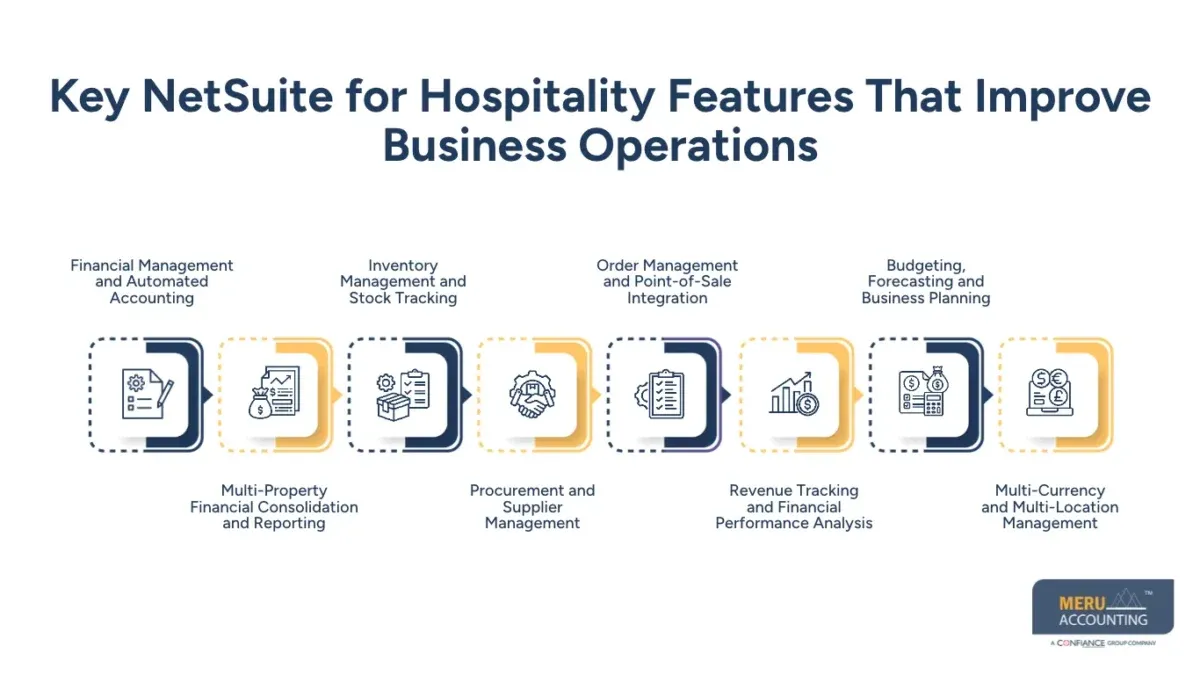
Key NetSuite for Hospitality Features That Improve Business Operations
The right ERP features depend on the size and needs of a hospitality business. NetSuite for hospitality offers several functions that can be set up to manage daily work and financial records.
Financial Management and Automated Accounting
NetSuite records income, expenses, invoices, payments and account balances in a central financial system. Automated posting rules can reduce manual work and keep transaction records consistent across business units.
Multi-Property Financial Consolidation and Reporting
Businesses with several hotels or restaurants can maintain separate entity records and prepare consolidated reports. This gives owners a view of group performance without losing access to individual property results.
Inventory Management and Stock Tracking
Hotels and restaurants hold food, beverages, cleaning items, guest supplies and other stock. Inventory features can track stock levels, item movement and purchase needs, helping managers reduce waste and avoid excess stock.
Procurement and Supplier Management
NetSuite for hospitality brings purchasing records into a central system, making it easier to record supplier details, purchase orders, bills and payment terms. Managers can review supplier costs, compare orders and keep a clear record of business purchases.
Order Management and Point-of-Sale Integration
Restaurants receive orders through dine-in, takeaway and delivery channels. A suitable POS connection can send sales and payment data to NetSuite, where the finance team can review revenue, taxes and related records.
Revenue Tracking and Financial Performance Analysis
NetSuite can group revenue by property, department, outlet or account. Managers can compare sales with operating costs and review which parts of the business contribute most to overall profit.
Budgeting, Forecasting and Business Planning
Hospitality businesses can prepare budgets for food purchases, staff costs, room operations and other expenses. Forecasts based on past results and current business plans give management a basis for future spending decisions.
Multi-Currency and Multi-Location Management
For hotel groups operating across international markets, NetSuite for hospitality provides multi-currency and multi-subsidiary management capabilities to manage financial information across locations. NetSuite provides multi-currency and subsidiary management features, subject to the chosen edition and configuration.
How NetSuite for Hospitality Benefits Hotel Operations
Hotels manage room bookings, guest payments, food services, housekeeping and maintenance costs. NetSuite for Hospitality can bring the financial side of these activities into a shared reporting structure.
Managing Room Revenue and Occupancy-Related Financial Data
Room revenue depends on room rates, bookings, cancellations and occupied room nights. When the property management system sends accurate transaction data, finance teams can review room income and related adjustments.
Integrating Property Management Systems (PMS)
A PMS holds key details about reservations, check-ins, check-outs and room charges. Connecting it with NetSuite can transfer approved financial data for accounting and reporting, reducing the need for repeated manual entries.
Tracking Housekeeping and Departmental Expenses
Hotels spend money on laundry, cleaning products, repairs, guest supplies and staff. Department-wise expense records make it easier to compare actual costs with budgets and review changes in operating expenses.
Managing Food, Beverage and Room Service Transactions
Hotels often run restaurants, cafes, bars and room service departments. POS and accounting connections in NetSuite for hospitality can bring sales, refunds, taxes and payment details into the financial system for review.
Monitoring Revenue Per Available Room (RevPAR)
RevPAR measures room revenue against available room capacity. It is calculated by dividing room revenue by available rooms for a given period. Hotel managers can compare this measure with occupancy and average daily rate (ADR) to review room performance.
Improving Financial Reporting Across Hotel Properties
NetSuite for hospitality enables hotel groups to compare income, expenses and profit across their properties. This gives senior management a clearer view of which locations are meeting their financial plans and where further review may be needed.
NetSuite Hospitality Integration: Connecting Essential Business Systems
NetSuite hospitality integration connects the ERP system with software used for bookings, guest services, sales, payments and workforce management. The aim is to transfer the right data between systems and reduce gaps in business records.
NetSuite Hospitality Integration With Property Management Systems (PMS)
A PMS records room bookings, guest bills, cancellations and other stay-related transactions. With NetSuite for hospitality, these integrated records provide a consolidated view of room revenue, guest billing and property-level financial activity.
NetSuite Hospitality Integration With POS Systems
Restaurant POS software records orders, discounts, refunds and payments. A POS connection can send daily sales summaries or transaction-level data to NetSuite, based on the reporting needs of the business.
Connecting Reservation and Booking Platforms
Hotels receive bookings through their websites, travel agencies and online booking platforms. NetSuite hospitality integration can connect relevant booking data with financial records, although reservation management usually remains within the PMS or booking platform.
Integrating Payroll and Workforce Management Systems
Hotels and restaurants employ staff across several departments and shifts. Payroll connections can transfer wage expenses, tax entries and payment data to NetSuite for financial reporting and account reconciliation.
Connecting Payment Processing and Banking Platforms
Payment gateways and bank feeds can provide details of card payments, refunds, settlements and bank transactions. Using NetSuite for hospitality, businesses can maintain a more consistent record of payment settlements, refunds and outstanding reconciliation items.
Synchronising Inventory, Procurement and Accounting Data
When stock is purchased or used, the related quantity and cost records need to remain consistent. Connecting inventory and procurement systems with NetSuite can provide a clearer record of purchases, stock movement and related expenses.
optional anymore
on running the business
How NetSuite for Hospitality Improves Financial Reporting and Business Decisions
Financial reports are useful only when the underlying data is accurate and properly classified. NetSuite for hospitality gives management a common source of financial information for reviewing business results.
Real-Time Financial Dashboards and Reporting
Dashboards can display selected financial measures, such as sales, expenses, account balances and outstanding payments. The figures depend on the timing and quality of data entered or transferred from connected systems.
Department-Wise Revenue and Expense Analysis
Management can review revenue and costs for rooms, restaurants, housekeeping, food services and other departments. This makes it easier to compare actual results with budgets and identify areas that need attention.
Cash Flow Monitoring and Financial Reconciliation
Cash flow reports show money received and paid during a period. Regular bank, payment gateway and account reconciliation can reveal missing entries, duplicate transactions and differences in settlement amounts.
Identifying Operational Costs and Profit Margins
Food purchases, labour, utilities, maintenance and other operating costs affect hospitality profit margins. Managers can review these costs against revenue to understand the financial performance of each location or department.
Using Financial Data for Business Forecasting
Past revenue, seasonal demand, room occupancy and spending patterns can form the basis of financial forecasts. Management can use these figures when planning staff costs, stock purchases and future budgets.
Common Challenges in Implementing NetSuite for Hospitality
An ERP project requires more than software installation. NetSuite for hospitality must be configured around the company’s business structure, accounting rules and daily work.
Integrating Existing Hospitality Software
Hotels may already use PMS, POS, booking and payment systems from different providers. Before implementation, businesses should check whether these systems have suitable connectors, APIs or other integration options.
Migrating Historical Financial and Operational Data
Old accounting records, supplier details, customer balances and transaction data need to be checked before migration. Poor-quality data can lead to incorrect opening balances and unreliable reports.
Configuring Workflows for Hotels and Restaurants
A hotel and a restaurant do not follow the same operating process. The NetSuite for hospitality setup should reflect how each business records sales, manages stock, approves purchases and handles payments.
Managing Employee Training and System Adoption
Employees need clear instructions on how to enter, review and approve transactions. Role-based training and written process notes can reduce mistakes during the change from old systems to the new setup.
Controlling Implementation Costs and Timelines
Costs may include software licences, integration work, data migration, training and ongoing maintenance. Businesses should define project goals, budgets, responsibilities and testing stages before implementation begins.
How Meru Accounting Manages Financial Records for Hospitality Businesses
Businesses using NetSuite for hospitality need accurate financial records to review income, control expenses and assess the results of each property or outlet. Meru Accounting provides accounting, bookkeeping, payroll and financial reporting services to businesses operating in the USA and other markets.
Our services cover key financial record processes, including:
- Accounting and bookkeeping: Recording room revenue, food sales, operating costs, supplier bills and other business transactions under the correct accounts.
- Account reconciliation: Comparing bank statements, payment records, POS settlements and accounting entries to identify differences and missing transactions.
- Payroll accounting: Recording salary costs, payroll liabilities and related entries to maintain clear employee expense records.
- Accounts payable and receivable: Maintaining supplier bills, payment records, customer balances and outstanding amounts.
- Financial reporting: Preparing income statements, balance sheets and other financial reports that show the financial results of the business.
- ERP-related financial processes: Reviewing transaction flows and accounting records to maintain consistency between operational data and financial reports.
Our Expert Perspective
In our view, hospitality ERP projects should begin with a clear review of the accounting process rather than software configuration alone. A hotel may record room income through its PMS, restaurant sales through its POS and staff costs through a payroll system. Unless these records follow consistent accounting rules, consolidated reports may not show the correct business position.
For this reason, businesses should review their chart of accounts, transaction mapping, reconciliation process and reporting needs before setting up NetSuite hospitality integration.
Key Takeaways
- NetSuite for hospitality brings financial management, inventory, procurement and reporting into one ERP system.
- Hotels can review room revenue, occupancy-related financial data and departmental expenses.
- Restaurants can connect POS sales, stock records and supplier purchases with accounting data.
- NetSuite hospitality integration links the ERP system with PMS, POS, payroll, booking and payment platforms.
- Accurate data migration and proper system setup are important for reliable financial reports.
- Regular reconciliation and clear accounting rules are needed to maintain accurate business records.
FAQs
NetSuite is used in the hospitality industry to manage hotel finances, restaurant sales, inventory, supplier payments, payroll and financial reporting through one ERP system.
The main features include financial management, inventory tracking, procurement, multi-property reporting, POS integration, budgeting and revenue analysis.
Yes, NetSuite can connect with hotel PMS and restaurant POS systems through APIs, connectors or third-party tools to transfer booking, sales and payment data.
NetSuite hospitality integration connects PMS, POS, payroll, booking and payment systems to reduce manual data entry and maintain consistent financial records.
Yes, NetSuite can suit multi-property hotel groups by combining financial data, tracking location-wise expenses and preparing consolidated reports across properties.
optional anymore
on running the business