
Managing several property companies can make finance work hard to track. NetSuite for real estate gives property owners and managers one system to manage books, entities, cash, costs, and reports. With the right setup, NetSuite for real estate can bring each legal entity into one clear system while still keeping its books apart.
A structured system also makes it easier to compare each property’s results and review group-level financial data. With clear entity rules and reporting processes, real estate firms can reduce manual work and make month-end reporting more consistent.
What You Will Learn From This Blog
- Understand how NetSuite fits the needs of real estate firms with multiple entities.
- Learn why a clean entity setup matters for accurate property books.
- Explore how NetSuite can reduce manual work across multiple entities.
- Explore ways to manage intercompany entries and cash activity more effectively.
- Review key NetSuite features for reports, controls, and month-end close.
- Identify best practices for setting up and managing NetSuite for real estate.
- See how Meru Accounting can assist with NetSuite accounting and financial management.
Introduction to NetSuite
What NetSuite Does
NetSuite for real estate is an ERP system that can bring finance, cash, billing, and reports into one place. NetSuite OneWorld is built to manage many legal entities through a set hierarchy.
Why One System Matters
Property groups often have one entity for each asset, fund, or project. Running each set of books in a separate file can make real estate accounting slow and hard to review. One system gives finance teams a shared base for data and reports.
Entity-Based Books
Each company can be set up as its own subsidiary. Transactions can then stay tied to the right legal entity, tax setup, and base currency. NetSuite uses a parent-child structure for these entities.
Shared Data Rules
A clear chart of accounts can give each entity a common base for property accounting. NetSuite also lets an account be tied to one or more selected subsidiaries, which can limit where that account is used.
Better Financial Control
NetSuite for real estate can give finance teams a single place to review balances, entries, and reports. Access can also be set by subsidiary, so staff can see only the entities tied to their role.
Why Real Estate Businesses Need Multi-Entity Accounting
Separate Property Companies
A real estate group may own ten buildings through ten legal entities. Each company can have its own rent, debt, repairs, taxes, and bank activity. Multi-entity accounting keeps those records apart while allowing group-level review.
Clear Property Results
Property owners need to know how each asset performs. Property accounting must show rent, costs, debt, and cash at the right entity and property level. A shared system can reduce the need to merge data by hand.
Intercompany Activity
One entity may pay a cost for another entity. A parent may also lend cash to a property company. Multi-entity accounting needs clear intercompany entries so both sides of each deal are recorded and can be cleared at close.
Group Reporting
Owners may need one report for the full group and another for each property. NetSuite lets users view data by subsidiary or use consolidated views where supported.
Tax And Audit Records
Accurate real estate accounting records should show where income and costs came from. The IRS notes that rental records should support reported income, expenses, tax work, and audit needs.
How NetSuite Streamlines Real Estate Accounting
One Chart Of Accounts
NetSuite for real estate can use a shared chart of accounts across entities. A common account set makes group reports easier to read and cuts the need to map separate books after each close.
Property-Level Tracking
Use classes, locations, departments, projects, or other fields to tag activity where needed. Such tags give real estate accounting teams more detail without creating a new general ledger account for every property.
Automated Consolidation
NetSuite OneWorld can roll data from child subsidiaries into consolidated reports. Foreign currency rates can also be used when entities have different base currencies.
Intercompany Entries
Multi-entity accounting becomes easier when related company entries are recorded in a controlled flow. NetSuite includes tools for intercompany sales, purchases, transfers, and journal entries.
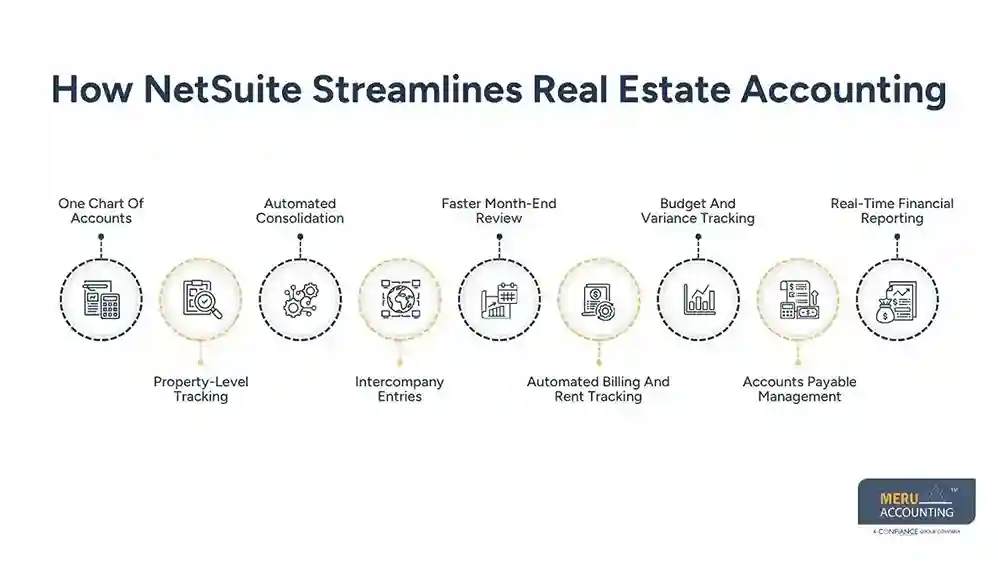
Faster Month-End Review
A set close process can make account review more repeatable. Teams can check bank balances, payables, receivables, accruals, debt, and intercompany balances by entity before group reports are issued.
Automated Billing And Rent Tracking
NetSuite for real estate can organize recurring rent, fees, and other property income within a structured accounting process. Automated billing rules can reduce repeated data entry and give teams a clearer record of amounts due and received.
Budget And Variance Tracking
Real estate teams can compare actual income and costs with approved budgets. Large variances become easier to spot, so managers can review unexpected repairs, lower rent income, or higher operating costs sooner.
Accounts Payable Management
NetSuite can organize vendor bills for repairs, maintenance, utilities, insurance, and other property costs. Approval workflows can route bills to the right person before payment, giving real estate accounting teams better control over outgoing cash.
Real-Time Financial Reporting
Managers can review financial data without waiting for separate spreadsheets from each entity. NetSuite for real estate can provide reports on income, expenses, cash, assets, liabilities, and entity results based on the firm’s reporting setup.
optional anymore
on running the business
Key NetSuite Features for Multi-Entity Real Estate Accounting
NetSuite OneWorld
OneWorld is central to NetSuite for real estate groups with many legal entities. It provides a hierarchy for subsidiaries and allows financial data to be viewed by entity or at a consolidated level.
Consolidated Reports
Real estate accounting teams can use consolidated financial statements to review the parent and its child entities. NetSuite also provides subsidiary context options for supported reports.
Currency Management
Groups with entities using different currencies need proper rate rules. NetSuite uses consolidated exchange rates when rolling child entities into a parent report.
Intercompany Framework
The intercompany framework can manage transactions between related entities. Proper setup is key because revenue, costs, assets, and liabilities between entities may need elimination at the group level.
Financial Report Builder
NetSuite lets users filter or group financial statement data by subsidiary. That can give managers a clearer view of property or entity results without building every report from scratch.
Best Practices for Managing Multi-Entity Accounting in NetSuite
Build A Clear Entity Tree
Start with the legal structure before loading data. Multi-entity accounting works best when parent companies, property companies, holding firms, and other entities are mapped to the right place.
Standardize The Chart Of Accounts
Create rules for rent, repairs, utilities, tax, debt, insurance, and other common costs. A standard chart makes property accounting reports easier to compare across properties.
Set Strong Naming Rules
Use clear names for properties, entities, accounts, vendors, and classes. In NetSuite for real estate, consistent naming can reduce errors when staff enter bills, journals, or cash activity.
Review Intercompany Balances
Set a regular review for due-to and due-from accounts. Multi-entity accounting can become hard to close when one entity records a balance, and the other side is missing or coded wrong.
Control User Access
Give users access based on their role and entity needs. NetSuite can restrict subsidiary views, which gives firms more control over who can see entity data.
How to Improve Real Estate Accounting With NetSuite
Use A Close Checklist
Create one close list for each entity. NetSuite for real estate works best when teams follow the same steps for bank checks, accruals, debt, fixed assets, rent, and intercompany balances.
Track Key Property Data
Use suitable classifications for rent, property costs, capital work, and other key items. A strong data model gives real estate accounting teams useful detail for each asset.
Review Reports By Entity
Run entity-level reports before the group close. Check large changes in rent, repairs, debt, cash, and operating costs before accepting the final numbers.
Keep Records Together
Store bills, contracts, receipts, journals, and other proof with the related transactions where the system setup allows. The IRS states that records should support income and expense amounts reported on tax returns.
Automate Repeat Work
Use system rules, saved searches, workflows, and approved integrations for repeat tasks where suitable. NetSuite for real estate can reduce manual entry when processes are well designed and tested.
Why Choose Meru Accounting for NetSuite Real Estate Accounting
NetSuite Accounting Support
Meru Accounting can assist real estate firms with day-to-day NetSuite for real estate accounting work. Our team can manage transaction records, account reconciliations, financial reports, and other routine finance tasks.
Multi-Entity Bookkeeping
Managing several property entities requires consistent processes. Our team can maintain separate books for each entity while keeping group reporting needs in view, making multi-entity accounting easier to manage.
Property-Level Reporting
Real estate owners need clear data for each property and entity. Meru Accounting can organize income, costs, assets, liabilities, and other records so your reports give a useful view of property performance.
Reconciliation And Close Support
Bank, credit card, loan, and intercompany accounts need regular checks. Our team can assist with reconciliations and month-end close tasks so errors can be found before financial reports are finalized.
Scalable Accounting Processes
As your property portfolio grows, finance work can become more complex. Meru Accounting can help maintain consistent real estate accounting processes across new entities, properties, and transactions while keeping reporting needs clear.
Our Expert Perspective
At Meru Accounting, we see NetSuite for real estate work best when the system design follows the legal and property structure from the start. A firm should not add entities, accounts, and custom fields without a clear reason. First map each property, owner, bank account, debt line, and intercompany flow. Then build the chart, access rules, close steps, and reports around that map. Strong setup at the start can reduce clean-up work later and give managers more trust in their numbers.
Key Takeaways
- NetSuite for real estate can bring many property entities into one system.
- Multi-entity accounting keeps legal entity books separate while allowing group review.
- A shared chart of accounts can make reports easier to compare.
- Intercompany entries need clear rules and regular review.
- Consolidated reports can give owners a group-level view.
- Property-level tags can give more useful operating data.
- Strong user access rules can reduce unwanted data access.
- A fixed month-end process can make close work more consistent.
- Good real estate accounting records are also important for tax support.
- A well-planned NetSuite setup can reduce manual finance work.
FAQs
NetSuite for real estate accounting is used to manage property finances, entities, transactions, reports, and financial data in one system.
NetSuite manages separate subsidiaries while allowing real estate businesses to create consolidated financial reports across entities.
Yes, NetSuite can consolidate financial data from multiple subsidiaries into group-level financial statements and reports.
NetSuite records transactions between related entities and can create elimination entries for consolidated financial reporting.
NetSuite for real estate can centralize financial data, simplify entity reporting, improve transaction control, and reduce manual accounting work.
optional anymore
on running the business