Amazon sellers can have thousands of dollars tied up in products that haven’t sold yet. But looking at Seller Central sales and payouts won’t tell you how much that stock is worth or what each sale actually costs. That’s why Amazon FBA accounting needs more than a record of money coming in and going out.
From supplier invoices and freight costs to unsold units, returns, and damaged goods, every stock movement affects your financial records. Getting inventory and cost of goods sold (COGS) right helps you see your actual margins, avoid overstating profits, and make better purchasing decisions.
What You Will Learn From This Blog
- What NetSuite is and how it works for small firms.
- Why small firms may need an ERP system.
- Which NetSuite tools can help with daily tasks.
- The key gains and limits of using NetSuite.
- What affects the NetSuite cost for small business use.
- When the move to NetSuite makes sense.
- How expert accounting support can help you get more value from the system.
What Is NetSuite and How Does It Work for Small Businesses?
Oracle NetSuite is a cloud-based ERP system that helps firms run key parts of their business from one place. It links finance, sales, stock, orders, and client data. This lets teams work with the same set of data rather than rely on many tools.
For small firms, NetSuite can help cut manual work and give owners a clear view of their books and daily tasks. For example, when a sale is made, the system can link the order, stock levels, invoice, and finance records. This helps teams track each step with less data entry.
NetSuite also gives users access to live reports and data from any place with an internet link. Owners can check sales, costs, cash flow, and open bills without waiting for a month-end report.
Still, NetSuite is not a basic bookkeeping tool. It is a full ERP system with a wide range of tools. A small firm should first check if it needs that level of control or if a simple accounting app can meet its needs.
Why Are Small Businesses Considering NetSuite ERP?
Small firms often start with basic tools for books, sales, and stock. These may work well at first, but as sales grow, the gaps can start to show. Data may sit in many places, reports may take more time, and staff may need to enter the same data more than once.
This is where NetSuite for small businesses may offer value. It brings key tasks into one system and helps teams work with shared data.
Some key reasons small firms look at NetSuite include:
- Better control: Owners can view key data and track work across teams.
- Less manual work: Linked tools can cut repeat data entry and lower the risk of errors.
- Clear reports: Finance and sales data can help owners make sound choices.
- Room to grow: Firms can add users, tools, and new workflows as needs change.
- One source of data: Teams can use the same records for sales, stock, and finance.
However, moving to an ERP system should solve a clear business need. A firm should not invest in NetSuite just because it is built for large firms or has many tools. The cost and setup effort must match the value it can bring.
optional anymore
on running the business
Key NetSuite Features That Benefit Small Businesses
NetSuite has a wide set of tools that can help small firms manage daily work and gain better control over their data.
1. Financial Management and Accounting
NetSuite helps teams track income, costs, bills, and cash flow. It can also help with bank checks, account records, and month-end close tasks. This gives owners a clear view of the firm’s financial health.
2. Inventory and Order Management
Firms that sell goods can use NetSuite to track stock, orders, and item costs. It helps teams see what is in stock and track orders from sale to delivery. This can help lower the risk of stock gaps or excess stock.
3. Customer Relationship Management (CRM)
NetSuite CRM helps teams track leads, sales, client records, and service tasks. Sales staff can view client data and follow each deal from the first call to the final sale.
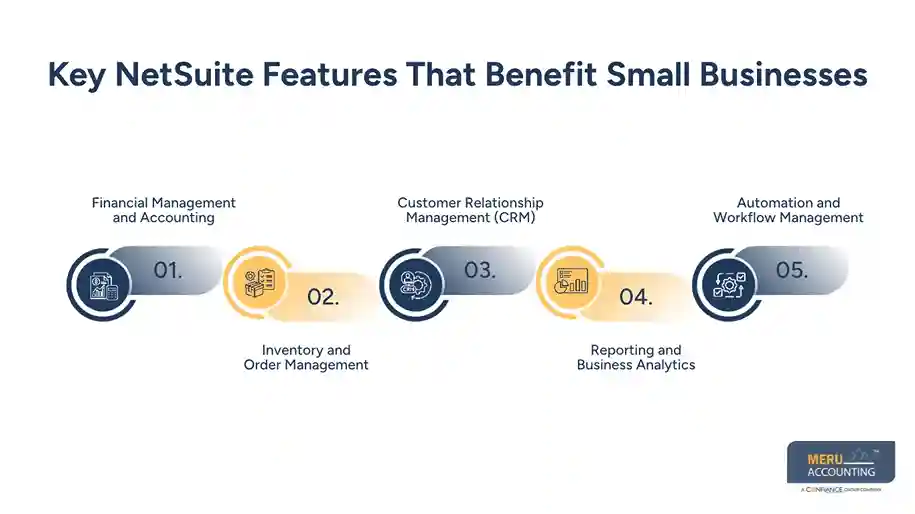
4. Reporting and Business Analytics
NetSuite offers reports and dashboards that show key business data. Owners can track sales, costs, profit, and cash flow. They can also use these reports to spot trends and find areas that need close review.
5. Automation and Workflow Management
The system can help automate tasks such as bill approval, order steps, and alerts. This can save staff time and help keep work on track. Teams can also set rules to guide how key tasks are done.
What Are the Benefits of NetSuite for Small Businesses?
The value of NetSuite for small businesses goes beyond having more tools in one place. It can help firms save time, improve data quality, and gain better control as they grow.
Here are some of the main benefits.
1. Better View of Business Finances
NetSuite links key finance data, so owners can see income, costs, bills, and cash flow in one place. This makes it easier to review business results and spot issues early.
2. Less Manual Data Entry
When teams use separate tools, they may need to enter the same data more than once. NetSuite can link key tasks and cut this work. This also helps lower the risk of errors in sales and finance records.
3. Faster Financial Reports
NetSuite can help teams get key reports without having to pull data from many apps. Owners can check sales, costs, and profit with less delay. This can also help with month-end close and budget reviews.
4. Better Control as the Business Grows
A small firm may start with a few users and a simple set of tasks. As it grows, it may need more tools, users, and reports. NetSuite can support these needs without the firm having to move to a new ERP system each time it grows.
5. Stronger Teamwork
Since teams can work with shared data, sales, finance, and stock staff can stay on the same page. This can help reduce delays and make it easier to track work across the firm.
These gains can be useful, but they are not automatic. The system needs the right setup, clean data, and staff who know how to use it. Without these, a firm may pay for tools it does not use or fail to get the value it had planned.
When Should a Small Business Invest in NetSuite?
NetSuite may be a good fit when a small firm has needs that basic book or sales tools can no longer meet. The right time to invest depends on the issues the firm faces and its plans for growth.
Here are some signs that it may be time to look at NetSuite:
- Your business uses many apps: Staff spend too much time moving data from one tool to the next.
- Reports take too long: It is hard to get a clear view of sales, costs, and profit.
- Your stock is hard to track: You need better control over stock levels, orders, and item costs.
- Your team is growing: More staff and new workflows make it hard to manage tasks with basic tools.
- You need better finance control: You want to track bills, cash flow, budgets, and results with more ease.
- You plan to expand: You need a system that can support more users, sales, or sites as the firm grows.
Before you buy, map out the tasks that cause the most trouble. Check how much time staff spend on them, what errors they cause, and how much they cost the firm. Then see if NetSuite can fix those issues.
For some firms, a lower-cost accounting app with a few add-ons may be enough. For others, the time saved and better control from an ERP system may make the cost worth it.
What Are the Limitations of NetSuite for Small Businesses?
While NetSuite has many tools, it may not be the right fit for every small firm. Its cost, setup needs, and range of features can be hard to manage if the firm does not need a full ERP system.
Some key limits to keep in mind are:
1. High Cost
The NetSuite cost for small business use can be a key concern. The full cost may include a base license, user fees, extra modules, setup, data migration, and staff training. These costs can add up, even before the firm starts to use the system in full.
2. Complex Setup
NetSuite may need expert help to set up the right tools, roles, reports, and workflows. A poor setup can lead to delays and extra costs. Firms should plan for this work before they sign up.
3. Staff Training Needs
NetSuite has many features, and staff may need time to learn how to use them. If users do not get the right training, they may fall back on old tools or use only a small part of the system.
4. Extra Tools May Raise Costs
Some firms may need more modules or custom tools to meet their needs. These can raise the total cost over time. It is wise to list the must-have features before you choose a plan.
5. Too Much for Very Small Firms
A firm with few staff, low sales volume, and simple finance needs may not need a full ERP system. In such cases, a basic accounting app may be easier to use and cost less.
NetSuite Cost for Small Business: What Should You Budget For?
The NetSuite cost for small business use is not the same for every firm. The price can vary based on the plan, number of users, tools, and level of setup needed. There may also be costs for data migration, custom work, training, and support.
Before you invest, ask for a full quote that covers:
- License fees: The base cost to use NetSuite.
- User fees: The cost may change based on how many staff need access.
- Extra modules: Added tools for stock, CRM, payroll links, or other tasks may raise the price.
- Setup and data move: You may need help to set up the system and move old records.
- Custom work: Changes to reports, forms, or workflows can add to the bill.
- Training and support: Staff may need help to learn the system and fix issues.
Do not judge the price by the base fee alone. Look at the full cost over the first year and the years that follow. Also, check if each added tool will save time, lower risk, or help the firm earn more.
A clear cost review can help you see if NetSuite is a sound use of funds or if a simpler tool is the better choice.
NetSuite Accounting Services for Small Businesses by Meru Accounting
Buying NetSuite is one decision; keeping the financial data inside it accurate and useful is another. Small businesses need more than software to manage their books. They need a team that understands account balances, transaction flows, reconciliations, and financial reports. That’s where Meru Accounting can help.
We provide outsourced NetSuite accounting support for small businesses, with services that cover the day-to-day work as well as more complex accounting needs.
Our NetSuite accounting services include:
- NetSuite Bookkeeping: Record sales, expenses, vendor bills, customer payments, and other financial transactions.
- General Ledger Management: Review account entries, maintain accurate balances, and keep the chart of accounts in order.
- Accounts Payable and Receivable: Track vendor payments, customer invoices, outstanding balances, and collections.
- Bank and Credit Card Reconciliation: Match transactions with bank and card statements and investigate discrepancies.
- NetSuite Financial Reporting: Prepare income statements, balance sheets, cash flow reports, and other financial reports.
- Month-End Close Support: Review accounts, post adjustments, reconcile balances, and help close the books on time.
- Accounting Cleanup and Catch-Up: Correct posting errors, review past transactions, and bring overdue records up to date.
Whether you’re already using NetSuite or planning to move your accounting operations to it, we can help manage the financial work behind the system. You get access to dedicated accounting support without the expense of building a full in-house team.
Our Expert Insight
We often advise small businesses not to choose NetSuite based on projected growth alone. A business should have a clear reason to upgrade, whether it’s better control over multiple entities, more detailed financial reports, or the need to manage complex transactions.
One point worth checking is whether the business will actually use NetSuite’s advanced features. For instance, a company with one location and a small product range may not need the same setup as a business managing multiple warehouses, sales channels, and entities.
Our advice is to match the software to your current accounting needs, not just your future plans. Paying for features you won’t use can make an otherwise good ERP investment hard to justify.
Key Takeaways
- NetSuite brings finance, sales, stock, and other key tasks into one system.
- It can help small firms cut manual work and get faster reports.
- The system may be a good fit for firms with complex workflows or plans to grow.
- The NetSuite cost for small business use includes more than the base license fee.
- Setup, training, extra modules, and support can raise the total cost.
- Very small firms with simple needs may get better value from a basic accounting app.
- Good accounting support is key to getting reliable data and reports from NetSuite.
FAQs
Yes. NetSuite can be a good fit for small businesses that need advanced accounting, inventory control, and business reports. Companies with basic bookkeeping needs may find simpler software more affordable.
The NetSuite cost for small business use depends on the license, number of users, and selected modules. Setup, data migration, training, and support can add to the total cost.
It can be expensive for startups with simple operations and tight budgets. However, startups with complex financial or inventory needs may find the investment worthwhile.
Yes. NetSuite supports general ledger management, accounts payable, accounts receivable, bank reconciliation, and financial reporting.
QuickBooks Online, Xero, and Zoho Books are options for businesses with basic accounting needs. Companies that need broader ERP features should compare other ERP systems based on cost and functionality.
optional anymore
on running the business