A nonprofit can have a healthy bank balance and still run short on funds for its next project. How? Part of that money may belong to a grant with strict spending rules, while some may come from donors who expect their gifts to support a specific cause. The rest may be available for day-to-day needs. A nonprofit bookkeeper helps keep these funds straight so the organization knows what it can spend and what it must set aside.
The challenge is not just keeping the books balanced. It is making sure every grant, gift, and expense is recorded in the right place. A missed entry or poorly tracked cost can lead to a gap in a grant report or leave the team unsure about how much funding is still available. Good nonprofit bookkeeping keeps these details clear and gives leaders a sound basis for financial decisions.
What You Will Learn From This Blog
- What a nonprofit bookkeeper does and how the role differs from business bookkeeping.
- How to record grants, track costs, and meet grant terms.
- How to track donor gifts and keep clear gift records.
- How to manage restricted and unrestricted funds.
- Which reports help leaders review the health of a nonprofit.
- Common grant and fund accounting errors and ways to avoid them.
- How expert support can help keep nonprofit books clear and up to date.
What Does a Nonprofit Bookkeeper Do?
A nonprofit bookkeeper keeps the day-to-day financial records of an organization. This work goes beyond noting cash in and cash out. It calls for a clear view of where funds come from, what they are meant to fund, and how they are used.
For example, a nonprofit may get a grant to run a food aid program. It may also get gifts that can be used for any need. The bookkeeper must track both sources with care so the team does not use grant funds for costs that the grant does not cover.
Key tasks often include:
- Recording income and costs: Entering grants, gifts, fees, payroll, rent, and other costs in the books.
- Tracking funds: Sorting income and costs by fund, program, grant, or donor use terms.
- Bank checks: Matching book entries with bank and card records to spot errors or missing items.
- Bill and pay records: Tracking bills due, staff pay, and funds owed to the group.
- Budget checks: Comparing real costs with the set budget for each grant or program.
- Financial reports: Giving leaders clear data on cash, funds, costs, and open grant balances.
A skilled bookkeeper also keeps key records in order. These may include grant letters, donor notes, bills, bank slips, and proof of payment. This makes it easier to answer questions and back up each entry during a review or audit.
How a Nonprofit Bookkeeper Manages Grants
Grants often come with set rules on how funds can be used. A nonprofit bookkeeper helps the team track grant income and costs so each award is used as agreed. This work starts when the grant is approved and must continue until all funds are spent or the award is closed.
1. Recording Grant Income and Tracking Award Terms
The first step is to record each grant in the books. The bookkeeper should note the grant maker, award sum, date, term, and purpose. They should also keep a copy of the signed award letter and note any key terms.
Some grants pay the full sum at once, while others pay in stages. Some may pay back costs after the group sends proof of spend. The bookkeeper must record each payment in the right way based on the award terms and the group’s accounting rules.
2. Monitoring Grant Spending and Eligible Expenses
Not all costs can be paid with grant funds. For example, a grant may cover food, travel, and staff time for one program but not office rent or costs for other work.
A nonprofit bookkeeper tracks each cost against the right grant and budget line. This helps the team spot costs that fall outside the grant terms before they become a larger issue.
3. Preparing Grant Reports and Supporting Documents
Grant makers may ask for reports that show how funds were used. These reports may list total costs, budget gaps, program spend, and funds left to use.
The bookkeeper helps gather this data from the books and keeps bills, pay records, and bank proof on file. Clear records make it easier for leaders to check the report before they send it to the grant maker.
4. Tracking Grant Balances and Reporting Deadlines
Each grant has a set term and may have due dates for reports or use of funds. The bookkeeper tracks the amount received, the amount spent, and the balance left.
They can also keep a list of key dates for reports, renewals, and grant closeout. This helps the team plan ahead and avoid late reports or funds that remain unused past the grant term.
How a Nonprofit Bookkeeper Tracks Donations
Donations may come from people, firms, local groups, and online giving sites. Each gift must be logged in the books with the right date, sum, source, and use terms. A nonprofit bookkeeper helps keep these records clear so the team can track gifts and show how funds support its work.
1. Recording Individual and Corporate Donations
Each gift should be recorded as soon as the nonprofit gets it. The entry should show who gave the funds, how much they gave, when the gift came in, and how it was paid.
Gifts may come by cash, check, bank transfer, card, or online giving site. The bookkeeper must also check that the total in the books matches the funds that reach the bank.
For large gifts or gifts from firms, the team should keep a copy of the gift letter or other proof of the terms.
2. Tracking Donor Restrictions and Giving Purpose
Some donors give funds for a set need, such as school supplies, food aid, or health care. Others let the nonprofit use their gifts where funds are most needed.
The bookkeeper must record these gifts in the right fund or class. This helps the team keep funds with use limits apart from gifts that can be used for daily costs.
3. Reconciling Donations With Bank Deposits
Online giving sites and card firms may take fees before they send funds to the nonprofit. For this reason, the gift total in the books may not match the bank deposit.
For example, if donors give $1,000 and the site keeps $30 in fees, the bank may show a deposit of $970. The bookkeeper should record the full gift income and the fee as a cost. This keeps both income and costs clear.
4. Maintaining Records for Donor Acknowledgments
Donors may need a record of their gifts for tax purposes. The bookkeeper can help keep gift dates, amounts, donor details, and proof of payment in order.
For gifts that need a formal acknowledgment, the nonprofit should follow IRS rules. The bookkeeper can help gather the data, but the team should check that each notice meets the rules that apply to the gift.
How a Nonprofit Bookkeeper Manages Restricted Funds
Restricted funds are gifts or grants that must be used for a set purpose or time. For example, a donor may give $20,000 to fund a school meal plan. The nonprofit cannot use that money to pay for an unrelated office cost.
A nonprofit bookkeeper helps track these funds so the team can use them as the donor or grant maker asked.
1. Understanding Restricted vs. Unrestricted Funds
Nonprofit funds may have different use terms. The two main types are:
- Restricted funds: Money that must be used for a set purpose or time based on donor or grant terms.
- Unrestricted funds: Money that the nonprofit can use to meet its needs, based on its own plans and budget.
This split is key to sound fund control. If a team treats all cash as one pool, it may spend funds that are meant for a set program.
2. Tracking Contributions With Donor Restrictions
A nonprofit bookkeeper should set up clear fund codes or classes for gifts with use terms. Each gift and cost must link to the right fund.
For example, a donor may give $15,000 for a youth care program. The bookkeeper should track all costs paid from that gift under the same fund. This lets the team see how much was spent and how much is left.
3. Recording the Release of Restrictions
Some gifts have limits that end once the nonprofit meets a set goal or time term. For example, a donor may give funds for a new care center. Once the center opens and the set costs are met, the funds may be released from restriction under the right accounting rules.
The bookkeeper must keep proof that the terms have been met and record the release in the books. This helps keep fund balances right and makes reports more useful.
4. Preventing the Misuse of Restricted Funds
Clear records help stop funds from being used for the wrong costs. A bookkeeper can review each cost, check the fund code, and flag entries that do not fit the donor’s terms.
Nonprofit leaders should also set clear rules for who can approve costs and who can move funds. Bookkeeping checks work best when they form part of a wider review process.
optional anymore
on running the business
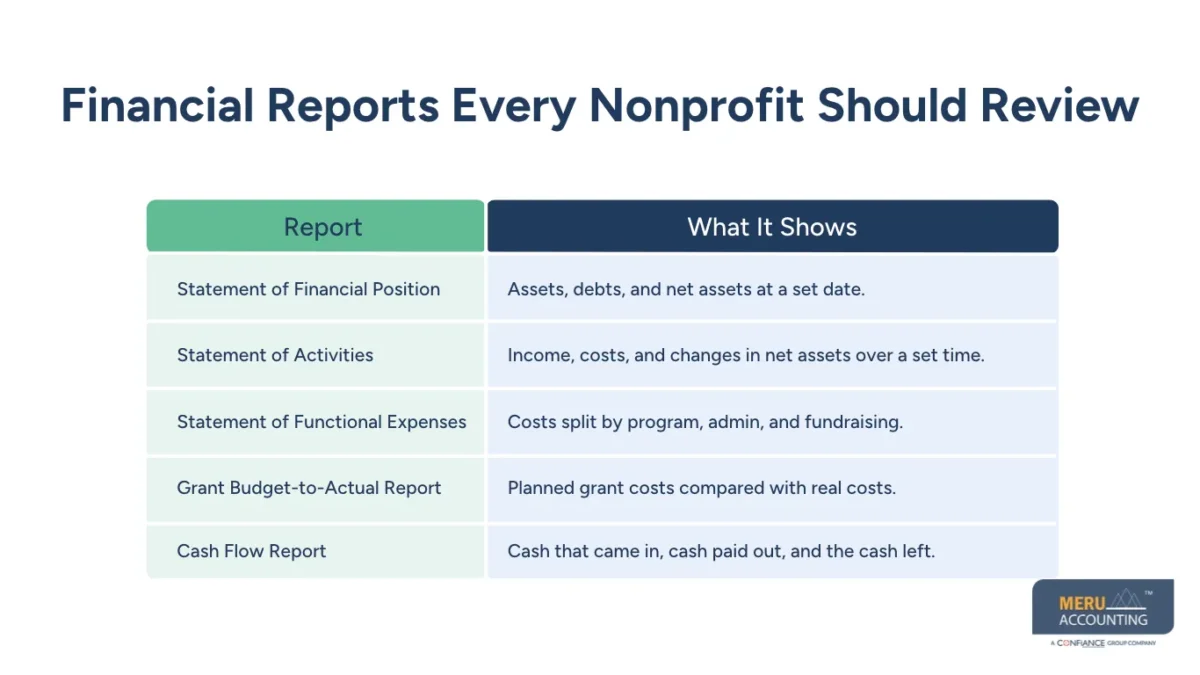
Financial Reports Every Nonprofit Should Review
Reports help nonprofit leaders see how funds are used and if the group can meet its goals. A nonprofit bookkeeper helps keep the data in these reports up to date.
Key reports include:
Report | What It Shows |
Statement of Financial Position | Assets, debts, and net assets at a set date. |
Statement of Activities | Income, costs, and changes in net assets over a set time. |
Statement of Functional Expenses | Costs split by program, admin, and fundraising. |
Grant Budget-to-Actual Report | Planned grant costs compared with real costs. |
Cash Flow Report | Cash that came in, cash paid out, and the cash left. |
Leaders should review these reports on a set schedule, such as each month or quarter. They should also check grant balances and fund limits before they approve new costs.
These reports can help the board ask the right questions, spot gaps, and make sound plans. They also give donors and grant makers a clearer view of how funds support the nonprofit’s work.
Common Grant and Fund Accounting Mistakes Nonprofits Should Avoid
Even a small error can affect a grant report or fund balance. A nonprofit bookkeeper can help spot these issues, but the whole team must follow sound rules.
Common mistakes include:
- Mixing restricted and unrestricted funds: This can lead to funds being used for costs that do not fit the donor’s terms.
- Late entry of gifts and grants: Delays can cause reports to show the wrong income or fund balance.
- Poor cost coding: Costs may be linked to the wrong grant or program.
- Missing proof of spend: Bills, bank slips, and pay records may be hard to find when a grant maker asks for them.
- Ignoring grant terms: Teams may miss limits on staff pay, travel, or other costs.
- Skipping bank checks: Errors, fees, or missing entries may go unnoticed.
- Late grant reports: Poor date tracking can lead to missed due dates and extra work.
To avoid these issues, nonprofits should set clear steps for gift entry, cost review, bank checks, and grant reports. They should also keep key files in one safe place and review fund balances on a set schedule.
How Meru Accounting Supports Nonprofit Bookkeeping Solutions
A grant report is only as reliable as the records behind it. If program costs are not linked to the right award, or donor gifts are not tracked by their intended use, nonprofit leaders may struggle to explain where the money went. Meru Accounting helps address these gaps with bookkeeping support built around the way nonprofit funding works.
Our nonprofit bookkeeping solutions cover the financial tasks that help keep grants, donations, and fund balances in order:
- Grant Accounting and Expense Tracking: Record grant receipts, assign expenses to the right awards, track spending against budgets, and maintain grant-wise records.
- Donor and Donation Tracking: Record individual and corporate gifts, track donor terms, and reconcile donation records with bank deposits and giving platform reports.
- Restricted Fund Accounting: Maintain separate records for restricted and unrestricted funds, track fund balances, and record the release of restrictions when applicable.
- Grant Reporting Support: Prepare expense summaries, budget-to-actual reports, and supporting records to help your team meet grant reporting needs.
- Account Reconciliation and Book Cleanup: Reconcile bank and account records, review unmatched entries, and correct gaps that affect fund balances and financial reports.
- Nonprofit Financial Reporting: Prepare reports that help management review program costs, available funds, income, and overall financial activity.
Whether your organization manages a few donor-funded programs or multiple grants with different spending terms, Meru Accounting can support the bookkeeping work behind them. This gives your team a clearer view of available funds, documented expenses, and the financial details needed to stay accountable to donors and grant makers.
Our Expert Insight
One area nonprofits should not overlook is the difference between receiving grant money and earning grant revenue. These are not always the same. Some grants come with conditions that must be met before the funds can be recognized as revenue. Others are simply restricted to a specific program or purpose.
For example, a nonprofit may receive a $100,000 grant in advance for a year-long program. If the grant has conditions tied to service targets or other measurable outcomes, the full amount may not qualify as revenue when the cash arrives. Recording it too soon can overstate income and give the board an inaccurate view of the organization’s finances.
We recommend reviewing grant agreements before recording funds and making this part of the month-end close. Pay close attention to spending terms, performance conditions, and any requirement to return unused funds. For complex awards, work with your CPA to confirm the right accounting treatment under U.S. GAAP.
Key Takeaways
- A nonprofit bookkeeper tracks grants, gifts, costs, and fund balances.
- Each grant should have clear records of its terms, budget, costs, and due dates.
- Donor gifts must be logged with the right source, date, amount, and use terms.
- Restricted funds must stay separate from funds that the nonprofit can use for any need.
- Monthly bank checks and fund reviews help spot errors early.
- Clear reports help leaders, donors, and grant makers see how funds are used.
- The right nonprofit bookkeeping solutions can help keep records up to date and support sound fund control.
FAQs
A nonprofit bookkeeper tracks each grant separately by recording its income, expenses, budget, and remaining balance. This helps ensure that funds are used for approved purposes and grant reports are accurate.
Using restricted funds for an unapproved purpose can lead to donor disputes, grant repayment requests, or compliance issues. Nonprofits should review donor terms and check expenses before using restricted funds.
Nonprofits should reconcile their bank accounts monthly and review grant and donation balances as part of the month-end close. More frequent reviews may be needed for grants with tight spending limits or reporting deadlines.
Nonprofits should keep grant agreements, approved budgets, invoices, receipts, payroll records, bank statements, and proof of payment. These records help support reported expenses and show how grant funds were used.
A nonprofit should consider outsourcing when it struggles to manage grant records, track donations, or prepare timely financial reports. Outsourced nonprofit bookkeeping solutions can provide ongoing support without the cost of a full-time in-house bookkeeper.
optional anymore
on running the business