Many accounting firms and business owners reach a point where growth starts creating pressure on internal resources, making offshoring accounting services a practical scaling solution.
Hiring more staff, expanding office space, and adding infrastructure often increases fixed costs faster than revenue growth. This is where structured global support models can change how operations scale.
Offshoring accounting services allows firms to move part of their accounting work to trained teams in different regions.
Instead of building large in-house departments, businesses can distribute work to skilled professionals who work remotely. This helps maintain control over costs while still handling more clients and transactions using offshore staffing for accounting firm structures.
This approach is not only about reducing expenses. It is about building a flexible operating model that supports growth without locking capital into long-term overheads.
What You Will Learn From This Blog
- Why scaling accounting work often increases fixed expenses
- How offshore accounting support reduces operational pressure
- Where offshoring fits into modern accounting operations
- How firms improve flexibility without increasing staff burden
- Real examples of how distributed teams support financial work
Introduction To Offshoring Accounting Services
Meaning Of Offshore Accounting Support
In offshoring accounting services, offshore accounting support refers to assigning accounting tasks such as bookkeeping, payroll, reconciliations, and reporting to teams located in other countries. These teams work remotely but follow the same accounting standards and reporting systems.
How The Model Works In Practice
Firms assign repetitive or time-heavy tasks to offshore teams. Local teams focus on advisory, client interaction, and review work. This division improves overall output without expanding fixed costs.
Growing Demand Across Accounting Firms
Many firms in the USA, UK, and Australia are adopting offshoring accounting services due to rising salary pressure and skill shortages. It helps them serve more clients without increasing office size or long-term commitments.
Key Operational Structure
Work is usually divided into:
- Data entry and bookkeeping
- Accounts payable and receivable
- Financial reporting support
- Tax preparation assistance
Technology Integration Role
Cloud accounting platforms allow real-time collaboration, making offshore staffing for accounting firm models easier to manage across regions. Tools like QuickBooks Online, Xero, and NetSuite make offshore coordination easier and more transparent.
Why Scaling Accounting Firms Often Increases Fixed Costs
Hiring Full-Time Staff
Traditional growth depends on hiring employees. Each new hire adds salary, benefits, and training cost, which makes offshoring accounting services a more flexible alternative.
These expenses remain even when the workload reduces, which is why many firms evaluate offshoring accounting services.
Infrastructure Expansion
With traditional expansion, more staff often means more office space, computers, licenses, and utilities—challenges reduced with offshoring accounting services. These costs become long-term financial commitments.
Training And Compliance Burden
Accounting standards change regularly. Training internal teams increases cost and time, especially for growing firms.
Technology And Software Scaling
Software licenses often increase with number of users. This adds recurring monthly expenses that cannot be easily reduced.
Limited Flexibility In Demand Changes
During slow seasons, firms still carry full fixed costs. This imbalance affects profitability and cash flow planning.
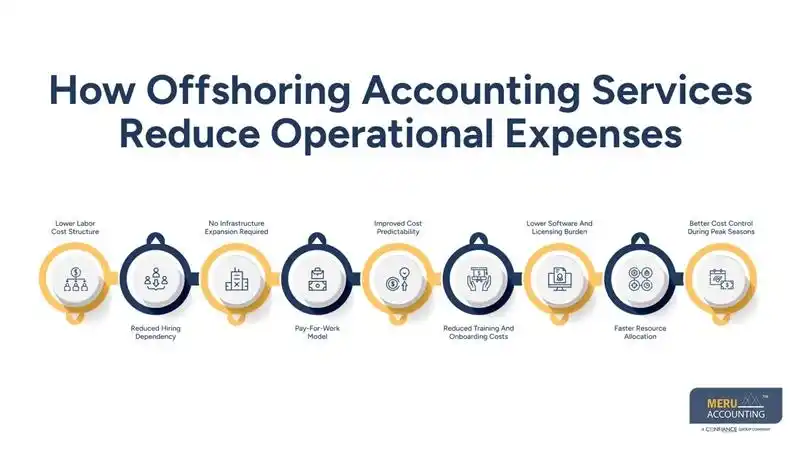
How Offshoring Accounting Services Reduce Operational Expenses
Lower Labor Cost Structure
One of the biggest advantages is reduced salary pressure. Offshore teams often operate at lower cost levels due to regional differences.
Reduced Hiring Dependency
Instead of hiring multiple in-house accountants, firms using offshore staffing for accounting firm models can allocate tasks externally. This avoids long recruitment cycles and onboarding expenses.
No Infrastructure Expansion Required
Since offshore teams work remotely, there is no need to expand office space or equipment investments. This helps firms avoid long-term lease commitments, utility costs, and hardware upgrades.
Pay-For-Work Model
Firms often pay based on tasks or hours completed. In offshoring accounting services, this makes cost structure more variable instead of fixed. It ensures businesses only pay for actual work delivered rather than idle employee time.
Improved Cost Predictability
Expenses become easier to forecast because they align with workload rather than employee count. This improves budgeting accuracy in offshore staffing for accounting firm setups and helps firms plan growth without unexpected cost spikes.
Reduced Training And Onboarding Costs
New hires require structured training, supervision, and system onboarding. Offshore teams already come with accounting process knowledge, which reduces training time and cost.
Lower Software And Licensing Burden
Scaling in-house teams often increases software licenses and system access costs. Offshore models distribute work across shared systems, helping reduce per-user licensing expenses.
Faster Resource Allocation
Work can be shifted quickly between offshore team members based on workload. This reduces idle time and improves overall utilization of resources in offshoring accounting services environments..
Better Cost Control During Peak Seasons
During tax season or audit periods, firms can increase offshore support temporarily instead of hiring permanent staff. This avoids long-term cost commitments.
Role Of Offshore Staffing For Accounting Firm Efficiency
Task Segmentation For Better Workflow
Routine tasks assigned offshore staff, senior accountants handle reviews and advisory work. Workflow balance improves across teams and reduces repeated manual handling across processes.
Faster Turnaround Times
Teams working across time zones complete tasks beyond office hours efficiently. Delivery speed increases and reports become available to clients in shorter timeframes.
Reduced Workload Pressure On Core Team
Local employees focus on client communication and analysis instead of repetitive data entry work. Daily workload reduces and allows better focus on higher value tasks.
Higher Output Without Overload
Offshore staffing for accounting firm operations allows firms to manage more clients without increasing internal strain. Business capacity grows steadily without placing extra pressure on internal teams.
Better Resource Utilization
Each team member focuses on specific tasks, improving overall efficiency and accuracy. Skills are allocated properly and operational time is used more effectively.
Key Areas Where Offshore Teams Support Accounting Operations
Bookkeeping And Data Entry
Daily transactions, invoice entries, and bank reconciliation tasks are handled efficiently by offshore teams. This improves record accuracy and keeps financial books updated on time.
Accounts Payable And Receivable
Tracking bills, payments, and receivables becomes more structured with dedicated offshore support. This helps reduce delays and improve cash flow visibility across accounts.
Payroll Processing Support
Offshore teams assist in salary calculations, tax deductions, and payroll record management. This ensures timely payroll processing with fewer manual errors in offshoring accounting services environments.
Financial Reporting Assistance
Monthly and quarterly reports are prepared faster with structured offshore coordination. In offshoring accounting services, this supports better financial review and quicker decision-making for management.
Tax Preparation Support
Offshore teams help organize data and documentation required for tax filing. This reduces last-minute pressure during filing periods in offshore staffing for accounting firm setups and improves compliance readiness.
How Offshore Staffing Improves Flexibility And Resource Allocation
Scalable Workforce Model
Firms using offshoring accounting services can increase or decrease offshore support based on workload without long-term commitments. This allows quick adjustment to changing business demands without restructuring teams.
Seasonal Workload Management
During tax season or audit periods, offshore teams help manage workload spikes efficiently. This ensures deadlines are met even during high-pressure reporting cycles.
Better Client Capacity Handling
Accounting firms can take on more clients without worrying about internal capacity limits. This supports business growth in offshore staffing for accounting firm models without requiring immediate expansion of in-house staff.
Reduced Dependency On Local Hiring
Recruitment challenges are reduced since offshore teams fill operational gaps. This helps avoid delays caused by hiring shortages or skill mismatches in local markets.
Balanced Cost Structure
With offshoring accounting services, expenses align with actual work demand, making financial planning more stable. This improves cost control and reduces financial stress during slow business periods.
How Meru Accounting Supports Offshore Accounting Transformation
At Meru Accounting, we have seen how structured offshore support changes the way accounting firms operate. Many of our clients initially struggled with rising payroll costs and limited internal capacity before adopting offshoring accounting services.
By integrating offshore accounting services, they were able to:
- Handle more clients without increasing office size
- Reduce pressure on senior accountants
- Improve reporting timelines
- Maintain consistent financial accuracy
Our teams work closely with firms using tools like QuickBooks, Xero, and other cloud systems. This ensures smooth coordination between onshore and offshore teams. The focus is not only cost control but also building a stable and scalable accounting structure.
We also support firms in setting up offshore staffing models that match their internal workflow, ensuring compliance and quality standards remain consistent across all processes.
Our Expert Perspective
From our experience working with accounting firms across different regions, the biggest shift is not only cost reduction but control over growth.
Many firms assume scaling requires hiring more staff locally. In practice, this often creates fixed cost pressure that limits long-term flexibility. When offshore staffing for accounting firm structures are introduced in a structured way, firms can separate core advisory work from routine processing tasks more effectively.
We have observed that firms using offshore models:
- Make faster financial decisions due to timely reporting
- Reduce burnout among internal teams
- Improve client onboarding speed
- Maintain more stable monthly expenses
The key success factor is not outsourcing alone, but building a clear workflow between internal and offshore teams. When this structure is followed, firms gain both stability and growth capacity at the same time.
Key Takeaways
- Scaling accounting firms often increases fixed costs due to hiring and infrastructure needs
- Offshore accounting support reduces dependency on full-time local staff
- Cost structure becomes flexible and aligned with workload
- Offshore staffing improves efficiency and turnaround time
- Firms can manage more clients without expanding office resources
- Technology plays a key role in connecting distributed teams in offshoring accounting services models
FAQs
It is a model where accounting tasks are handled by teams located in different countries who work remotely using shared systems and tools.
No. Quality depends on process control and training. With proper systems, accuracy remains consistent.
Yes. Even small firms use offshore teams to reduce workload and manage costs better.
Bookkeeping, payroll, reporting, and data entry are commonly assigned tasks.
Yes. Many offshore teams work in overlapping hours or provide next-day updates depending on the arrangement.