At some point, spreadsheets, receipts, and a few hours of bookkeeping each week stop being enough. A growing business has more moving parts, and even a small gap in its books can lead to poor cost estimates, missed payments, or reports that don’t tell the full story. That’s why many owners now see an outsourced bookkeeper as a practical part of their finance team rather than just an extra pair of hands.
The appeal goes beyond saving money on a new hire. Businesses can bring in experienced bookkeeping support, get a better handle on their records, and avoid spending time on work that doesn’t need their daily attention. With the right bookkeeping outsourcing services, they can build a more reliable finance process without making their team bigger.
What You Will Learn From This Blog
- What an outsourced bookkeeper does and how the service works.
- Why growing businesses are moving away from handling all bookkeeping in-house.
- Which bookkeeping outsourcing services help keep financial records in order.
- How outsourced and in-house bookkeeping compare in terms of cost, control, and support.
- When to hire an outsourced bookkeeper and what to look for in a service provider.
What Is an Outsourced Bookkeeper?
An outsourced bookkeeper is an external professional or team hired to manage some or all of a business’s bookkeeping work. Rather than hiring a full-time employee, a business works with an outside provider that handles financial records based on an agreed scope of work.
The work may include recording sales and expenses, managing bills and customer payments, reconciling bank accounts, and preparing monthly reports. Some businesses need help with daily entries, while others need support with month-end close, old records, or ongoing account reviews.
Most outsourced bookkeeping teams work online. They use the business’s approved accounting software and share reports, updates, and queries through secure channels. This setup lets owners and managers review their books without having to manage every entry themselves.
An outsourced bookkeeper can also work with an existing finance team. For example, an in-house accountant may handle budgets and tax planning while the outside team takes care of daily entries and account reconciliation.
optional anymore
on running the business
Why Growing Businesses Are Choosing Outsourced Bookkeepers
As transaction volumes rise, bookkeeping needs more time and care. Many businesses find that their current staff can no longer keep up with the work. Hiring an external team can help address this gap.
Here are some of the main reasons businesses make the switch.
1. Lower Costs Without Adding Full-Time Staff
Hiring an in-house bookkeeper comes with more than a salary. Businesses may also need to cover benefits, paid leave, training, office space, and software costs.
Working with an outsourced bookkeeper can help reduce these costs. Businesses pay for the agreed work or level of support instead of carrying the full cost of another employee. This can be useful for small and mid-sized companies that need regular bookkeeping but cannot justify another full-time role.
2. Access to Trained Bookkeeping Professionals
Good bookkeeping takes more than entering numbers. It requires an understanding of account categories, payment records, reconciliations, and month-end tasks.
An outsourced team can bring experience across different business types and transaction patterns. This can help businesses keep their records in order and spot issues such as duplicate entries, missing bills, or unmatched bank transactions before they affect reports.
3. More Time for Core Business Work
Business owners often spend time chasing invoices, checking expenses, and sorting out records when books fall behind. These tasks can take attention away from sales, customer service, and daily operations.
An outsourced bookkeeper takes on the agreed bookkeeping work, giving owners and managers more time to focus on the parts of the business that need their input.
4. More Reliable Financial Records
Late entries and missed bank matches can make reports hard to trust. Regular bookkeeping helps keep income, costs, and account balances up to date.
An outside team can follow a set schedule for recording transactions, reviewing accounts, and reconciling balances. With proper review steps, businesses can spot gaps early and have more reliable figures for monthly decisions.
5. Flexible Support as the Business Grows
A business may have a steady workload one month and a much higher volume the next. Seasonal sales, new locations, and added staff can all increase bookkeeping work.
An outsourced team can adjust its level of support as the workload changes. This gives the business room to grow without having to hire and train new staff each time the volume of work rises.
What Bookkeeping Outsourcing Services Do Growing Businesses Need?
The right services depend on the size of the business, its transaction volume, and the state of its current records. Most growing companies need a mix of daily bookkeeping and regular account reviews.
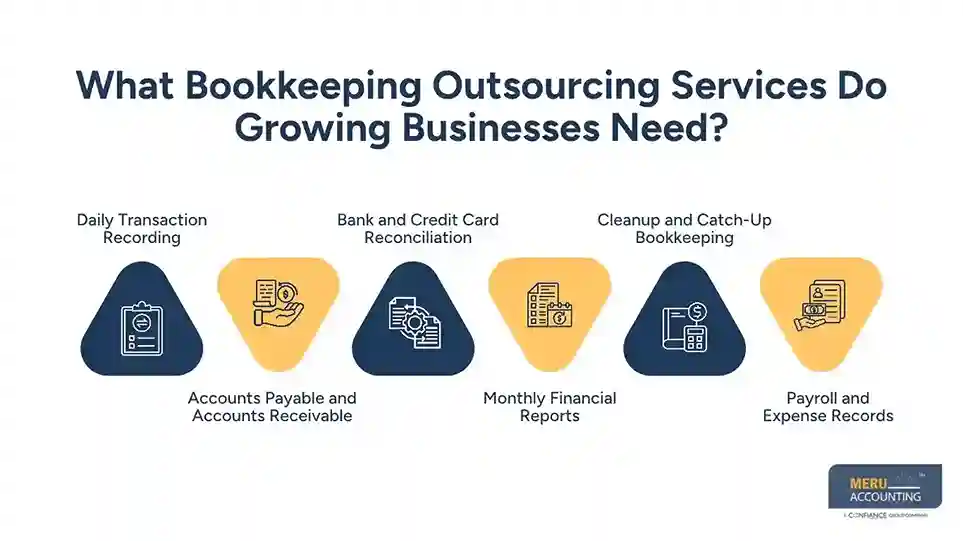
Common bookkeeping outsourcing services include:
1. Daily Transaction Recording
This covers sales, purchases, expenses, deposits, and other business transactions. Each entry must be recorded in the right account and period so the books reflect actual business activity.
2. Accounts Payable and Accounts Receivable
The team records supplier bills, tracks due dates, and keeps customer invoices in order. It can also maintain payment records and flag overdue balances for follow-up.
3. Bank and Credit Card Reconciliation
Bank and credit card accounts are compared with the books to find missing entries, duplicate records, and unmatched payments. Regular reconciliation helps keep account balances accurate.
4. Monthly Financial Reports
Businesses need clear reports to review income, costs, and cash flow. A bookkeeping team can prepare profit and loss statements, balance sheets, and other agreed reports for monthly review.
5. Cleanup and Catch-Up Bookkeeping
Some businesses have months of unrecorded transactions or accounts that have not been reconciled. Cleanup work brings old records up to date, while catch-up bookkeeping fills gaps in past periods.
6. Payroll and Expense Records
Bookkeeping support may also cover payroll entries, staff expense claims, reimbursements, and related account records. This helps keep wage costs and business expenses in the right accounts.
The scope should be clear before work begins. Businesses should know which tasks the provider handles, which tasks stay in-house, and who reviews the final records.
Outsourced Bookkeeper vs. In-House Bookkeeper: What's the Difference?
Both options can help a business keep its books in order. The main difference is how the work is staffed, managed, and paid for.
Factor | Outsourced Bookkeeper | In-House Bookkeeper |
Cost | Pay for agreed services or hours | Salary, benefits, and other staff costs |
Staffing | Access to an external professional or team | One or more employees |
Workload | Support can be adjusted as needs change | Extra work may require more staff |
Expertise | May offer experience across many business types | Depends on the employee’s skills |
Management | Work is guided by agreed tasks and review steps | Managed directly by the business |
Availability | Depends on the service agreement | Depends on employee work hours |
Business control | Shared through access, reports, and review processes | Direct day-to-day oversight |
An in-house employee may suit a business that needs someone on-site throughout the day or has a large internal finance team. An outside team may be a better fit when the main need is steady bookkeeping at a lower staffing cost.
Before choosing, businesses should compare the total cost, level of support, work scope, and review process rather than looking at the hourly rate alone.
When Should a Growing Business Hire an Outsourced Bookkeeper?
There is no fixed revenue level at which a business must outsource its books. The need often becomes clear through daily work problems.
Here are some signs that it may be time to hire an outsourced bookkeeper:
- Bookkeeping keeps falling behind: Sales, bills, and expenses are not entered on time.
- Monthly reports are late: Owners cannot review results when they need to make decisions.
- Transaction volume has increased: The current team struggles to keep up with sales, payments, and expenses.
- Reconciliation is not done on time: Bank and credit card balances do not match the books.
- Hiring in-house is too costly: The business needs regular support but cannot justify another full-time employee.
- Old records need cleanup: Missing entries and unreconciled accounts make it hard to trust past reports.
If these issues keep coming up, an outside team may help bring more order to the books. It is best to address the gaps early rather than wait until tax time or a major business review.
How Meru Accounting Supports Growing Businesses With Bookkeeping Outsourcing Services
When a business starts handling more customers, vendors, and transactions, its bookkeeping needs change. It may need more frequent account reviews, better control over unpaid invoices, timely reports, and help clearing old records. At Meru Accounting, we understand these demands and provide bookkeeping support that fits the way a business operates.
We support businesses at different stages of growth, from those looking to clear a backlog to those that need ongoing help with their books.
Our bookkeeping outsourcing services cover all the tasks growing businesses need:
- Day-to-Day Bookkeeping: Recording sales, purchases, expenses, deposits, and other transactions to keep accounts current.
- Accounts Payable and Receivable: Tracking vendor bills, customer invoices, due dates, payments, and outstanding balances.
- Bank and Credit Card Reconciliation: Matching account activity with recorded transactions and looking into missing or unmatched entries.
- Monthly Bookkeeping and Financial Reports: Maintaining monthly records and preparing profit and loss statements, balance sheets, and other reports.
- Catch-Up and Cleanup Bookkeeping: Updating overdue books, correcting entry gaps, and reconciling past periods.
- Payroll and Expense Recording: Maintaining payroll entries, employee reimbursements, and business expense records.
Businesses can engage us for specific bookkeeping tasks or build a dedicated team around their ongoing needs. We also work with accounting firms that need dependable bookkeeping support for their clients. Our aim is to make professional bookkeeping more accessible, with service costs at a fraction of what businesses may spend on an in-house team.
Our Expert Insight
One mistake growing businesses make is treating bookkeeping as a recordkeeping task rather than part of their financial control process. For example, when a company adds new sales channels, locations, or payment methods, its chart of accounts may no longer provide enough detail to track revenue and costs properly. A single sales account may hide differences in product margins, while expenses grouped under broad categories can make it hard to see where costs are rising.
From an accounting standpoint, this is a good time to review the chart of accounts, account mapping, and month-end close process. Revenue should be recorded in the right period, expenses should be assigned to the right accounts, and balance sheet accounts should be reviewed rather than carried forward without checks. These steps help make financial reports more useful as the business becomes more complex.
Our advice is to review the bookkeeping setup whenever there is a major change in how the business earns, spends, or collects money. Hiring an outsourced bookkeeper should not just help clear the daily workload; it should also give the business access to the right bookkeeping knowledge as its financial needs become more complex.
Key Takeaways
- An outsourced bookkeeper can help growing businesses manage rising transaction volumes without adding full-time staff.
- Regular bookkeeping helps keep financial records accurate and reports up to date.
- Bookkeeping outsourcing services can cover daily entries, payables, receivables, reconciliation, and financial reports.
- Businesses should compare cost, experience, work scope, and review steps before choosing a provider.
- The right level of outside support can change as the business grows.
FAQs
An outsourced bookkeeper can manage transaction entries, bank reconciliation, accounts payable, accounts receivable, expense tracking, and monthly financial reports. Some providers also offer catch-up bookkeeping and payroll record support based on the business’s needs.
Yes. Many bookkeeping providers offer part-time, hourly, or monthly service plans. This works well for businesses that have regular bookkeeping needs but not enough work to justify a full-time employee.
Not necessarily. Most bookkeeping work can be done through limited, secure access to accounting software and financial records. If bank feeds or direct access are needed, businesses should use restricted permissions rather than share banking passwords.
Responsibility depends on the service agreement and the nature of the error. A reliable provider should have clear review procedures, defined responsibilities, and a process for correcting mistakes. Business owners should also review reports and approve key financial transactions.
Yes. An outsourced bookkeeping team can support businesses with multiple locations, sales channels, and large transaction volumes. The provider should have a clear process for tracking transactions by location, reconciling accounts, and preparing consolidated financial reports where needed.
optional anymore
on running the business