Outsourced bookkeeping for CPAs has become a practical option for small accounting firms that want to handle more clients without adding a large in-house team. Bookkeeping takes time, needs care, and must stay up to date. When routine work takes too much staff time, an outside bookkeeping team can take over daily tasks while the CPA firm keeps control of client work and final review.
For many small firms, the real question is not whether outsourcing is possible. The key question is whether the cost, quality, and time saved make the move worthwhile. The answer depends on client volume, staff capacity, service mix, and the level of bookkeeping work required.
What You Will Learn From This Blog
- What outsourced bookkeeping means for CPA firms.
- Why small accounting firms choose outside bookkeeping teams.
- What tasks an outside bookkeeper can handle.
- How CPA outsourcing Services fit into a small firm.
- What benefits and risks firms should assess.
- How to estimate possible cost savings.
- When outsourcing may be a good fit for a CPA firm.
Understanding Outsourced Bookkeeping for CPAs
Outsourced bookkeeping for CPAs means hiring an outside team to handle routine bookkeeping tasks for a CPA firm or its clients. The work may cover sales, bills, expenses, deposits, payments, bank reconciliations, and credit card checks. The team may also handle month-end tasks such as adjusting entries, accruals, prepaid items, and basic financial reports.
The CPA firm keeps control over the work scope, review process, tax work, and client advice. Clear instructions help a CPA outsourcing services provider follow the firm’s accounting rules, reporting needs, and client-specific requirements. A defined process also makes it easier to find missing entries, balance issues, and other items that need CPA review.
Regular bookkeeping work also keeps client records current throughout the year. With timely entries and reconciliations, CPA firms can spend less time catching up on old transactions and more time reviewing financial data and serving clients.
Why Small Accounting Firms Consider Bookkeeping Outsourcing
Staff Capacity
Small firms often have limited staff. During busy months, routine bookkeeping can take time away from tax work, client calls, and advisory tasks.
Client Growth
More clients often mean more books to maintain. CPA outsourcing services can give growing firms additional bookkeeping capacity without requiring a new full-time hire for every increase in client work.
Hiring Pressure
Finding skilled bookkeeping staff can take time. An outside team gives the firm another staffing route when local hiring does not fit its needs.
Workload Control
Work can rise and fall during the year. Outsourced bookkeeping for CPAs can give firms additional support during periods of higher workload. A flexible outside team can be useful when a firm needs more hands for a set period.
Better Use of CPA Time
CPA time is often more valuable when spent on tax planning, review, reporting, and client advice. Outsourced bookkeeping for CPAs can move routine bookkeeping tasks away from CPA workloads, leaving more time for higher-value client services.
What Services are Included in Outsourced Bookkeeping for CPAs?
Transaction Recording
An outside team may record income, purchases, expenses, deposits, and payments. Work should follow the firm’s chart of accounts and written rules.
Bank Reconciliation
Outsourced bookkeeping for CPAs can include regular bank and card reconciliations, with open items listed for CPA or client review.
Accounts Payable
Bookkeeping staff may enter bills, code costs, and track amounts due. Payment approval can remain with the client or CPA firm.
Accounts Receivable
The team may post customer invoices and receipts and track unpaid balances. Collection calls or credit decisions can remain outside the bookkeeping scope.
Financial Reports
As part of outsourced bookkeeping for CPAs, the team may prepare profit and loss statements, balance sheets, cash reports, and other agreed reports for CPA review.
optional anymore
on running the business
How CPA Outsourcing Services Support Small Accounting Firms
Routine Work Transfer
CPA outsourcing Services can move repetitive tasks from internal staff to an outside team. The firm can then assign more staff time to work that needs CPA judgment.
Clear Workflows
Effective outsourced bookkeeping for CPAs should define who sends data, who records it, who checks it, and who provides final approval. Clear roles reduce confusion and rework.
Shared Workload
CPA outsourcing Services can add capacity when several client files need work at once. The firm does not have to solve every workload spike through new hiring.
Review and Control
The CPA firm should keep final control over client reports and professional decisions. Outsourcing should not remove the firm’s duty to check work.
Client Service
When routine books stay current, the firm may have better records for tax filings and client meetings. The IRS notes that good records are needed to prepare financial statements and support tax return items.
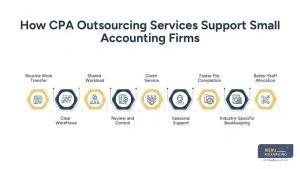
Seasonal Support
CPA outsourcing Services can provide extra capacity during tax season and other busy periods. This can reduce pressure on in-house staff when several client files need work at the same time.
Faster File Completion
An outside bookkeeping team can work on assigned files based on agreed deadlines. Regular progress updates can keep books ready for CPA review and reduce delays in tax and reporting work.
Industry-Specific Bookkeeping
Outsourced bookkeeping for CPAs can support firms serving clients across industries with different bookkeeping requirements and reporting needs. An experienced outside team can follow client-specific rules for areas such as real estate, retail, construction, or professional services.
Better Staff Allocation
Outsourcing routine bookkeeping can allow internal employees to focus on tasks that need more accounting knowledge. Staff can spend more time on tax preparation, financial review, client meetings, and advisory work.
Key Benefits of Outsourced Bookkeeping for CPAs
Lower Staffing Cost
An outside team may cost less than adding a full-time employee, depending on the work scope and service model. The right comparison should include wages, benefits, software, training, management time, and office costs.
More Staff Time
Outsourced bookkeeping for CPAs can take recurring work off the firm’s internal task list. Staff can then focus on tax work, review, planning, and client needs.
Flexible Capacity
A firm can choose a monthly service level based on its client list. Work can also be adjusted when the number of files changes.
Access To Skilled Staff
CPA outsourcing services may give firms access to accounting professionals with experience across different client types and accounting systems. Firms should still check training, experience, and quality controls before signing an agreement.
Better Turnaround
A defined workflow can keep books on a set schedule. Regular work may reduce the pile of unfinished files that often grows during busy periods.
Potential Challenges of Outsourcing Bookkeeping for CPAs
Quality Risk
Poor bookkeeping can create extra work for the CPA firm. A clear review process, sample checks, and error tracking can reduce this risk.
Data Security
Client financial data must be handled with care. Firms should check access controls, user rights, data storage, backup rules, and security policies before sharing records.
Communication Gaps
Communication becomes especially important when using outsourced bookkeeping for CPAs. Written instructions and a named point of contact can help the external team follow client-specific requirements.
Loss Of Direct Control
Some owners worry that work outside the office may be harder to monitor. A task list, deadline chart, review log, and regular status report can keep the firm informed.
Client Acceptance
Some clients may prefer an in-house team. The CPA firm should explain who performs the work and who remains responsible for review and client service.
How Much Can Small CPA Firms Save With Outsourced Bookkeeping?
Compare Full Employment Cost
Outsourced bookkeeping for CPAs can provide an alternative to carrying these ongoing employment costs internally. A fair comparison should include wages, payroll taxes, benefits, paid leave, hiring costs, training, software, equipment, and office space.
Use a Simple Cost Model
Suppose a firm spends $55,000 a year on direct employee pay. After adding payroll costs, benefits, software, training, and other costs, the true annual cost can be much higher.
CPA outsourcing services offered at a fixed monthly fee may cost less, but the result depends on the scope, transaction volume, and service requirements.
Check Current Wage Data
The U.S. Bureau of Labor Statistics reports a May 2024 median annual wage of $49,210 for bookkeeping, accounting, and auditing clerks. That figure is a useful starting point, but it does not represent the full employer cost of a staff member.
Measure Time Saved
A better test is to track hours spent on routine books before adopting outsourced bookkeeping for CPAs. If 100 client files require large amounts of recurring work, even a small time saving per file can add up across the year.
Consider Revenue Capacity
Cost savings are only part of the case. If freed staff time allows a CPA to take on higher-value work, the added revenue may matter more than the bookkeeping fee itself.
How To Decide If Outsourcing Is Worth It
Review Your Client Mix
Look at the number of bookkeeping clients, transaction volume, accounting systems, and month-end needs. A firm with many routine files may gain more value from outsourced bookkeeping for CPAs than a firm with only a few complex books.
Check Internal Hours
Track how many hours staff spend on transaction entry, reconciliations, corrections, and monthly close work. Use actual time rather than estimates.
Set Quality Rules
Before outsourcing, define coding rules, close dates, review steps, file naming, communication rules, and correction timelines.
Start With a Small Group
A pilot with a few client files can show whether the provider’s CPA outsourcing services meet your quality and turnaround needs. The firm can adjust the workflow before moving more work.
Review the Results
After the pilot, compare cost, hours saved, error rates, turnaround, and staff feedback to determine whether outsourced bookkeeping for CPAs is delivering the expected value.
Why Choose Meru Accounting for Outsourced Bookkeeping?
Small CPA firms need a bookkeeping partner that can manage routine work while following their existing processes. Meru Accounting provides outsourced bookkeeping for CPAs with a focus on accurate records, timely work, and clear communication. Our team can handle recurring bookkeeping tasks based on each firm’s needs and workflow.
Dedicated Bookkeeping Support
Meru Accounting provides trained accounting professionals who can manage daily bookkeeping tasks for CPA firms and their clients. The work can include transaction recording, bank reconciliation, accounts payable, accounts receivable, and month-end bookkeeping.
Flexible Service Plans
Every CPA firm has a different client base and workload. Meru Accounting can provide bookkeeping support based on the number of clients, transaction volume, and required services rather than forcing every firm into the same work model.
Process-Based Work
Our team follows defined work steps for data entry, account reconciliation, reporting, and issue tracking. Clear processes make it easier for CPA firms to monitor work and review completed files.
Cost-Effective Support
Hiring an in-house bookkeeper can add salary, benefits, training, software, and other staff costs. Outsourced bookkeeping for CPAs can help small firms manage bookkeeping costs while gaining access to trained accounting staff without adding full-time payroll expenses.
Support For Growing Firms
As a CPA firm’s client list grows, bookkeeping work can also increase. Meru Accounting can provide additional bookkeeping capacity so firms can manage more work without relying only on internal hiring.
Our Expert Perspective
From our experience at Meru Accounting, small CPA firms often face the same issue: bookkeeping work takes up staff time that could be used for tax, review, and client advisory work. The problem becomes more visible when several client files need attention at the same time.
Outsourced bookkeeping for CPAs works best when firms first identify which routine tasks can be handled effectively by an outside team. Routine entries, reconciliations, and month-end work are often good starting points, while complex accounting decisions and final review can remain with the CPA firm.
We also recommend starting with a clear workflow and a small group of client files. This gives the firm a chance to check accuracy, turnaround time, communication, and overall fit before moving more work outside.
Key Takeaways
- Outsourced bookkeeping for CPAs can add capacity without a large internal hire.
- Small firms should compare total employment cost, not salary alone.
- Bookkeeping work can include entries, reconciliations, payables, receivables, and reports.
- CPA outsourcing Services can move routine work away from CPA staff.
- The CPA firm should keep review and client responsibility under its control.
- Security, communication, and quality checks should be set before work starts.
- A small pilot can test the provider before wider use.
- Savings should be measured through cost, hours, quality, and added revenue.
- Good records remain important for tax and financial reporting.
- Outsourcing is most useful when the work scope is clear and repeatable.
FAQs
Yes, it can be worth it when routine bookkeeping takes too much staff time. The best choice depends on client volume, cost, quality, and the firm’s need for extra capacity.
It may include transaction entry, bank reconciliation, accounts payable, accounts receivable, month-end work, and basic financial reports. The exact scope depends on the service agreement.
Yes, some firms can lower costs by avoiding full-time hiring and related expenses. Savings depend on workload, employee cost, provider fees, and the amount of work moved outside.
It can be safe when the provider uses strong access controls, secure systems, backups, and clear data rules. CPA firms should check the provider’s security process before sharing client records.
Not always. A firm may outsource routine tasks while keeping review, complex accounting, client advice, and final decisions in-house. A small pilot can show which tasks fit best.
optional anymore
on running the business