
Outsourced finance and accounting is becoming more common among USA-based CPA firms, but many firms still ask the same question: Is it safe? The short answer is yes—outsourced finance and accounting can be safe if the CPA firm chooses the right partner, follows strong security steps, and stays compliant with U.S. regulations.
Many CPA firms are now using outsourcing to manage heavy workloads, improve accuracy, and reduce costs. However, safety concerns such as data privacy, compliance, and quality of work remain the top questions.
In this blog, we will explain how CPA firms can safely use finance outsourcing services without risking data, client trust, or compliance.
What You Will Learn From This Blog
By the end of this blog, you will learn:
- What outsourced finance and accounting means and how it works for CPA firms
- Why CPA firms are choosing finance outsourcing services, including the benefits and reasons behind this trend
- What risks CPA firms face when outsourcing, such as data security and compliance issues
- How to keep client data safe when sharing information with an outsourcing partner
- Which compliance rules CPA firms must follow, including IRS and data protection requirements
- Best practices for secure outsourcing, including steps to protect data and maintain quality
- How to choose a reliable outsourcing partner, including what to look for in a vendor
- Real-life examples of safe outsourcing, showing how CPA firms have successfully outsourced without risk
What Is Outsourced Finance and Accounting?
Outsourced finance and accounting means hiring an external team to handle accounting tasks instead of doing them in-house. These tasks can include bookkeeping, payroll, tax filing support, financial reporting, bank reconciliation, and more.
For CPA firms, outsourcing can help manage workload, reduce costs, and improve accuracy. Outsourcing does not mean giving away control. Instead, it means partnering with a trusted provider who follows the CPA firm’s rules and standards.
In many cases, outsourced finance and accounting also includes technology support and process improvement. This means the outsourcing partner can help CPA firms implement better accounting systems, improve workflows, and provide faster financial reporting.
As a result, CPA firms can deliver better service to their clients while keeping operations smooth and efficient.
Why CPA Firms Are Considering Outsourced Accounting and Finance
CPA firms are increasingly looking for outsourced finance and accounting because they offer several benefits:
More Time for Client Work
Outsourcing removes the burden of routine tasks, letting staff focus on higher-value services like tax planning and consulting.
Lower Operating Costs
Hiring in-house staff for every task can be expensive. Outsourced finance and accounting help reduce overhead and payroll costs.
Access to Skilled Professionals
Outsourcing firms often have specialized teams trained in accounting rules and systems.
Better Technology and Tools
Outsourcing firms use modern accounting software, which can improve accuracy and reporting.
Why USA-Based CPA Firms Outsource Finance and Accounting
USA-based CPA firms choose outsourced finance and accounting for several strong reasons:
Managing Workload During Busy Seasons
During tax season, CPA firms often face heavy workloads. Outsourced finance and accounting help handle routine tasks so staff can focus on urgent client needs.
Handling Complex Client Needs
Some clients require ongoing bookkeeping or financial reporting. Outsourcing can help manage these tasks without overloading internal teams.
Reducing Staffing Gaps
When staff are unavailable due to leave or turnover, outsourcing provides a steady support system.
Scaling Operations
CPA firms can grow faster when they use finance outsourcing services, because they can handle more clients without hiring more staff.
Key Risks of Finance Outsourcing Services
Even though outsourcing is useful, CPA firms must be aware of risks. Here are the key risks:
Data Security Risks
Client financial data is very sensitive and must stay protected. If the outsourced finance and accounting partner has weak security, data can leak.
Compliance Risks
CPA firms must follow IRS rules, GAAP standards, and other regulations. If the outsourcing partner is not compliant, the firm can face penalties.
Quality and Accuracy Risks
If the outsourcing team lacks proper training, mistakes can happen in financial reports or tax records.
Control and Oversight Risks
Some CPA firms worry that outsourcing will reduce control over client work. Without clear rules, this can happen.
Communication and Timing Risks
If the outsourcing partner does not respond quickly or misses deadlines, the CPA firm can face client dissatisfaction.
How CPA Firms Can Ensure Safety While Outsourcing
To make sure outsourced finance and accounting is safe, CPA firms must take proactive steps. Here are the best safety steps:
Choose a Partner with Strong Security
Check whether the partner uses strong security measures like encryption, secure login, and multi-factor authentication (MFA).
Set Clear Access Rules
CPA firms should limit access to client data. Only allow team members who need it.
Use Secure File Sharing
Avoid email when sharing sensitive client files or documents with your outsourced finance and accounting partner. Use secure portals or encrypted transfer systems for sharing.
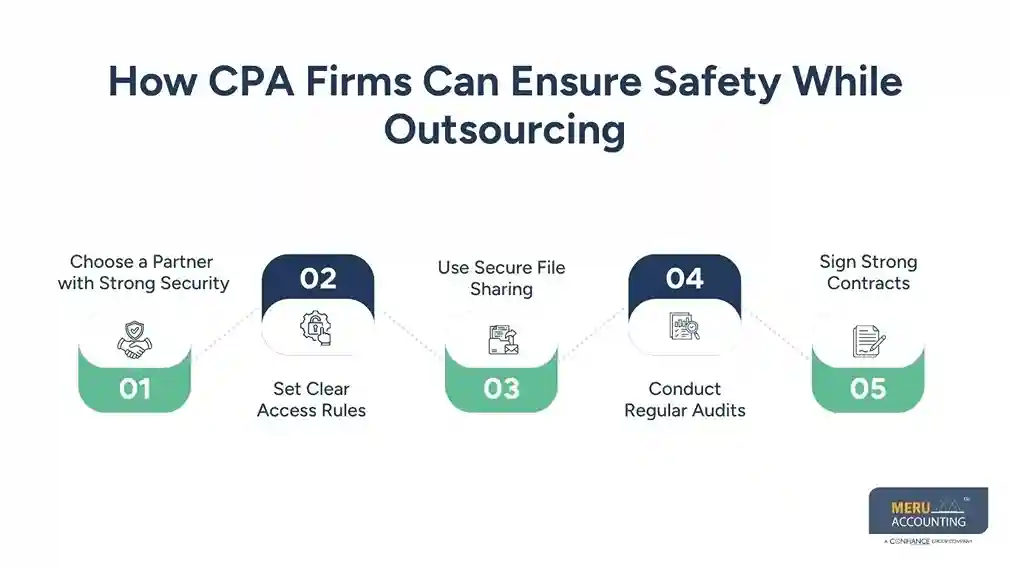
Conduct Regular Audits
CPA firms should regularly review the outsourcing partner’s work for accuracy and compliance.
Sign Strong Contracts
Contracts should include data protection rules, confidentiality, and clear service standards.
Compliance Requirements for Outsourced Accounting and Finance
Compliance is a major concern for CPA firms. Here are key compliance areas:
IRS Rules
CPA firms must follow IRS guidelines, especially for tax data. The outsourcing partner should be trained in IRS rules.
GAAP Standards
Financial reports must follow GAAP rules. The outsourcing partner must understand GAAP requirements.
Client Confidentiality
CPA firms must protect client data. The outsourcing partner must sign non-disclosure agreements (NDAs) and follow strict privacy rules.
Data Protection Laws
CPA firms must follow laws like the Gramm-Leach-Bliley Act (GLBA) and other privacy rules. The outsourcing partner must also comply.
Best Practices for Secure Finance Outsourcing Services
Here are the best practices CPA firms should follow:
Use Innovative Technology
Choose partners who use secure accounting software, cloud systems, and strong cybersecurity.
Train Internal Staff
Train your internal staff on how to manage outsourcing relationships and handle data securely.
Set Clear Work Standards
Create a detailed workflow for the outsourcing team, including deadlines, review steps, and reporting rules.
Review Work regularly
Do regular checks for accuracy and compliance. This helps avoid mistakes and build trust.
Maintain Open communication
Regular meetings and clear updates help prevent misunderstandings and ensure work stays on track.
How to Choose a Reliable Outsourced Finance and Accounting Partner
Choosing the right partner is the most important step. Here are key factors:
Strong Reputation
Check reviews, client testimonials, and case studies.
Security Standards
Ensure the partner uses strong security, including encryption, MFA, and secure systems.
Industry Experience
Choose a partner who has experience working with CPA firms and understands accounting rules.
Clear Pricing
Make sure the partner offers clear pricing and no hidden costs.
Strong Communication
The partner should respond quickly and provide regular updates.
Real-Life Examples: Safe Outsourcing Success Stories
Example 1: Busy CPA Firm During Tax Season
A CPA firm in Texas used finance outsourcing services for bookkeeping and payroll. The outsourcing partner followed strict security rules and completed work on time. The firm was able to focus on tax filings and client support, improving client satisfaction.
Example 2: Mid-Sized CPA Firm with Many Clients
A mid-sized firm in Florida used outsourced accounting for monthly reporting. The outsourcing team was trained in GAAP standards and followed strict review steps. The firm improved reporting accuracy and reduced workload.
Why Meru Accounting Is a Safe Choice for CPA Firms
When CPA firms need reliable finance outsourcing services, Meru Accounting is a trusted partner. Here’s why:
Strong Security Standards
Meru Accounting uses secure systems, strict access controls, and data protection rules to keep client data safe.
Experienced Accounting Team
Our team has strong knowledge of U.S. accounting rules, tax laws, and financial reporting standards.
Clear Communication
We provide regular updates, timely responses, and clear reports so CPA firms stay in control.
Flexible Services
We offer scalable services, allowing CPA firms to grow without adding internal staff.
Quality and Accuracy
Our work is reviewed and audited for accuracy, ensuring strong results and fewer errors.
Key Takeaways
- Outsourced finance and accounting can be safe if CPA firms choose the right partner.
- CPA firms can benefit from reduced workload, lower costs, and skilled teams.
- Key risks include data security, compliance, and quality issues.
- CPA firms must follow strong safety steps and compliance rules.
- Choosing a reliable partner like Meru Accounting helps ensure safety and quality.
FAQs
Yes, it can be safe if the outsourcing partner uses strong security, follows compliance rules, and has good quality checks.
CPA firms can outsource bookkeeping, payroll, financial reports, bank reconciliation, and tax support tasks.
CPA firms should use secure systems, limit access, use secure file sharing, and sign strong contracts.
Look for strong security, good reviews, experience with CPA firms, clear pricing, and strong communication.
Yes, outsourcing helps reduce routine work, so staff can focus on client support and high-value tasks.