
The finance industry is going through a major shift. Firms are now managing more portfolios, more investors, and more reporting demands than ever before. This growth has made traditional accounting setups harder to maintain and scale. At the same time, technology has stepped in to simplify complex financial work. One of the most important tools driving this change is portfolio accounting systems. These systems help firms track investments, monitor performance, and manage financial data in one structured place.
But something interesting is happening in the market. Even as firms adopt portfolio accounting systems, many are choosing to outsource accounting and tax functions instead of keeping everything in-house. This is not a cost-cutting trend alone. It reflects a deeper operational shift in how modern finance teams are built.
In this blog, we will explore why this shift is happening, how firms are benefiting from it, and why combining technology with outsourcing is becoming the new standard.
What You Will Learn From This Blog
In this blog, you will learn:
- What portfolio accounting systems are and why they matter
- The meaning of what is portfolio accounting system in practical use
- How these systems improve financial control and reporting
- Why firms are moving away from full in-house accounting teams
- Why outsourcing accounting and tax functions is growing
- How technology and outsourcing work together in modern finance
What Is Portfolio Accounting System and Why Does It Matter Today?
To understand this shift, we first need to clearly define what is portfolio accounting system in real business terms.
A portfolio accounting system is a finance tool that tracks all investments, trades, and performance data across one or more portfolios. It gives firms a clear view of financial activity instead of relying on many spreadsheets or separate systems.
In simple terms, it serves as one trusted source for portfolio financial data.
Modern firms handle large numbers of transactions each day. These may include trades, fees, dividends, cash flows, and value changes. Without automation, managing this data becomes slow and more likely to lead to mistakes.
This is why portfolio accounting systems have become essential. They help firms:
- Track portfolio performance in real time
- Record and reconcile financial transactions
- Generate accurate reports for clients and investors
- Maintain audit-ready financial records
- Support regulatory compliance requirements
As firms grow, these systems become the backbone of financial operations. However, even with strong systems in place, they do not eliminate the need for accounting expertise.
How Portfolio Accounting Systems Improve Financial Visibility Across Firms
One of the biggest benefits of portfolio accounting systems is getting a better view of firm finances. In the past, firms often worked with data that was spread across many places. Different teams used different tools, and reports were made manually. This led to delays and gaps in financial reports.
Now, with one connected system, firms can see a full view of their finances right away.
Real-Time Financial Tracking
Firms can track portfolio activity as it takes place. This cuts delays and helps teams make better choices.
Unified Data Across Portfolios
All financial data is kept in one system. This cuts repeat work and helps reduce report errors.
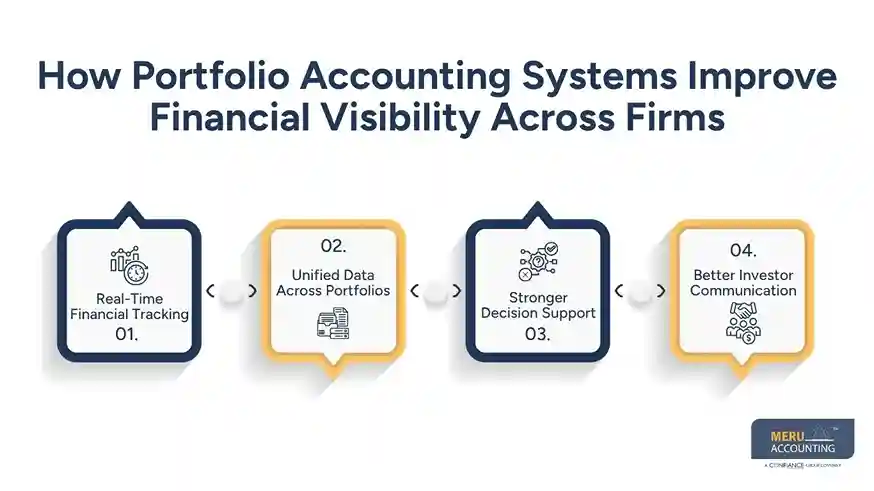
Stronger Decision Support
When data is correct and up to date, firm leaders can make better choices about investments and day-to-day operations.
Better Investor Communication
Clients expect reports that are clear, on time, and accurate. These systems make it easier to provide steady and reliable reports.
Even with a better view of finances, firms still face challenges with rules, tax work, and data review. This is where outsourcing can add real value.
Why Firms Using Portfolio Accounting Systems Are Rethinking In-House Accounting
At first glance, it may seem like portfolio accounting systems reduce the need for large accounting teams. While these systems automate data handling, they do not replace financial expertise.
Instead, they change the type of work required from accounting teams.
Many firms now face increasing pressure in areas such as:
- Multi-jurisdiction tax compliance
- Regulatory reporting requirements
- Investor-level financial transparency
- High transaction volumes across portfolios
- Faster reporting deadlines
In-house teams often become overloaded with routine work like reconciliations, data checks, and report preparation. This leaves less time for strategic financial analysis.
As a result, firms using portfolio accounting systems are rethinking their internal structure. They are realizing that systems should manage data, while experts should handle accounting judgment, compliance, and tax strategy.
This is leading to a major shift toward outsourcing models.
Top Reasons Firms Are Outsourcing Accounting and Tax Functions
The growth of portfolio accounting systems has helped drive the rise of outsourcing. Below are the main reasons for this shift.
Cost Control and Steady Planning
Running a full in-house accounting team is costly. Payroll, benefits, training, and software costs keep going up.
Outsourcing helps firms shift these fixed costs to flexible costs. They now need to pay only for the services they use, which helps with budget planning.
Access to Skilled Support
Tax laws and accounting rules are complex and change all the time. It can be hard for in-house teams to stay current on every update.
External experts bring strong taxation and reporting skills, which help cut risk and improve accuracy.
Lower Risk of Compliance Issues
Mistakes in tax work or reports can lead to fines and audits. This is one of the biggest risks for finance teams.
Outsourcing firms focus on regulations and stay up to date with changes, helping firms stay on track and avoid issues.
Growth Without Hiring Pressure
As firms grow, accounting work rises fast. Hiring and training new staff takes time and money.
Outsourcing helps firms grow right away without adding more in-house staff.
Better Focus on Core Work
When portfolio accounting systems handle data and outsourcing handles accounting tasks, in-house teams can focus on planning, investor support, and business growth.
This split of work helps teams work better across the firm.
How Portfolio Accounting Systems and Outsourcing Work Together
Many firms assume that they need to choose between technology and outsourcing. But, in reality, the best results often come when both of them are present.
Portfolio accounting systems handle:
- Transaction recording
- Portfolio tracking
- Data aggregation
- Performance reporting
Outsourced accounting and tax teams handle:
- Financial statement preparation
- Tax planning and filing
- Regulatory compliance
- Audit support and documentation
This combination creates a balanced financial ecosystem. Systems ensure speed and accuracy in data, while experts ensure correctness in interpretation and compliance.
Firms using both approaches often experience faster reporting cycles and fewer financial errors.
Why Firms Using Portfolio Accounting Systems Are Moving Toward Hybrid Finance Models
A growing number of firms are adopting a hybrid finance model.
In this model:
- Technology manages financial data
- Outsourced experts manage accounting and tax work
- Internal teams focus on strategy and decision-making
This model is becoming popular because it offers flexibility and control.
Key benefits include:
- Lower operational overhead
- Faster financial reporting
- Reduced dependency on large internal teams
- Better compliance outcomes
- Improved scalability during growth phases
Instead of building large finance departments, firms are building lean and flexible structures supported by external expertise.
Meru Accounting Portfolio Accounting Services
As firms adopt portfolio accounting systems, many need support to manage accounting and tax functions effectively. Meru Accounting provides specialized services designed for this exact need.
Meru Accounting works with firms that already use portfolio accounting systems and helps them improve financial efficiency without adding internal workload.
Services include:
- Portfolio-based accounting support
- Multi-entity bookkeeping and reconciliation
- Tax preparation and filing services
- Monthly, quarterly, and annual reporting support
- Compliance tracking and documentation
- Financial data alignment across portfolios
The goal is simple: help firms reduce internal pressure while improving accuracy and compliance.
By combining portfolio accounting systems with outsourced expertise from Meru Accounting, firms can operate with greater efficiency and fewer financial bottlenecks.
Key Takeaways
- Portfolio accounting systems help firms track investments, trades, and portfolio results in one place.
- Firms use portfolio accounting systems to get a clear view of money data, improve reports, and cut manual work.
- Even with strong systems, firms still need skilled help for tax work, reports, and rule needs.
- Outsourcing helps cut costs, lower risk, and give firms access to skilled accounting and tax experts.
- Outside accounting teams help firms grow without the need to hire and train large in-house teams.
- A mix of portfolio accounting systems and outsourced accounting help can improve speed, accuracy, and control.
- Firms can spend more time on clients, growth plans, and fund goals when day-to-day accounting tasks are handled by experts.
FAQs
A portfolio accounting system is used to track and manage money data across many investment portfolios. It helps firms track gains, trades, and reports in one place.
They are important because they improve accuracy, cut hand work, and give firms a real-time view of fund results.
Even with portfolio accounting systems, firms still need skilled help for tax rules, report quality, and finance plans. Outsourcing helps fill this need.
In many cases, outsourcing is not taking the place of in-house teams. Instead, firms use a mix of systems and outside experts to handle accounting tasks.
The main benefits are lower costs, better rule support, access to skilled staff, faster reports, and easier firm growth.