Prepaid real estate taxes accounting is important for property owners who pay real estate taxes before the related tax period. A payment made early does not always mean the full amount can be claimed as a tax deduction in the year of payment. The right treatment depends on the tax rules, accounting method, property use, and period covered by the payment.
For cash-method taxpayers, expenses are generally deducted when paid, but the IRS has rules for expenses paid in advance. An advance payment may need to be assigned to the period it covers unless a special rule, such as the 12-month rule, applies.
Accurate prepaid real estate taxes accounting keeps book records clear and organized. A property owner should know what was paid, which property was involved, what tax period the payment covers, and when the amount may be treated as an expense.
What You Will Learn From This Blog
- An understanding of how prepaid real estate taxes accounting works and why accurate records matter.
- The key reasons why payment dates and tax periods can affect deduction timing.
- A clear view of how cash and accrual accounting methods affect property tax treatment.
- The conditions under which a prepaid property tax deduction may be allowed.
- The correct way to record prepaid real estate tax payments in accounting records.
- Common mistakes that can lead to incorrect accounting or tax reporting.
What Is Prepaid Real Estate Taxes Accounting?
Meaning Of Prepaid Real Estate Taxes
Prepaid real estate taxes accounting covers the recording and review of property tax payments made before the related period. The payment may be recorded as a prepaid amount when the cost relates to a future period.
Why Timing Matters
Tax deductions are tied to specific rules. A taxpayer should not assume that paying a bill early always creates an immediate deduction for the full amount.
Bookkeeping Records And Tax Records
Accurate property tax bookkeeping keeps financial records correct, while tax rules determine what can be reported on the tax return. The accounting entry and tax deduction may not always occur in the same year, so both records should be reviewed before filing.
Property Tax Example
Suppose an investor pays $6,000 for property taxes in December, but the payment relates to a later period. The owner should review the tax bill and accounting method before treating the full $6,000 as a current expense.
Why Clear Records Matter
Accurate prepaid real estate taxes accounting records should show the property, amount paid, payment date, tax period, and tax bill. Clear documentation creates a traceable record from the bank payment to the accounting entry and tax return.
How Does Prepaid Property Tax Accounting Work?
Review The Tax Bill
Start with the actual tax bill before making the accounting entry. Check the amount, property address, tax period, due date, and payment date.
Identify The Accounting Method
Prepaid real estate taxes accounting can differ based on whether the taxpayer uses cash or accrual accounting. The IRS says cash-method taxpayers generally deduct expenses when paid, while accrual taxpayers generally deduct expenses when incurred, subject to specific rules.
Record The Payment
If the payment relates to a future period and must be deferred, record it in a prepaid tax account instead of charging the full amount to current tax expense.
Track The Tax Period
The tax period is central to prepaid property tax deduction work. A payment made in December may relate to a different period, so the payment date should not be the only factor reviewed.
Reclassify The Amount
When the related period arrives and the expense becomes deductible under the applicable rules, the prepaid balance can be moved to the proper expense account.
Keep Supporting Records
Keep the tax bill, receipt, bank statement, property ledger, and payment proof. These records make prepaid real estate taxes accounting easier to review at year-end.
optional anymore
on running the business
When Is A Prepaid Property Tax Deduction Allowed?
Cash-Method Taxpayers
Cash-method taxpayers generally deduct expenses in the year they pay them. However, the IRS states that an expense paid in advance may need to be deducted in the year to which it applies unless the 12-month rule applies.
Accrual-Method Taxpayers
Accrual accounting generally records expenses when the liability is incurred, rather than simply when cash is paid. Property tax payments can have specific economic-performance rules, so the facts need to be reviewed.
The 12-Month Rule
The IRS 12-month rule can allow certain advance payments to be deducted without capitalization when the required conditions are met. The rule does not apply to every prepaid cost.
Personal Property
For an individual homeowner, a prepaid property tax deduction must meet the rules for deductible real estate taxes. The IRS says deductible real estate taxes must be imposed on the taxpayer and paid either at closing or to the taxing authority.
Rental Property
For rental property owners, prepaid real estate taxes accounting helps distinguish between property tax payments that may be currently deductible and amounts that require different tax treatment. The IRS notes that rental expenses are generally deducted in the year paid for cash-basis taxpayers.
SALT Limits
Individual taxpayers should also review the state and local tax deduction limit. For 2025 returns, the IRS lists an overall $40,000 SALT limit, subject to additional rules and income-based limits.
How Tax Deduction Timing Works For Prepaid Real Estate Taxes
Payment Date
The payment date is important, but it does not answer every tax question. Prepaid real estate taxes accounting requires the owner to look at what the payment covers and which rules apply.
Tax Period
The tax period tells you what the property tax relates to. A bill paid in one year may relate partly or fully to another period, which can change the timing of the deduction.
Cash-Basis Example
Assume an investor pays $5,000 in December for property taxes. The payment should first be reviewed to determine whether the amount is a current deductible expense or an advance payment that may be subject to a timing rule.
Accrual-Basis Example
An accrual taxpayer generally considers when the liability is fixed and when the applicable economic-performance rule is met. Paying the bill early does not automatically decide the deduction date.
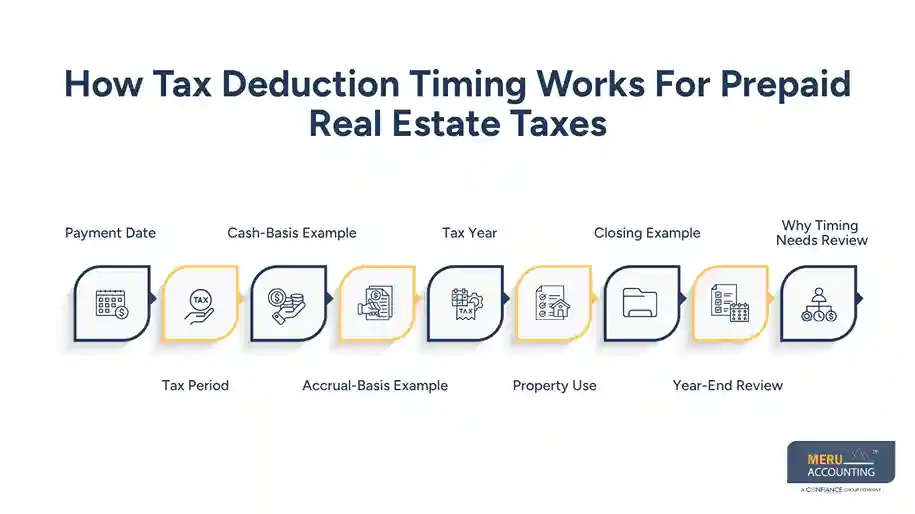
Tax Year
The tax year is a key part of prepaid real estate taxes accounting because the deduction must be assigned to the proper year under the applicable tax rules. Reviewing the payment date along with the period covered by the tax bill can prevent timing errors.
Property Use
The use of the property can affect how taxes are treated for tax purposes. Personal, rental, and business properties may have different reporting rules, so the property type should be confirmed before claiming a prepaid property tax deduction.
Closing Example
Real estate taxes paid at closing can require an allocation between the buyer and seller. IRS guidance generally treats the seller as paying taxes up to the sale date and the buyer as paying taxes from the sale date.
Year-End Review
A year-end review of prepaid real estate taxes accounting should compare tax bills, payment records, property details, and the remaining prepaid balance. The review can show whether any amount needs to remain prepaid or be moved to an expense account.
Why Timing Needs Review
A prepaid property tax deduction should be based on the actual tax facts, not only on the bank transaction date. Reviewing the bill, ownership period, accounting method, and property use gives a stronger basis for the tax treatment.
How To Record Prepaid Real Estate Taxes In Accounting
Debit The Prepaid Tax Account
When future-period treatment applies, prepaid real estate taxes accounting may require a debit to a prepaid tax asset. The amount should agree with the payment and supporting tax bill.
Credit The Bank Account
The bank or cash account is credited for the amount paid. The entry should match the actual payment shown in the bank records.
Track Each Property
Property owners with several assets should keep separate tax records for each property. Property-level tax tracking makes it easier to spot errors, review tax costs, and confirm that each payment is linked to the correct property and tax period.
Reclassify Future Expense
When the amount becomes an expense under the applicable accounting treatment, the prepaid balance can be transferred to the property tax expense account.
Reconcile At Year-End
Year-end prepaid real estate taxes accounting should include a review of all prepaid balances. Each remaining balance should have a clear tax bill and explanation.
Match Books And Tax Records
Bookkeeping records should be compared with tax work before the return is completed. A book expense does not automatically mean that the same amount is available as a tax deduction.
Common Mistakes With Prepaid Property Tax Deductions
Deducting Every Early Payment
One common error is treating every payment made before year-end as a current deduction. The prepaid property tax deduction must follow the rules that apply to the taxpayer and payment.
Ignoring The Accounting Method
Cash and accrual methods can produce different timing results. Prepaid real estate taxes accounting should therefore begin by confirming the accounting method used for tax purposes.
Mixing Property Accounts
Combining taxes for personal and rental properties can create unclear records. Each property should have its own tax detail where needed.
Missing SALT Limits
A taxpayer may qualify for a real estate tax deduction but still face the SALT limit. For 2025 returns, the IRS states that the overall limit is $40,000, with special rules for higher-income taxpayers.
Ignoring Closing Statements
Property purchased or sold during the year may require a tax allocation between the buyer and seller. The closing statement can contain key information for the prepaid property tax deduction.
Losing Payment Proof
A bank statement may show that money was paid but may not explain the tax period. Keep the tax bill and payment receipt with the accounting records.
How Meru Accounting Can Help With Property Tax Records
Property-Level Bookkeeping
Meru Accounting can organize prepaid real estate taxes accounting by property, entity, and period. Clear records make it easier to review property tax balances and related transactions.
Prepaid Balance Review
Our team can review prepaid tax accounts during monthly and year-end close work. The review can identify old balances, missing documents, and entries that need attention.
Tax-Ready Records
Meru Accounting can organize tax bills, payment records, property ledgers, and related documents. Better records give tax professionals a clear base for return preparation.
Multi-Property Tracking
Owners with several rental properties may have tax bills with different due dates and tax periods. Prepaid real estate taxes accounting can keep those payments tied to the correct property.
Review Of Deduction Timing
Our accounting team can flag transactions that may need tax review before they are treated as deductions. A prepaid property tax deduction should be supported by the facts and current tax rules.
Our Expert Perspective
Our experience with real estate accounting shows that many timing issues start with unclear property records. Strong prepaid real estate taxes accounting begins by linking each tax bill to the right property, payment date, tax period, and accounting method.
Year-end review should confirm that prepaid balances match the related bills and that amounts are not recorded or claimed in the wrong tax year. Clear records should also separate bookkeeping treatment from tax decisions, since the accounting entry does not always decide the tax deduction.
Keeping tax bills, payment receipts, bank records, property ledgers, and year-end reconciliations together creates a clear audit trail, while large or unusual advance payments should receive extra review before the books and tax return are finalized.
Key Takeaways
- Prepaid real estate taxes accounting tracks property tax payments made before their related period.
- The payment date does not always determine the tax deduction date.
- Cash-method and accrual-method taxpayers can have different timing rules.
- Advance payments may be subject to special rules.
- The IRS 12-month rule can apply to certain qualifying advance payments.
- A prepaid property tax deduction should be checked against the taxpayer’s facts.
- Personal and rental property taxes should be kept separate.
- SALT limits can affect an individual’s deductible property taxes.
- Tax bills, receipts, bank records, and closing statements should be retained.
- Prepaid real estate taxes accounting should be reviewed before year-end tax filing.
- Professional tax advice is useful for large, unusual, or complex property tax payments.
FAQs
Prepaid real estate taxes accounting records property tax paid in advance and determines whether the amount is treated as a current expense or prepaid cost based on tax and accounting rules.
A prepaid property tax deduction may be allowed in the payment year for some taxpayers, but the result depends on the accounting method, property use, advance-payment rules, and applicable tax limits.
The IRS generally applies different timing rules to cash and accrual taxpayers, while certain advance payments may be subject to specific rules that affect when the deduction is allowed.
Prepaid property taxes for rental properties may be deductible when the applicable tax rules are met, but the timing depends on the property’s use, accounting method, and nature of the payment.
A prepaid property tax is an amount paid before its related period, while property tax expense is the amount recognized for the period under the applicable accounting and tax rules.
optional anymore
on running the business