
The qualified business income deduction allows eligible U.S. business owners to deduct up to 20% of their qualified business income from federal taxable income. Introduced under Section 199A, this tax benefit applies to eligible sole proprietors, partnerships, LLC owners, and S corporation shareholders. It can reduce the amount of income subject to federal income tax without changing the business structure.
However, eligibility depends on business type, taxable income, employee wages, and the nature of business activities. The QBI deduction for S corporations also follows specific rules for shareholder salaries and business profits. Understanding these requirements is essential to avoid incorrect claims and missed tax benefits.
What You Will Learn From This Blog
- How Section 199A works and which income qualifies.
- Who can claim the qualified business income deduction.
- How the QBI deduction for S corporations works.
- How to calculate the deduction using business income.
- How income limits and W-2 wages affect eligibility.
- Which IRS forms are required to claim the deduction.
- Common eligibility mistakes and ways to avoid them.
What is the Qualified Business Income Deduction and How Does It Work?
Understanding Section 199A
Section 199A allows eligible taxpayers, including qualifying S corporation shareholders, to claim the QBI deduction for S corporations of up to 20% of qualified business income. The qualified business income deduction reduces taxable income rather than business profit. It generally applies to individuals and certain trusts and estates, not C corporations.
What Income Qualifies?
Eligible income generally includes domestic business profits, ordinary gains, and certain business-related income after allowable deductions. Capital gains, dividends, and most investment income are excluded from the calculation.
How the 20% Rule Works
Suppose a business owner earns $100,000 in eligible QBI. The initial calculation allows a $20,000 deduction, subject to the taxable income limit and other applicable rules.
Which Business Structures Qualify?
Sole proprietorships, partnerships, eligible LLCs, and S corporations can generate qualifying income. The business’s tax classification matters more than its legal name.
Is the Deduction Permanent?
The 2025 federal tax law made Section 199A permanent. For 2026, eligible taxpayers can continue claiming the qualified business income deduction. A minimum deduction of $400 is also available to qualifying taxpayers with at least $1,000 of QBI from businesses in which they materially participate.
optional anymore
on running the business
Who Qualifies for the Qualified Business Income Deduction?
Sole Proprietors and Single-Member LLCs
Sole proprietors may qualify when they earn eligible income from a domestic trade or business. Single-member LLCs taxed as sole proprietorships generally follow the same rules.
Partnership and Multi-Member LLC Owners
Partners and eligible LLC members may claim a deduction based on their share of qualifying income. Their Schedule K-1 reports the relevant business income and tax details.
S Corporation Shareholders
Eligible shareholders may claim the qualified business income deduction on their individual returns. The corporation passes the required information through Schedule K-1.
Specified Service Businesses
Accounting, law, health, consulting, and financial service businesses may face additional restrictions as specified service trades or businesses (SSTBs). Eligibility depends on the owner’s taxable income and the applicable phase-in rules.
Business Activity Requirements
The business must generally conduct regular domestic commercial activity for profit. Employee wages do not qualify, and rental income must meet the relevant trade or business requirements.
How Does the QBI Deduction for S Corporations Work?
Shareholder Eligibility
An S corporation does not claim this personal deduction itself. Instead, it reports eligible income and related details to shareholders through Schedule K-1. Each shareholder calculates the qualified business income deduction on their own return.
Reasonable Salary Rules
Working shareholders must receive reasonable compensation for their services. Their W-2 salary is excluded from QBI, while eligible remaining business profit may qualify.
W-2 Wage Information
The QBI deduction for S corporations may be limited by employee wages when shareholder taxable income exceeds the applicable threshold. Accurate payroll records are therefore important.
Example of an S Corporation Claim
Suppose a shareholder receives $60,000 in salary and has $120,000 in eligible business profit. The salary is excluded, while the eligible $120,000 may enter the deduction calculation, subject to other limits.
Schedule K-1 Reporting
The corporation must report the required QBI, wage, and property details. Shareholders should review these figures before claiming the qualified business income deduction for S corporations to avoid reporting errors.
How to Calculate the Qualified Business Income Deduction
Identify Eligible Business Income
Start by adding eligible income from each qualified business. Subtract applicable business deductions and exclude nonqualifying items, including shareholder wages and capital gains.
Apply the 20% Calculation
Multiply eligible net QBI by 20%. For example, $150,000 in eligible income produces an initial deduction of $30,000.
Apply Wage and Property Limits
For higher-income taxpayers, the deduction is generally limited to the greater of:
- 50% of allocable W-2 wages.
- 25% of allocable W-2 wages plus 2.5% of qualified property basis.
Include REIT and PTP Income
Eligible REIT dividends and publicly traded partnership income may qualify for a separate 20% deduction calculation.
Check the Overall Income Limit
The final qualified business income deduction cannot exceed 20% of taxable income before this deduction, less net capital gain and qualified dividends.
How Do Taxable Income Limits and W-2 Wage Rules Affect the QBI Deduction?
2026 Income Thresholds
The 2026 taxable income thresholds are:
- Married filing jointly: $403,500.
- Married filing separately: $201,775.
- Other filing statuses: $201,750.
Phase-In Range
The wage and property limits apply gradually above these thresholds. The phase-in range ends at $553,500 for joint filers and $276,750 for other filing statuses, except married filing separately, for which it ends at $276,775.
Importance of Employee Wages
The QBI deduction for S corporations can depend on qualifying W-2 wages paid by the business. Payments to independent contractors do not count as W-2 wages.
Qualified Business Property
Eligible tangible property used in the business may count toward the property limit. Its unadjusted basis immediately after acquisition is used in the calculation. Land and inventory do not qualify.
SSTB Income Restrictions
Specified service businesses face additional limits as taxable income rises above the threshold. Owners must review their business classification before claiming the qualified business income deduction.
How to Claim the Qualified Business Income Deduction on Your Tax Return
Collect Required Tax Records
Gather Schedule C, Schedule K-1, business income statements, payroll reports, and qualified property details. Review income, expenses, and ownership records to ensure that all figures are correct before starting the qualified business income deduction calculation.
Identify Eligible Business Income
Separate qualifying business income from excluded items such as capital gains, dividends, and W-2 salary. If you own multiple businesses, calculate eligible income and losses for each business under the applicable IRS rules.
Choose the Correct IRS Form
Use Form 8995 if your taxable income is within the applicable threshold and you meet the other eligibility conditions. Form 8995-A generally applies when taxable income exceeds the threshold or special calculations are required.
Calculate the Initial Deduction
Multiply your eligible QBI by 20% to determine the initial deduction amount. For example, if your qualified business income is $100,000, the initial deduction is $20,000 before applying other limits.
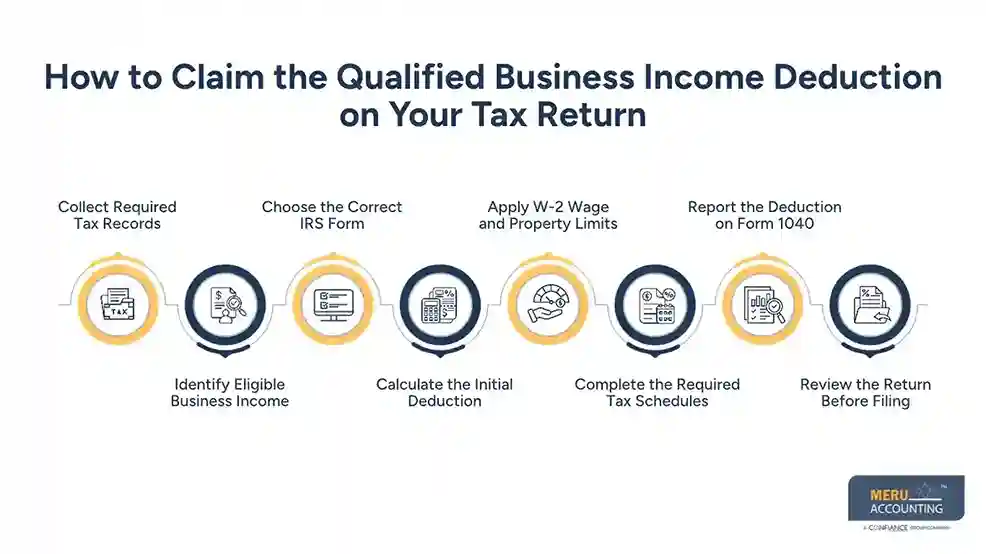
Apply W-2 Wage and Property Limits
If your taxable income exceeds the applicable threshold, calculate the W-2 wage and qualified property limits. These rules can reduce the final deduction, particularly for business owners with high taxable income.
Complete the Required Tax Schedules
Use the relevant IRS form to report eligible income, business deductions, wages, and qualified property. S corporation shareholders should also review Schedule K-1 to confirm that the QBI details match the corporation’s tax records.
Report the Deduction on Form 1040
Transfer the final qualified business income deduction to the applicable line of Form 1040. This amount reduces federal taxable income but does not reduce self-employment tax or payroll tax obligations.
Review the Return Before Filing
Check income limits, business classification, shareholder compensation, and supporting documents. Review the calculations against the latest IRS instructions to reduce reporting errors and avoid claiming an incorrect deduction.
What are the Common QBI Deduction Eligibility Mistakes to Avoid?
Counting All Business Income
Not every business receipt qualifies. Excluding capital gains, dividends, and other nonqualified income is necessary for an accurate calculation.
Including S Corporation Salary
Shareholder W-2 compensation is not QBI. Including salary in the calculation can lead to an incorrect deduction.
Ignoring SSTB Rules
Accounting, legal, and consulting businesses may face income-based restrictions. Owners should check these rules before filing.
Using Incorrect Wage Figures
Independent contractor payments cannot be counted as W-2 wages. Review payroll records to prevent calculation errors.
Filing Without Proper Documentation
Incorrect forms, missing Schedule K-1 details, and incomplete income records can affect the claim. Keep all supporting tax documents for review.
Overlooking Business Losses
Business losses can reduce qualified business income and affect the deduction available in the current or future tax year. Owners should review current and previously suspended losses before calculating their eligible amount.
Applying the 20% Rate Without Checking Income Limits
A common mistake is assuming that every eligible business owner can claim the full 20% deduction. Taxable income limits, W-2 wage rules, qualified property, and the overall taxable income cap can reduce the final amount.
Accounting and Financial Reporting Services by Meru Accounting
Accurate financial records are important when calculating business income, tracking payroll expenses, and preparing tax documents. Meru Accounting provides accounting, bookkeeping, payroll, accounts payable, accounts receivable, and financial reporting services for U.S. businesses.
Our services include:
- Bookkeeping: Recording business income, expenses, and transactions.
- Payroll accounting: Maintaining employee wage and payroll records.
- Accounts payable and receivable: Tracking vendor bills and customer payments.
- Financial reporting: Preparing reports on business income and expenses.
Well-maintained records give business owners a clear basis for tax preparation and financial review. A qualified U.S. tax professional should confirm eligibility and prepare the final tax claim.
Our Expert Perspective
The qualified business income deduction requires more than applying a flat 20% rate to business profit. Shareholder salaries, taxable income, business classification, and employee wages can change the final amount.
Business owners should review their records throughout the year rather than wait until tax filing season. Regular checks of payroll reports, business expenses, and Schedule K-1 details can reduce errors and make tax preparation more accurate.
Key Takeaways
- Section 199A allows eligible owners to deduct up to 20% of qualified business income.
- Sole proprietors, eligible LLC owners, partners, and S corporation shareholders may qualify.
- The QBI deduction for S corporations is claimed by shareholders, not the corporation.
- Reasonable shareholder salaries are excluded from QBI.
- The 2026 income threshold is $403,500 for joint filers and $201,750 for most other filers.
- W-2 wages and qualified property can affect higher-income taxpayers.
- Forms 8995 and 8995-A are used to calculate the deduction.
- Accurate financial records are essential for a correct claim.
FAQs
The qualified business income deduction allows eligible U.S. small business owners to deduct up to 20% of qualifying business income under Section 199A.
Yes, eligible S corporation shareholders can claim the deduction on their individual federal tax returns using qualifying income reported through Schedule K-1, excluding reasonable W-2 compensation.
Capital gains, dividends, employee wages, S corporation shareholder salaries, and certain investment income are generally excluded from qualified business income.
For 2026, the taxable income threshold is $403,500 for married couples filing jointly, $201,775 for married individuals filing separately, and $201,750 for other filing statuses.
Eligible taxpayers generally complete IRS Form 8995 or Form 8995-A, depending on their taxable income and applicable tax rules, and report the deduction on Form 1040.
optional anymore
on running the business