S Corp tax filing is a key step for small business owners in the USA. Many owners are not sure how to file taxes for an S corporation correctly. Filing taxes the right way helps avoid mistakes and IRS penalties. It also makes sure owners do not face the risk of S Corp double taxation.
Choosing the right business structure can provide valuable tax advantages, liability protection, and better financial organization. This guide explains the filing process in simple steps, highlights common mistakes to avoid, and shows how businesses can maintain compliance while preventing unnecessary tax burdens.
What You Will Learn From This Blog
- What an S corporation is and how it differs from a C corporation.
- How S Corp tax filing works from start to finish.
- How to file taxes for an S Corp correctly.
- How S corporations avoid double taxation.
- Documents required before preparing Form 1120-S.
- Common mistakes that lead to IRS penalties.
- Payroll rules for shareholder-employees.
- How outsourced accounting simplifies S corporation tax return filing.
- Best practices for maintaining IRS compliance.
- Practical tips to improve filing accuracy every year.
What is an S Corporation?
An S corporation is a business structure recognized under U.S. tax law. A company is first formed as a regular corporation and then elects this tax status by meeting IRS eligibility requirements and filing the appropriate election with the IRS.
The main advantage of this business structure is pass-through taxation. Instead of the business paying federal income tax, its profits and losses pass directly to the owners (shareholders), who report them on their personal tax returns. This tax treatment helps avoid double taxation while providing many of the legal protections of a corporation.
Why Choose an S Corporation?
- It gives owners limited liability, which protects personal assets from business debts.
- It helps avoid paying taxes twice, which happens with C corporations.
- The pass-through rule means owners pay tax only once, on their share of profits.
- Ownership can be transferred without too many rules, making it flexible.
- The rules for S Corp tax filing are clear, and forms are simpler than for C corporations.
What is S Corp Double Taxation?
- S Corp double taxation means profits get taxed twice, once at the company level and once at the owner level.
- This happens if S corp rules are broken and the IRS treats it like a C corp.
- For example, if a company issues two classes of stock, it may lose S corporation status.
- Shareholders then pay tax on dividends after the company has already paid corporate tax.
- Proper S Corp tax filing keeps the status active and avoids this costly issue.
Requirements for S Corp Status
- The company must be based in the U.S. and follow domestic rules.
- It must have no more than 100 shareholders in total.
- All shareholders must be U.S. citizens or legal residents.
- The company can issue only one class of stock, not multiple types.
- It must file Form 2553 with the IRS to get and keep S corporation status.
How to File Taxes for an S Corp
Keep proper records
- Track all income, expenses, payroll, and shareholder details each month.
- Good records make S Corp tax filing easier and help avoid IRS audits.
Complete Form 1120-S
- This is the primary annual tax return form for businesses that have elected S corp status.
- It shows the company’s income, losses, credits, and deductions.
Distribute Schedule K-1
- Each shareholder gets a K-1 that lists their share of income and expenses.
- They must use it to file their own personal tax return.
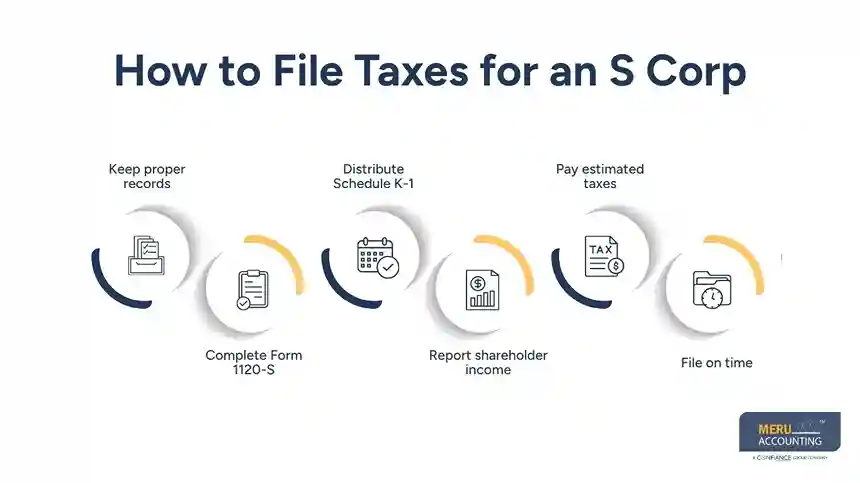
Report shareholder income
- Shareholders add the K-1 income to their personal Form 1040.
- This avoids double taxation, as the business itself does not pay federal tax.
Pay estimated taxes
- Shareholders may need to pay estimated quarterly taxes during the year.
- This avoids large tax bills and IRS penalties later.
File on time
- S Corp tax filing must be done by March 15 for calendar year companies.
- Filing late brings fines and risks losing the S corporation status.
How Outsourced Accounting Helps Simplify S Corporation Tax Return Filing
Outsourced accounting provides continuous financial management instead of only seasonal tax preparation. Professional accountants maintain records, reconcile accounts, prepare reports, and organize financial data throughout the year. As a result, preparing an S corporation tax return becomes faster, more accurate, and less stressful.
Rather than collecting months of financial information at tax time, businesses already have organized records available for review and filing.
Organizing Financial Records Throughout the Year
Year-round bookkeeping is one of the biggest advantages of outsourced accounting. Every financial transaction is recorded consistently, creating reliable records for preparing an S corporation tax return.
Professional accountants help organize:
- Sales transactions
- Vendor payments
- Operating expenses
- Bank deposits
- Credit card activity
- Loan transactions
- Shareholder distributions
Well-maintained records reduce confusion during tax season and improve reporting accuracy.
Preparing Accurate Financial Statements
Financial statements provide the information required to prepare an S corporation tax return. Outsourced accountants prepare reports that reflect the company’s financial position throughout the year.
Common reports include:
- Profit and Loss Statement
- Balance Sheet
- Cash Flow Statement
- General Ledger
- Trial Balance
Accurate financial statements simplify tax preparation and provide valuable insights for business decisions.
Managing Payroll and Shareholder Distributions
Payroll management plays an important role for every S corp. Owners who work in the business generally receive reasonable compensation, while additional profits may be distributed to shareholders.
Outsourced accounting professionals help by:
- Processing payroll accurately
- Recording payroll taxes
- Tracking shareholder distributions
- Maintaining payroll documentation
- Reconciling payroll accounts
Proper payroll records support compliance and improve the accuracy of the annual tax return.
Supporting Compliance With IRS Requirements
IRS compliance requires complete financial documentation and consistent accounting practices. Outsourced accounting teams monitor financial records throughout the year and help businesses maintain organized documentation.
Their support includes:
- Recording financial transactions
- Maintaining accounting records
- Reviewing expense classifications
- Reconciling bank accounts
- Preparing year-end financial reports
- Organizing supporting documentation
These practices reduce compliance risks and make preparing the company’s annual tax return more efficient.
Improving Accuracy Before Filing a Tax Return
One of the greatest benefits of outsourced accounting is the review process completed before filing. Financial records are examined carefully to identify missing information or reporting inconsistencies.
The review typically includes:
- Bank reconciliations
- Expense verification
- Income matching
- Payroll review
- Shareholder account reconciliation
- Financial statement analysis
- Documentation checks
Completing these reviews before filing improves the quality of the tax return and helps minimize corrections after submission.
Common Mistakes in S Corp Tax Filing
- Missing the March 15 deadline and paying late fees to the IRS.
- Not giving K-1 forms to shareholders before their filing date.
- Mixing personal expenses with business accounts which confuse records.
- Forgetting to pay payroll taxes for employees and shareholders on salaries.
- Not keeping records of the shareholder basis which affects future tax rules.
- Ignoring extra state tax filing rules that apply in some states.
Avoiding S Corp Double Taxation
- Always follow IRS rules to keep the S corporation election active.
- File Form 1120-S on time each year without missing deadlines.
- Pay reasonable salaries to shareholders who work in the business.
- Do not hold back too many profits in the company without a reason.
- Keep records clear and separate to prove compliance during audits.
- Work with a tax advisor if the rules feel too complex.
Documents Needed for S Corp Tax Filing
- Bank statements showing deposits and withdrawals for the year.
- Payroll reports for shareholder-employees and staff.
- Receipts of business expenses such as rent, utilities, and supplies.
- Profit and loss statement showing yearly performance.
- A balance sheet lists the assets and liabilities of the company.
- Past year’s tax returns for reference and accuracy.
- Details of each shareholder and their ownership percentage.
Benefits of Doing S Corp Tax Filing Right
- Prevents the risk of IRS audits and extra taxes.
- Avoids S Corp double taxation and saves owners money.
- Builds trust with lenders and makes loans easier to get.
- Shows a clear financial picture for business growth.
- Protects S Corp status and keeps the company in good standing.
State Taxes for S Corporations
- Some states fully accept federal S corporation rules.
- Others do not and tax S corps like normal corporations.
- Some states ask for extra filing forms in addition to IRS forms.
- Always check your state’s website for tax requirements.
- Filing both federal and state forms avoids local tax penalties.
Payroll and S Corp Taxes
Fair Salary Requirement
Shareholder-employees must get a fair salary for their work. The pay must match the role, skills, and hours given. This keeps the S corp in line with IRS rules and stops underreporting of income.
Payroll Taxes Apply to Wages
Payroll taxes like Social Security and Medicare apply to wages. Both the firm and the worker share these costs. Paying through payroll also gives staff access to future Social Security and Medicare benefits.
Dividends After Salary
Any profit left after paying wages can be shared as dividends. These are not tied to work done and give an extra return to owners. This split between pay and dividends helps in tax savings.
Dividends and Self-Employment Tax
Dividends distributed to shareholders under the S corp election are generally not subject to self-employment tax. This is one of the primary tax benefits of this IRS tax election. It helps reduce the overall tax burden while still providing income.
IRS Scrutiny on Low Salaries
The IRS checks if S corporation owners pay themselves a low wage to cut taxes. Owners must pay a fair wage that reflects market rates. A fair wage keeps the firm safe from fines and audits.
Timeline for S Corp Tax Filing
- January – Collect bank statements and financial records.
- February – Prepare payroll reports and tax forms.
- March – File Form 1120-S and send K-1 forms to shareholders.
- April – Shareholders use K-1 to file personal returns.
- Quarterly – Shareholders pay estimated taxes during the year.
Example of S Corp Tax Filing
- ABC Inc. is an S corporation with three equal shareholders.
- It earns $300,000 in profit during the year.
- Each shareholder owns 1/3 and gets a K-1 with $100,000 income.
- They each report this on their personal tax return Form 1040.
- ABC Inc. pays no federal income tax as a company.
- This way, it avoids S corp double taxation and saves money.
Key Tips for Filing Taxes for an S Corporation
- Always update accounting records each month for accuracy.
- Keep personal and business bank accounts separate.
- File Form 1120-S early to avoid a last-minute rush.
- Give K-1 forms to shareholders on time before April.
- Use help from a CPA if you are unsure of the process.
- Track the shareholder basis every year for future tax needs.
Penalties for Late S Corp Tax Filing
- The IRS charges $220 per shareholder, per month, for late filing.
- Extra fines apply if K-1 forms are not given on time.
- Continued failure can cause loss of S corporation status.
- If an S corp is lost, the company may become a C corp.
- That change brings the burden of S Corp double taxation again.
How S Corp Tax Filing Differs from C Corp Filing
Feature | S Corporation | C Corporation |
Double taxation | Avoided with a pass-through | Yes, taxed at two levels |
Tax form | 1120-S | 1120 |
Shareholder reporting | On K-1, personal return | Dividends after corporate tax |
Stock types allowed | One only | Multiple classes allowed |
Owner limit | 100 maximum | Unlimited shareholders |
Best Practices to Avoid Tax Filing Errors
- Use simple accounting software to manage books.
- Hire a CPA to review filings before submission.
- Keep every receipt and invoice in a safe folder.
- Reconcile bank statements every month for accuracy.
- Stay updated on IRS and state rule changes for S Corp.
Why Choose Meru Accounting for S Corp Tax Filing
Learning how to file taxes for an S corporation is very important for owners. Correct S Corp tax filing saves money, avoids IRS problems, and protects business status. By following the rules, owners can prevent S Corp double taxation and keep their company safe.
At Meru Accounting, we help businesses file their S Corp tax returns with accuracy and care. Our team handles bookkeeping, prepares Form 1120-S, and issues K-1s on time. We also guide owners to avoid mistakes that may cause double taxation. With our support, you can focus on running your business while we handle the complex tax work. Meru Accounting ensures smooth, stress-free, and compliant S Corp tax filing for long-term success.
Our Expert Perspective
Preparing an S corporation tax return requires much more than completing annual tax forms. Based on our experience supporting companies with S corp status across various industries, businesses achieve better tax compliance when bookkeeping, payroll, and financial reporting remain accurate throughout the year.
Organized financial records reduce filing errors, simplify Form 1120-S preparation, and ensure shareholders receive accurate Schedule K-1 forms on time.
We have also found that many tax filing issues arise because businesses delay accounting until year-end. Maintaining updated books, reconciling accounts regularly, and reviewing payroll before filing helps prevent IRS notices, penalties, and unnecessary corrections.
At Meru Accounting, we believe year-round accounting support creates a smoother S Corp tax filing process while helping business owners focus on growth instead of tax-related stress.
FAQs
Form 1120-S is the return used for S corporations.
Yes, if it loses its S corporation status due to mistakes.
It is March 15 for calendar-year corporations.
No, profits are passed to shareholders to report.
The IRS charges heavy fines per shareholder per month.
optional anymore
on running the business