Investing in multiple properties can be highly rewarding, but managing several investments simultaneously presents unique challenges. Tracking income, expenses, taxes, and property performance across a portfolio requires precision and expertise. Real estate accounting provides investors with a structured framework to organize financial data, monitor investments, and plan growth effectively.
This approach allows investors to make informed decisions, minimize risks, and identify new opportunities for portfolio expansion. Through proper accounting practices, investors can maximize returns while maintaining compliance with tax and regulatory obligations.
Real estate accounting not only organizes financial information but also enhances the strategic planning required to grow a multi-property portfolio efficiently.
What You Will Learn From This Blog
- How real estate accounting organizes financial records for multiple properties
- The role of accounting in optimizing property investment strategies
- Methods to forecast growth and plan budgets for portfolio expansion
- Ways to identify risks and manage expenses efficiently
- How professional accounting services can simplify multi-property management
What Is Real Estate Accounting And How Does It Support Multi-Property Investments
Understanding Real Estate Accounting
Real estate accounting involves tracking all financial activities related to property investments. It includes rental income, property expenses, maintenance costs, mortgage payments, and tax obligations.
Accurate records and periodic real estate auditing allow investors to evaluate the performance of each property and make data-driven decisions.
Categorizing Property Expenses
Expenses in real estate accounting are divided into categories like operating costs, repairs, management fees, and taxes. Categorization provides a clear picture of where money is being spent and identifies areas for potential savings.
Recording Rental Income
Monitoring rental income across several properties ensures timely collection and highlights underperforming assets. Accounting software can automate this process, reducing errors and administrative work.
Ensuring Compliance With Regulations
Tax laws and local property regulations can vary by region. Proper accounting combined with regular real estate auditing maintains accurate records to comply with these rules, helping avoid penalties and legal issues.
Evaluating Property Performance
Investors can compare the performance of properties by analyzing cash flow, net operating income, and return on investment. This evaluation guides decisions about acquisitions, sales, or reinvestment.
How Real Estate Accounting Supports Investors In Growing Their Multi-Property Portfolio
Tracking Cash Flow Across Properties
Cash flow monitoring ensures investors know which properties generate profit and which may require attention. Positive cash flow allows for reinvestment in additional properties.
Identifying High-Yield Opportunities
By analyzing financial records, investors can spot properties or areas with better returns. Accounting data highlights opportunities to expand in markets with strong rental demand.
Planning Acquisition Strategies
Accurate real estate accounting helps determine affordability for new property purchases. Detailed records also provide guidance on loans, financing options, and timing.
Reducing Operational Inefficiencies
Accounting identifies unnecessary costs and overlapping vendor arrangements. Efficient expense control increases overall portfolio profitability significantly.
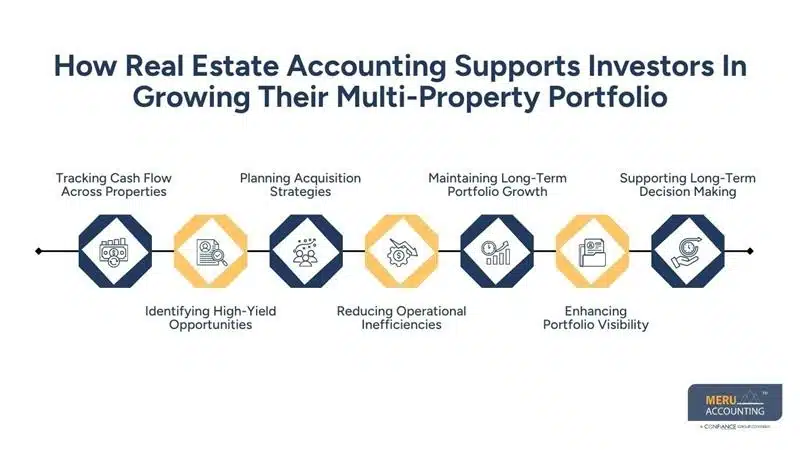
Maintaining Long-Term Portfolio Growth
Structured financial oversight ensures that portfolio growth is sustainable. Investors can plan expansions strategically, avoid over-utilization, and manage cash flow effectively.
Enhancing Portfolio Visibility
Regular financial reporting provides a clear view of overall property performance. Investors can track trends, compare properties, and make informed decisions.
Supporting Long-Term Decision Making
By combining structured oversight with detailed reporting, investors can plan expansions carefully while maintaining healthy cash flow. This approach consolidates tracking income and expenses across multiple properties into a single, actionable perspective.
How Real Estate Accounting Improves Investment Decision-Making For Property Investors
Data-Driven Decisions
Detailed financial reports provide insights into which investments are performing well. Decisions about buying, selling, or renovating properties are supported by real numbers rather than assumptions.
Comparative Analysis of Properties
Accounting and real estate auditing allow for side-by-side comparisons of different properties. Metrics like rental yield, occupancy rates, and maintenance costs guide better investment choices.
Forecasting Returns
Historical accounting data can be used to forecast future returns and estimate potential profits from new investments. Accurate projections reduce uncertainty and risk.
Scenario Planning
Real estate accounting allows investors to model different financial scenarios. Changes in interest rates or rents can be evaluated effectively.
Avoiding Financial Pitfalls
Proper accounting highlights financial weaknesses or liabilities early, preventing costly mistakes and losses. Investors gain a clearer view of their portfolio’s health.
Performance Tracking Across Properties
Financial tracking helps investors monitor income and expenses across multiple properties. Regular performance reviews support stronger decisions for future property investments.
How to Plan Budgets and Forecast Growth for Property Expansion
Establishing Annual Budgets
Budgeting begins with estimating income and expenses for each property, while real estate auditing helps verify financial accuracy. Clear allocation of funds improves financial control across the portfolio.
Predicting Cash Flow Needs
Real estate accounting forecasts identify periods of high expense, such as repairs or taxes. Adequate liquidity planning ensures smooth financial operations throughout the year.
Setting Investment Goals
Financial targets guide expansion plans for new property acquisitions. Defined goals help maintain focus on long-term portfolio growth direction.
Evaluating Financing Options
Accounting data helps determine the feasibility of loans or partnerships for property acquisition. It ensures financing decisions align with portfolio growth plans.
Monitoring Progress Against Budgets
Regular review of actual versus planned expenses, along with real estate auditing, helps investors stay on track. Adjustments can be made to avoid overspending or underutilizing funds.
How Real Estate Accounting Identifies Risks in Multi-Property Portfolios
Spotting Overleveraged Properties
Accounting reveals properties that carry excessive debt relative to income, helping investors manage risk and avoid cash flow crises.
Early identification allows investors to restructure loans or adjust investment strategies proactively.
Monitoring Vacancy Rates
High vacancy rates can reduce profitability. Accounting systems track occupancy trends, allowing timely interventions like marketing campaigns or rent adjustments.
Regular vacancy monitoring helps plan tenant retention strategies and maintain steady income.
Detecting Unusual Expenses
Unexpected maintenance costs or vendor charges identified during real estate auditing can signal operational or financial issues. Accounting highlights anomalies for prompt action.
Analyzing expense patterns prevents recurring problems and reduces unnecessary spending.
Tax and Regulatory Compliance
Accounting ensures all tax filings are correct and deadlines are met, minimizing legal risks.
Proper documentation also simplifies audits and avoids costly penalties.
Market Risk Assessment
Real estate accounting allows investors to track property performance against market trends. Comparing results to market averages guides informed decisions on acquisitions or sales.
How to Track Maintenance Costs and Manage Vendor Payments Efficiently
Centralized Record-Keeping
Keeping all maintenance expenses in one place allows for easy tracking and budgeting. Centralized records also simplify reviewing past spending patterns for better planning.
Scheduled Maintenance Tracking
Accounting can include reminders for routine maintenance, reducing the likelihood of costly repairs. Regular scheduling ensures properties remain in good condition and retain value.
Vendor Payment Management
Tracking vendor payments ensures timely settlements, avoids late fees, and strengthens vendor relationships. Maintaining a payment schedule improves trust and long-term cooperation with vendors.
Cost Analysis For Repairs
Comparing costs across properties during real estate auditing helps identify where expenses can be reduced without compromising quality. Analyzing repair costs helps plan future budgets and control unexpected spending.
Supporting Audit Readiness
Organized records make financial audits simpler and faster, reducing stress and administrative burden. Prepared documentation ensures smooth compliance with regulatory and financial reporting requirements.
Why Choose Meru Accounting For Multi-Property Real Estate Accounting
Expert Knowledge In Real Estate
Meru Accounting specializes in managing multi-property portfolios, ensuring all accounting processes are accurate and compliant.
Our professionals bring deep experience in real estate finance and property management.
Customized Financial Solutions
We tailor services to meet the unique needs of each investor, whether it’s cash flow monitoring, tax planning, or portfolio expansion strategies.
Solutions are designed to address specific investment goals and financial priorities.
Streamlined Reporting
Meru Accounting provides clear, actionable reports that make complex financial data easy to understand.
Reports highlight key performance metrics, helping investors make informed decisions quickly.
Strategic Planning Support
Our team assists in creating budgets, forecasting growth, and identifying investment opportunities to expand portfolios.
Technology-Driven Accounting Support
Modern accounting tools improve record management, financial reporting accuracy, and the efficiency of real estate auditing processes. Automated systems reduce manual errors and save valuable administrative time.
Our Expert Perspective
From our experience at Meru Accounting, investors who maintain structured accounting practices see measurable improvements in portfolio performance. Our clients often find that accurate financial records and regular real estate auditing not only clarify their current position but also reveal opportunities to expand confidently and sustainably. Multi-property investments become manageable, profitable, and strategically guided when accounting is handled professionally.
Key Takeaways
- Real estate accounting organizes financial data for multiple properties and helps track income and expenses accurately
- Accounting enables informed investment decisions by providing detailed property performance insights
- Budget planning and forecasting ensure sustainable portfolio growth
- Identifying risks early helps investors minimize losses and optimize returns
- Professional accounting services simplify multi-property management and reduce operational burdens
FAQs
Real estate accounting organizes financial activities related to properties, including income, expenses, and taxes. Accurate records help investors make informed financial decisions confidently.
Accounting tracks cash flow, forecasts returns, and identifies opportunities to expand without overextending finances.
Yes, it identifies financial risks like high debt, high vacancy rates, and unusual expenses early, allowing timely action.
By recording all maintenance and vendor expenses centrally, investors can monitor trends, schedule repairs, and manage payments on time.
Professional services provide accurate records, compliance with regulations, tailored advice, and reduce the time investors spend on financial management.