
Real estate auditing plays an important role in improving financial clarity for companies that manage properties in different locations. In multi-location setups, real estate auditing helps identify errors, reduce mismatched records, and support accurate reporting across all property units.
Without proper checks, real estate accounting can become inconsistent and difficult to control, especially when transactions are spread across cities or countries.
For property businesses, financial data comes from rent, maintenance, taxes, vendor payments, and lease records.
When these are not reviewed properly, mistakes can directly affect accounting quality and decision-making. This blog explains how structured auditing improves accuracy, compliance, and reporting in such business models.
What You Will Learn From This Blog
- How real estate auditing supports financial accuracy in multi-location property setups
- Why does managing real estate accounting become more complex across different sites
- The role of audits in improving data control and reporting quality
- How audits help maintain compliance in property operations
- How reconciliation between property locations improves financial clarity
- Practical insights from Meru Accounting on audit-based financial control
Understanding Real Estate Auditing In Multi-Location Property Businesses
Meaning of Real Estate Auditing in Property Systems
Real estate auditing is the process of checking financial records, property transactions, and compliance data across real estate assets. It ensures that income, expenses, and contracts are recorded correctly. In multi-location setups, this process becomes essential for control and supports better financial clarity across operations.
Structure of Multi-Location Property Operations
Businesses with properties in different cities face scattered financial data. Each location may follow different reporting patterns. Here, auditing helps bring uniformity across records and improves trust in financial accounting data.
Importance of Centralized Review Systems
A centralized audit system reviews all property-level data in one place. This reduces duplication and missing entries. It also supports consistent accounting practices across all branches and improves reporting accuracy.
Common Financial Data Reviewed in Audits
Auditors review rent receipts, vendor bills, maintenance costs, and lease agreements. These records directly affect financial accuracy and reporting quality across property portfolios.
Role of Technology in Audit Processes
Modern audit systems use software tools to track property transactions. These tools help reduce manual errors and improve the speed and accuracy of financial reviews across locations.
Link Between Auditing and Accounting Accuracy
Strong audit processes directly improve accounting quality. They ensure financial statements reflect real business activity without errors or missing data, especially in multi-location property setups.
Why Does Real Estate Accounting Become Complex Across Multiple Property Locations
Different Property Regulations Across Regions
Each location may follow different tax and legal rules. This makes financial recording harder to manage without proper audit checks and increases the chance of reporting differences across regions.
High Volume Of Transactions
Multi-location businesses handle large numbers of rent and expense entries. Without proper audit support, small errors can grow into major financial mismatches across property records.
Lack Of Uniform Reporting Methods
Different teams may follow different accounting formats. This creates inconsistency in reports across locations and reduces clarity in financial consolidation.
Currency And Payment Differences
International property setups may deal in different currencies. This increases complexity in financial reporting and requires strong audit support to maintain accuracy.
Delay In Data Consolidation
When data is not updated in real time, reporting delays occur. Structured real estate auditing helps fix timing gaps in financial records and improves reporting flow.
Risk Of Human Error
Manual entry mistakes are common in multi-location systems. Regular review processes reduce such risks and improve accuracy in financial records, strengthening real estate accounting across all locations.
Role of Real Estate Auditing in Ensuring Real Estate Accounting Accuracy
Verification Of Financial Entries
Each transaction is checked for correctness to ensure financial records remain reliable and complete across property operations. Reducing errors at this stage improves the overall quality of reporting.
Detection Of Missing Transactions
Missing rent entries or unpaid invoices are identified during audits, improving reporting quality and reducing gaps in financial records. Proper tracking of income sources becomes more consistent across locations.
Cross-Checking Property Data
Data from multiple locations is compared to ensure consistency across all assets and strengthen overall financial accuracy. Early identification of mismatches helps maintain cleaner financial records.
Correction Of Reporting Errors
Any errors found during review are corrected before final reports are prepared, improving clarity and reliability of financial statements. Final reports better reflect actual business performance.
Strengthening Internal Controls
Strong internal checks are built through audit systems, reducing risks and improving discipline in property financial management. Standardized processes across locations support better financial governance.
Supporting Financial Decision Making
Accurate audit findings help management make better financial decisions based on trusted financial data and verified reports. Improved visibility supports stronger budgeting and investment planning.
How Real Estate Auditing Enhances Compliance In Multi-Location Property Businesses
Ensuring Tax Compliance Across Regions
Structured real estate auditing helps enforce regional tax regulations with accuracy. Proper compliance checks reduce filing gaps and support consistent financial documentation across multiple locations.
Meeting Reporting Standards
Financial reports aligned with IFRS and other global frameworks strengthen accuracy and comparability. Standardized reporting improves clarity for stakeholders and supports reliable performance tracking.
Reducing Legal Risks
Regular audit procedures identify compliance gaps before they escalate into penalties or disputes. Strong review mechanisms protect organizations from regulatory and contractual issues.
Monitoring Lease Agreements
Lease contracts are examined to verify rent schedules, escalation clauses, and renewal conditions. Accurate verification ensures financial entries reflect true contractual commitments.
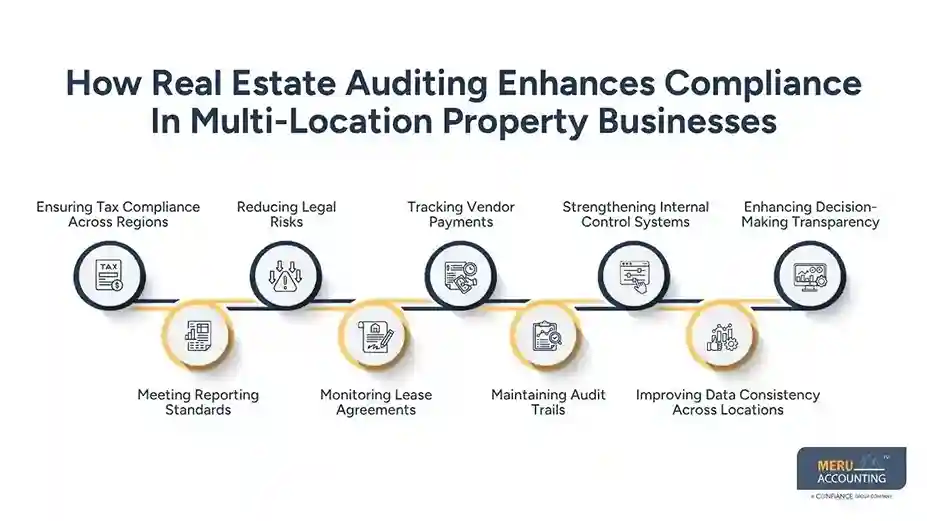
Tracking Vendor Payments
Vendor records are validated against agreements and supporting documents. Careful reconciliation reduces errors such as duplicate billing or incorrect payment entries.
Maintaining Audit Trails
Comprehensive audit trails record every transaction and adjustment for reference and verification. Transparent documentation strengthens accountability within real estate accounting systems.
Strengthening Internal Control Systems
Audit processes reinforce internal controls by ensuring approvals, validations, and financial workflows follow defined protocols. Strong control mechanisms reduce inconsistencies across multi-location operations.
Improving Data Consistency Across Locations
Standardized audit practices help align financial data across all property sites. Consistent data handling reduces discrepancies and enhances portfolio-wide reporting accuracy.
Enhancing Decision-Making Transparency
Reliable audit outputs provide clearer financial visibility for management teams. Improved transparency supports more informed and confident strategic decisions across property portfolios.
How Data Reconciliation Between Property Locations Strengthens Financial Reporting
Matching Income Records Across Sites
Rental income and other revenue streams are aligned across all property locations to ensure consistency. Accurate validation helps improve real estate auditing outcomes and financial clarity.
Identifying Data Gaps
Missing entries, duplicate postings, and mismatched records are identified during review processes. Clean and structured verification supports reliable reporting across portfolios.
Consolidating Financial Statements
Financial data from multiple properties is merged into unified statements for overall analysis. Error-free consolidation ensures consistency in group-level reporting.
Improving Reporting Speed
Streamlined reconciliation processes reduce delays in preparing financial reports. Faster processing enhances operational efficiency and reporting cycles.
Enhancing Data Accuracy
Corrected and verified datasets reduce inconsistencies in financial records. Improved precision builds stronger trust in reported figures and analytics.
Supporting Management Decisions
Reliable consolidated data enables better investment planning and strategic decisions. Strong insights are supported through accurate real estate accounting systems.
Why Choose Meru Accounting?
Industry-Focused Accounting Support
Meru Accounting provides structured financial services for property businesses. Our approach strengthens both real estate auditing and real estate accounting systems.
Multi-Location Data Management
We help manage financial data across different property locations. This ensures smooth real estate accounting reporting.
Audit-Based Financial Review
Our team of certified experts performs detailed checks to improve accuracy. This improves real estate auditing quality and control.
Software Integration Support
Meru Accounting works with platforms such as QuickBooks, Xero, and other leading tools. Seamless integration improves workflow efficiency and reduces manual reporting errors.
Compliance And Reporting Assistance
We ensure reports follow tax and legal standards. This strengthens real estate auditing outcomes.
Experience Across Global Markets
With experience serving clients in the US and other international markets, Meru Accounting delivers reliable financial support for complex property structures and global operations.
Our Expert Perspective
From our experience in financial reporting for multi-location property businesses, a recurring challenge is the lack of visibility in data movement between sites, which often leads to inconsistencies in financial records.
Real estate auditing serves as a structured control mechanism that goes beyond routine checking. It actively ensures that financial data is properly tracked, validated, and aligned across all property locations, reducing the likelihood of reporting discrepancies.
When implemented consistently, this approach eases the burden on finance teams, strengthens internal controls, and enhances confidence in financial outcomes. It also improves accuracy, transparency, and overall reliability within real estate accounting systems.
Key Takeaways
- Real estate auditing improves financial accuracy in multi-location property businesses
- Real estate accounting becomes complex without proper audit systems
- Data reconciliation reduces errors across property locations
- Compliance improves with structured audit processes
- Centralized reporting strengthens financial control
- Firms like Meru Accounting help improve audit-based accounting systems
FAQs
It is a process of checking the financial records of property businesses to ensure accuracy and proper reporting.
Because data comes from many locations, making it harder to track and manage correctly.
Errors, missing data, and mismatches in records are identified before final reporting, helping ensure more reliable financial statements.
Yes, audits ensure that all financial records follow tax rules and regulations.
Auditors review rent receipts, vendor bills, maintenance costs, and lease agreements to ensure all entries are correct and complete.