Every real estate deal has a money trail. Investors put in capital, properties generate income, expenses are paid, and money goes back to investors. When those transactions start piling up, knowing who contributed what, who received a distribution, and what the books show can get messy fast. Real Estate accounting software can bring those details into one system and make them easier to track.
The right software does more than record rent and expenses. It can help track investor capital, distributions, ownership, property results, and financial reports without relying on a maze of spreadsheets. For firms with several deals or entities, accounting software for Real Estate investors can also make monthly bookkeeping and investor reporting more consistent.
In this blog, we’ll look at the key features that matter most, how software handles capital contributions and distributions, and the accounting issues investors should watch as their portfolios grow.
What You Will Learn From This Blog
This guide explains what to look for in Real Estate accounting software, including:
- Why real estate investors need tools built for property and investor records
- Key features for capital contributions and distributions
- How software can support investor and property-level reporting
- Common accounting issues that can cause errors
- How accounting software for Real Estate investors can support better control as a portfolio grows
- How professional accounting support can improve the use of real estate accounting systems
Why Real Estate Investors Need Specialized Accounting Software
A normal business accounting system may track sales, bills, payroll, and bank activity well. Real estate investments often need more detail.
An investor may own several properties through separate LLCs or partnerships. Each property can have its own rent, repairs, debt, insurance, taxes, and other costs. At the same time, investors may add capital at different times or receive distributions based on the deal terms.
Using spreadsheets alone can make these records hard to manage. Data may be entered more than once, formulas can break, and it can become difficult to confirm which investor owns what.
Good Real Estate accounting software helps bring these records together. It can give owners a clear view of each property, entity, and investor without forcing them to build a new system for every deal.
For larger portfolios, accounting software for Real Estate investors can also help reduce manual work. This can make monthly close tasks, account reviews, and investor reporting easier to manage.
Key Features to Look for in Real Estate Accounting Software
Not every accounting platform offers the same tools. Investors should focus on features that match the way their properties and deals are set up.
Capital Contribution Tracking
Capital contributions should be easy to record and review. The system should show who contributed money, when it was added, and which property or entity received it.
This is important when investors make more than one contribution over the life of a deal. A useful system should let you track each entry and maintain a running view of investor capital.
Real Estate accounting software can also reduce the risk of mixing investor funds with operating income or other cash activity.
Distribution Tracking
Distributions need the same level of care. Investors may receive cash at different points based on the partnership agreement or deal structure.
A strong system should record the amount, date, investor, and related property or entity. It should also keep distributions separate from operating expenses.
This matters because a distribution is not simply another business expense. Partnership tax rules can affect a partner’s basis and the tax treatment of certain distributions.
Investor Ownership and Equity Tracking
Investor records should show more than a name and dollar amount. The system should help connect each investor to their ownership interest and capital activity.
When ownership changes, the accounting records need to reflect those changes. This can become difficult when several investors enter or leave a deal at different times.
The best accounting software for Real Estate investors should make these records easier to review and keep aligned with the deal structure.
Investor Reporting
Investors want clear information about their money. They may need reports showing contributions, distributions, income, expenses, and ending balances.
Real Estate accounting software can help create reports at the investor, property, or entity level. This can save time when preparing regular investor updates.
Reports should be clear enough for an investor to understand without needing to sort through raw transaction data.
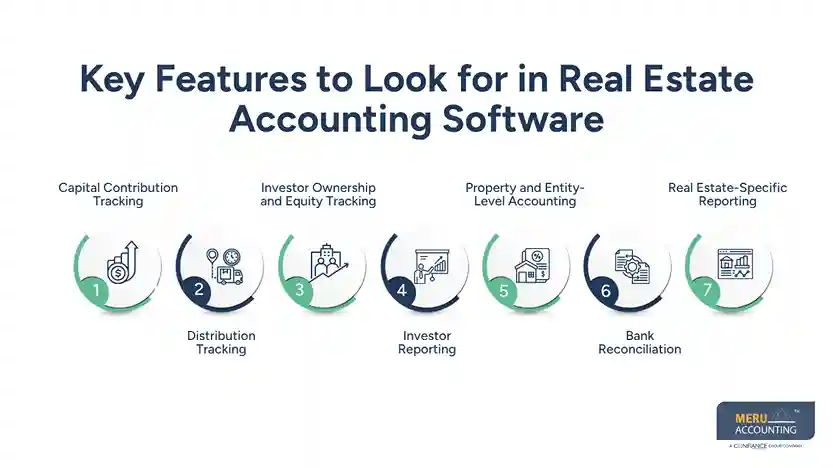
Property and Entity-Level Accounting
Real estate portfolios often include several entities. Keeping each entity’s activity separate is vital.
A good system should let you track each property’s income and costs while also giving you a broader view of the portfolio. This helps prevent transactions from one property being posted to another.
Multi-entity support is one of the key reasons investors may choose specialized Real Estate accounting software over a basic accounting setup.
Bank Reconciliation
Bank reconciliation is another core feature to consider. The system should help match bank activity with recorded transactions and identify items that need review.
Regular reconciliation can catch duplicate entries, missing transactions, and classification errors before they affect financial reports.
For investors with several property accounts, this feature can save a large amount of manual work.
Real Estate-Specific Reporting
Beyond standard profit and loss reports, investors may need property-level income statements, balance sheets, cash flow reports, and equity reports.
The value of Real Estate accounting software comes from being able to organize these reports around the way the investment is actually structured.
optional anymore
on running the business
How Accounting Software Handles Capital Contributions and Distributions
Capital contributions and distributions are central to many real estate investment deals. They should not be treated as simple deposits and withdrawals. When an investor contributes cash, the accounting record should show the contribution and link it to the correct investor and entity. When money is later distributed, the system should record the payment against the right investor account.
This creates a better audit trail. It also makes it easier to compare beginning balances, new contributions, distributions, allocated activity, and ending balances. The tax side can be more complex. IRS guidance states that a partner’s adjusted basis can increase through money or property contributed and can decrease through certain distributions. The tax basis in a partnership interest is not always the same as the capital or equity amount shown in the books.
That distinction is important. Software can organize and track the data, but the accounting records should still be reviewed against the partnership agreement and tax requirements. For property distributions, additional rules can apply. The IRS also provides Form 7217 for certain partners receiving property from a partnership.
This is why accounting software for Real Estate investors should be viewed as a control and reporting tool, not a replacement for professional tax advice.
Common Accounting Challenges Real Estate Investors Should Avoid
Mixing Property and Investor Transactions
Keeping property expenses, investor contributions, and distributions in the wrong accounts can make financial reports hard to trust. Each transaction should be linked to the right entity and purpose.
Relying Too Much on Spreadsheets
Spreadsheets can work for a small deal. As the number of investors and transactions grows, they become harder to control.
Losing Track of Capital Accounts
Investor capital should be reviewed on a regular basis. Missing one contribution or distribution can create an incorrect ending balance.
Delaying Bank Reconciliations
Unreconciled accounts can hide missing or duplicate transactions. Monthly reconciliation gives investors and accountants a better chance to catch errors early.
Creating Investor Reports Manually
Manual reports take time and increase the chance of using old or incorrect data. A connected accounting system can make report preparation more consistent.
Real Estate Accounting Services Using Real Estate Accounting Software
Real estate accounting needs more than software setup. The books need to reflect how each property, entity, and investor relationship actually works. Meru Accounting brings that accounting knowledge together with Real Estate accounting software to build and maintain books that are easier to review and use.
Our Real Estate Accounting Services
- Property Bookkeeping: Income, expenses, loans, and other property transactions.
- Investor Accounting: Capital contributions, distributions, ownership records, and investor activity.
- Entity-Level Accounting: Separate books for LLCs, partnerships, and individual properties.
- Account Reconciliation: Regular review of bank and financial account activity.
- Financial Reporting: Property-level and investor reports for clear financial review.
- Book Cleanup: Finding and correcting past errors, misclassifications, and gaps.
Our team also helps set up the chart of accounts and accounting workflow around the deal structure. This practical approach makes accounting software for Real Estate investors more useful because the system reflects the way the investment is actually managed—not just how transactions are entered.
Our Expert Insight
One issue we see in real estate accounting is the assumption that every investor transaction is simply a debit or credit to an investor account. In practice, the accounting can depend on the deal structure, partnership agreement, and nature of the transaction. A capital contribution, loan from an investor, and distribution can have very different effects on the books.
We also recommend reviewing investor balances at the deal and entity level, rather than relying only on a software-generated report. Software can process transactions quickly, but it cannot determine whether an entry reflects the actual terms of an investment. That review is where accounting experience matters most.
For growing real estate portfolios, clean books come from combining the right system with sound accounting judgment. Real Estate accounting software should support that process, not replace it.
Key Takeaways
- Choose Real Estate accounting software that supports property, entity, and investor-level records.
- Track every capital contribution and distribution by investor and entity.
- Use bank reconciliation to keep transaction records accurate.
- Look for reports that make investor activity easy to review.
- Do not rely on software alone for complex tax decisions.
- Keep accounting records and partnership agreements aligned.
- Consider professional accounting support as your portfolio grows.
FAQs
It depends on your property count, entity structure, and investor reporting needs. Choose software that can handle more than basic income and expense tracking.
Set up each investor with the correct capital or ownership account. Record contributions and distributions against the appropriate investor and entity.
Yes. It can help keep financial activity separate for each LLC while managing the books through one accounting system.
Common reports include income statements, balance sheets, cash flow reports, general ledgers, and investor activity reports.
No. Book capital accounts and tax basis can be calculated differently, so the software balance should not be treated as a tax-basis figure.
optional anymore
on running the business