
You may be leaving money on the table without realizing it. Real Estate agent tax deductions can cover more than the big expenses you already track. Gas for showings, MLS fees, listing photos, signs, software, client gifts, and even certain home office costs can add up fast over the course of a year.
The challenge is knowing which expenses the IRS allows, which have limits, and which need better records to support your claim. Many agents focus on common deductions and overlook smaller business costs that may still qualify. At the same time, claiming a personal expense as a business cost can create problems at tax time.
In this blog, we’ll cover common and overlooked Real Estate agent tax write offs, explain vehicle and mileage deductions, and share practical ways to keep better records.
What You Will Learn From This Blog
In this blog, you will learn:
- Which Real Estate agent tax deductions are common and which are often missed.
- How vehicle and mileage costs may qualify for a deduction.
- Which client, marketing, software, and office costs may count as business expenses.
- Why records are important when claiming Real Estate agent tax write offs.
- When a tax professional can help review your deductions.
What Are Real Estate Agent Tax Deductions?
Real Estate agent tax deductions are eligible business costs that may reduce the income subject to tax. For a self-employed agent, these costs may be reported as business expenses, depending on the agent’s tax setup and the nature of the expense.
A deduction is not the same as a tax credit. A deduction lowers taxable income, while a credit generally reduces tax owed. That difference is worth knowing when you review your year-end numbers.
The IRS uses the terms “ordinary” and “necessary” when discussing business expenses. In general, an ordinary expense is common and accepted in your trade or business. A necessary expense is helpful and appropriate for the business.
This means a cost should have a clear link to your real estate work. Personal costs should not be treated as business costs just because you are a real estate agent.
Common Real Estate Agent Tax Deductions You Should Know
Many agents already track the big expenses. These can include:
Marketing and advertising: Online ads, print ads, business cards, signs, flyers, listing promotion, and website costs may be business expenses when used for your real estate work.
MLS and professional fees: MLS fees, real estate board dues, association fees, and other costs tied to your work may qualify when they meet the applicable tax rules.
Office expenses: Supplies, postage, printing, and other routine office costs may be deductible when they are used for business.
Software and subscriptions: CRM tools, transaction platforms, e-sign tools, accounting software, cloud storage, and other business apps can add up over the year.
Professional services: Legal, accounting, tax, and other professional fees related to your business may also be worth reviewing.
These basic categories form the starting point for Real Estate agent tax deductions. However, the missed expenses are often found in the smaller costs that occur throughout the year.
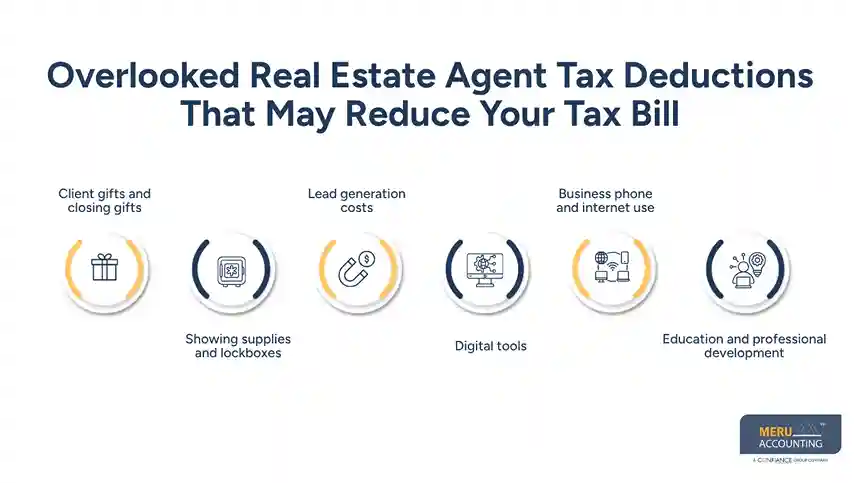
Overlooked Real Estate Agent Tax Deductions That May Reduce Your Tax Bill
Some Real Estate agent tax deductions are easy to overlook because they do not always appear as one large bill.
Client gifts and closing gifts
Gifts given to clients for a valid business reason may qualify, but special limits can apply. Keep the receipt and note who received the gift and why it was given. Do not assume the full cost is always deductible.
Showing supplies and lockboxes
Signs, lockboxes, open-house supplies, name badges, and similar items may be business costs when they are used in your real estate work.
Lead generation costs
Lead platforms, paid referral programs, listing promotion, and other lead-generation costs can be significant for agents. Keep invoices and payment records so you can show the business purpose.
optional anymore
on running the business
Digital tools
A small monthly fee for a CRM or e-sign service can become a high annual cost. Review recurring charges for software, cloud storage, scheduling tools, website services, and business communication platforms.
Business phone and internet use
If you use your phone or internet for business, the business-use portion may need to be tracked and separated from personal use. A clear method for calculating business use is better than guessing at year-end.
Education and professional development
License-related costs, continuing education, conferences, and training may be worth reviewing. However, tax rules can differ based on the type of education and how it relates to your existing trade or business.
These overlooked costs can add up. Good bookkeeping makes it much easier to find them before your return is prepared.
Vehicle and Mileage Tax Deductions for Real Estate Agents
Driving is a major part of many real estate businesses. You may drive to showings, inspections, client meetings, open houses, and other business locations.
The IRS allows eligible taxpayers to use the standard mileage method or, when permitted, the actual expense method for business vehicle use. The choice can affect how your deduction is calculated.
For 2026, the IRS business mileage rate is 72.5 cents per mile from January 1 through June 30 and 76 cents per mile from July 1 through December 31.
That makes a reliable mileage log especially important.
Your log should show the date, miles, destination, and business reason for the trip. Keep supporting records when needed.
Also, do not treat every mile driven as a business mile. Normal commuting is generally not deductible. The IRS has specific rules for transportation between your home and work locations, including situations where a qualifying home office is your principal place of business.
For many agents, mileage is one of the most valuable areas to review when looking for missed Real Estate agent tax write offs.
How Meru Accounting Helps With Real Estate Agent Tax Deductions
Keeping track of Real Estate agent tax deductions can become hard when expenses are spread across bank accounts, cards, apps, receipts, and mileage logs.
Meru Accounting can help real estate agents keep their books organized and make business costs easier to review. The goal is not to claim every expense. It is to keep clear records, classify costs properly, and give your tax professional better information at tax time.
A structured bookkeeping process can help you:
- Separate business and personal transactions.
- Track recurring business expenses.
- Organize receipts and supporting records.
- Review expense categories throughout the year.
- Spot costs that may need tax review.
- Keep financial reports ready for tax planning.
This can also make it easier to discuss potential Real Estate agent tax write offs with your CPA or tax preparer. Good books do not replace tax advice, but they give your tax professional cleaner data to work with.
Our Expert Insight
A common mistake we see with Real Estate agent tax deductions is focusing only on whether an expense looks business-related. The better question is whether the expense has a clear business purpose and enough records to support it. This matters most with mixed-use costs, such as vehicles, phones, travel, and home office expenses.
Our advice is to review these expenses before filing, not after. Separate personal and business use, check any deduction limits, and keep records that show the amount and business purpose. Good tax planning is less about claiming every possible expense and more about claiming the right expenses with the right support.
Key Takeaways
- Real Estate agent tax deductions can include many routine business costs.
- Marketing, MLS fees, software, supplies, professional fees, and eligible vehicle costs are common areas to review.
- Smaller expenses can be easy to miss without good bookkeeping.
- Mileage records should show key details such as the date, miles, destination, and business purpose.
- Personal expenses should not be mixed with business expenses without a proper allocation.
- Some Real Estate agent tax write offs have limits or special rules.
- A qualifying home office may provide a deduction, but specific IRS requirements apply.
- Keep receipts, invoices, logs, and other records that support your expenses.
- Work with a qualified tax professional when an expense is unclear or your tax situation is complex.
FAQs
Real estate agents generally use business expense deductions rather than a special “real estate agent” deduction. Eligible costs reduce business income when they meet IRS rules.
Yes, a legitimate business expense can still qualify if you paid it personally. Keep proof of payment and document the business purpose.
The deductions are based on the nature and use of the expense, not simply your contractor status. Many self-employed agents report business income and expenses on Schedule C.
Keep receipts and other tax records for as long as the IRS requires for that return. Records should support the amount, date, and business purpose of the expense.
The deduction may be difficult to defend if the IRS asks for support. A clear paper trail can help show that the expense was a legitimate business cost.
optional anymore
on running the business