Real estate developer accounting plays a key role in handling the financial structure of large and multi-phase property projects. It helps developers track costs, monitor revenue, and maintain control over budgets across different stages of construction.
In complex property developments, even small financial errors can affect project timelines and profitability. That is why real estate development accounting is widely used to bring structure and clarity to financial data.
In modern property projects, financial activity happens across land purchase, approvals, construction, vendor payments, and sales booking. Without proper accounting systems, it becomes difficult to understand the true financial position of a project.
This blog explains how structured accounting improves control, reduces risks, and supports better decision-making in real estate projects.
What You Will Learn From This Blog
- How real estate developer accounting improves project control and financial clarity
- Key challenges faced in complex property development projects
- Methods used for revenue recognition and cost tracking
- Importance of cash flow planning in construction cycles
- Role of reporting in better decision-making
- Benefits of outsourcing accounting functions for developers
- How firms like Meru Accounting support project efficiency
Introduction To Real Estate Developer Accounting
Real estate developer accounting provides a structured way to record all financial transactions in property projects. It ensures that every cost and income is tracked properly from land acquisition to final handover, helping developers maintain a clear view of project finances at every stage.
In property development, each project is treated as a separate unit under a project-based accounting system. This approach helps developers measure profit or loss at the project level instead of mixing financial data across multiple developments.
Along with this, real estate development accounting strengthens financial control by dividing costs into clear categories such as land, labor, materials, and approvals, which improves the clarity of financial reporting.
Accurate cost tracking is also a key part of this system, as it helps avoid budget overruns by allowing developers to compare planned versus actual spending and maintain financial discipline.
Overall, this structured approach improves financial transparency, builds trust with investors, banks, and stakeholders, and ensures that financial records remain reliable and easy to verify.
Challenges Faced In Real Estate Developer Accounting For Complex Projects
Multiple Project Coordination Issues
Large developers manage several projects at once. Real estate developer accounting helps avoid confusion by separating financial data for each project.
Unpredictable Cost Variations
Material and labor costs often change due to market conditions, supply chain issues, and seasonal demand fluctuations. This creates ongoing challenges in maintaining accurate project budgets over time effectively.
Long Project Cycles
Real estate projects take years to complete, often moving through multiple financial phases and approval processes. Real estate development accounting helps track financial performance over long periods with structured reporting methods.
Regulatory Compliance Pressure
Developers must follow tax laws, GST rules, accounting standards, and multiple reporting requirements at the local and national levels strictly. Mistakes in compliance can lead to penalties, legal issues, and significant delays in project approvals.
Data Management Complexity
Handling invoices, vendor bills, contracts, and payment records manually increases errors and delays in financial reporting processes. As the project size grows, the volume of financial data becomes harder to manage without automation tools effectively.
Key Ways Real Estate Developer Accounting Improves Efficiency In Complex Projects
Budget Planning Accuracy
Real estate developer accounting helps create accurate budgets based on historical data and project scope.
Strong budget planning reduces financial uncertainty across long construction phases.
Real-Time Cost Monitoring
Developers can track ongoing expenses and compare them with planned budgets to control overspending. Continuous tracking supports better financial discipline during execution.
Risk Identification Early
Financial reports highlight risks in advance, allowing corrective action before issues grow. Early warnings help prevent major cost escalations in later stages.
Vendor Payment Management
Structured accounting ensures timely payments to contractors and suppliers. Smooth payment cycles improve vendor relationships and project continuity.
Improved Decision Making
With clear data, developers can decide whether to continue, delay, or modify project plans. Better insights support more confident financial and operational decisions.
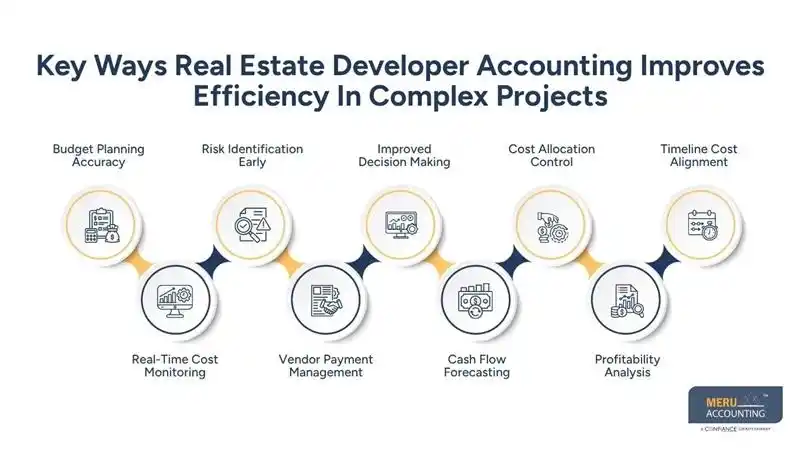
Cash Flow Forecasting
Future inflows and outflows are projected to maintain financial balance across all phases. Proper forecasting reduces chances of funding shortages during construction.
Cost Allocation Control
Expenses are assigned to specific project heads for better clarity and tracking. Clear allocation prevents misreporting and budget confusion.
Profitability Analysis
Project-wise profit evaluation becomes easier with structured financial data. Accurate analysis helps identify high-performing developments.
Timeline Cost Alignment
Financial planning is aligned with construction milestones for better control. Aligned timelines help avoid unnecessary financial pressure during delays.
Revenue Recognition Methods In Real Estate Developer Accounting
Percentage Completion Method
Revenue is recorded based on the project completion stage. Real estate development accounting often uses this method for long-term projects. Progress measurement helps match income with actual work done during construction.
Project Milestone Method
Income is recognized when specific milestones like slab completion or possession are achieved. Clear milestones create a structured and easy-to-track revenue system.
Sales Booking Method
Revenue is recorded when buyers sign agreements, depending on legal standards. Early booking helps in understanding expected cash inflows from the project.
Compliance With Accounting Standards
Rules like IFRS 15 and ASC 606 guide how revenue is recognized in real estate projects. Following these standards ensures consistency in global financial reporting practices.
Financial Accuracy In Reporting
Proper recognition methods ensure financial statements reflect real project performance. Accurate reporting supports better investor confidence and audit readiness.
Managing Cash Flow Efficiently With Real Estate Developer Accounting
Cash Inflow Planning
Real estate developer accounting helps forecast cash inflows from sales and investments. Accurate forecasting supports better planning of future project activities and funding needs.
Expense Scheduling Control
Payments to contractors and suppliers are planned based on available cash. Proper scheduling avoids unnecessary financial pressure during active construction phases.
Avoiding Liquidity Issues
Proper planning ensures developers do not run out of cash during construction phases. Maintaining liquidity helps keep project work running without interruption or delay.
Loan And Financing Tracking
Loans, interest, and repayments are monitored to maintain financial stability. Clear tracking reduces the risk of missed payments and rising financial burden.
Working Capital Management
Efficient accounting ensures funds are available for daily project operations. Strong working capital control supports the smooth execution of ongoing site activities.
Role Of Real Estate Development Accounting In Project Lifecycle Management
Land Acquisition Stage
Costs related to land purchase and legal approvals are recorded accurately. Early recording helps establish a clear financial base for the entire project.
Construction Stage Tracking
Real estate developer accounting helps monitor material, labor, and contractor expenses. Continuous tracking ensures construction spending remains within planned limits.
Sales And Marketing Stage
Expenses related to advertising and brokerage are tracked separately. Clear separation helps evaluate marketing efficiency and sales performance.
Completion And Handover Stage
Final costs and revenue are reconciled before project closure. Proper reconciliation ensures all financial obligations are fully settled.
Post-Completion Reporting
Financial summaries help evaluate project success and profitability. Post-project analysis supports better planning for future developments.
Importance Of Accurate Financial Reporting For Real Estate Developers
Investor Confidence Building
Clear reports build trust among investors and funding partners. Strong financial clarity improves long-term investment relationships and funding support.
Legal Compliance Support
Real estate development accounting ensures proper tax and regulatory reporting. Accurate compliance reduces the risk of penalties and legal complications.
Performance Evaluation
Developers can assess which projects are more profitable. Comparative analysis helps identify strong and weak project outcomes.
Audit Readiness
Well-maintained records simplify audit processes. Organized data reduces delays and stress during financial audits.
Strategic Planning Support
Reports help plan future projects with better financial accuracy. Better planning supports smarter investment and resource allocation decisions.
How Outsourced Real Estate Developer Accounting Enhances Efficiency
Cost Reduction Benefits
Outsourcing reduces the need for large in-house finance teams. Lower operational costs help developers allocate more funds to project execution.
Expert Financial Support
Real estate developer accounting handled by specialists reduces errors and improves accuracy. Experienced professionals ensure better handling of complex financial structures.
Use Of Advanced Tools
Outsourced teams use software for real-time reporting and automation. Technology-driven systems improve the speed and accuracy of financial data.
Time Savings For Developers
Developers can focus on construction and sales instead of bookkeeping. Reduced administrative workload improves overall project focus and productivity.
Scalability Support
Accounting services can scale as the project size increases. Flexible support helps manage multiple projects without operational stress.
Meru Accounting Support For Real Estate Developers
Meru Accounting provides specialized industry knowledge in real estate developer accounting, offering structured financial solutions tailored for property developers managing complex and multi-phase projects.
Our approach ensures that every financial element is recorded and monitored with clarity, helping developers maintain better control over project costs and performance.
We also offer end-to-end accounting support, where all financial activities are managed from project setup to final reporting with accuracy and consistency. Our team integrates advanced software solutions such as QuickBooks, Xero, and Odoo for real-time tracking of financial data.
Along with this, we focus on high-risk and compliance management, ensuring adherence to tax laws and accounting standards at every stage of development.
Our Expert Perspective
From our experience working with real estate developers, strong financial control is one of the most important factors behind smooth project execution.
Real estate developer accounting works best when it is integrated into daily project monitoring rather than treated as a back-end reporting function. Real-time tracking of costs, liabilities, and revenues helps developers avoid budget overruns and manage cash flow more effectively.
We have also seen that structured real estate development accounting improves decision-making, reduces payment delays, and strengthens investor confidence by ensuring clear and accurate financial reporting across all project stages.
Key Takeaways
- Real estate developer accounting improves financial control in complex projects.
- Clear tracking of costs, revenue, and project performance becomes possible through structured systems.
- Proper cash flow planning avoids financial shortages during construction cycles.
- Revenue recognition methods ensure accurate and reliable financial reporting.
- Outsourcing improves efficiency and reduces internal workload for developers.
- Strong accounting systems support better and more informed decision-making.
FAQs
Real estate developer accounting is a structured system used to manage financial records in property development projects. This process tracks costs, revenue, and progress across all stages of construction.
Real estate developer accounting helps developers control budgets and reduce financial errors in large projects. Strong financial tracking supports better planning and improves project stability.
Real estate development accounting supports timely planning of income and expenses during construction cycles. Proper monitoring ensures funds are available when required for project activities.
Common methods include percentage completion, milestone-based recognition, and sales booking approach. These methods help in recording income based on project progress and legal standards.
Outsourcing improves accuracy by giving access to experienced accounting professionals and structured systems. Cost efficiency and timely reporting also increase when external experts handle financial management.