
Real estate investor bookkeeping becomes more complex when an investor owns properties through several LLCs. Each LLC may buy a different property, pay its own bills, and use funds from different bank accounts. If costs are mixed, the books can lose the link between a property, its LLC, and the related purchase.
Accurate bookkeeping for real estate investors should show what was paid, which property it relates to, which LLC paid it, and how the cost should be treated for tax purposes. A clear system can also make year-end tax work easier and give investors a better view of the true cost of each deal.
What You Will Learn From This Blog
- How to track purchase and closing costs for each property and LLC.
- Which costs may form part of a property’s basis and which may be current expenses.
- How to keep personal, property, and LLC funds separate for cleaner real estate investor bookkeeping.
- How to deal with costs shared by two or more LLCs.
- How multi-LLC bookkeeping can keep tax records clear.
- How an accounting team can review acquisition records before tax filing.
Introduction To Real Estate Investor Bookkeeping
Why Acquisition Records Matter
Real estate investor bookkeeping should start with a clear record of each property purchase. A single deal can have many costs, such as legal fees, title fees, inspections, lender fees, and closing charges.
Track Each LLC On Its Own
For bookkeeping for real estate investors, each LLC should have its own books and bank records. A separate set of books makes it easier to see the cash flow, assets, debts, and costs tied to that entity.
Link Costs To The Property
Every purchase cost should be linked to the right property. For example, a $4,000 legal bill for Property A should not sit in the books of an LLC that owns Property B.
Keep a Deal File
Keeping the closing statement, invoices, loan papers, receipts, and proof of payment together supports organized bookkeeping for real estate investors. A full file gives the tax team a clear record when the return is made.
Review Records Before Closing
A review before the deal closes can strengthen real estate investor bookkeeping by catching wrong entity names, missing bills, and costs paid from the wrong account. Fixing such issues early is often easier than fixing them at year-end.
How To Track Real Estate Acquisition Costs Across Multiple LLCs
Create An LLC-Level Ledger
Bookkeeping for real estate investors works best when each LLC has a clear ledger. The ledger can show the property, vendor, date, amount, account, and type of cost.
Use Property-Level Codes
Property-level tracking is an important part of real estate investor bookkeeping, especially when multiple LLCs own different properties. Using consistent codes makes acquisition costs easier to organize and review.
Record The Date And Payee
Record when the cost was paid and who received the money. A simple note on the bill can also state why the cost was incurred.
Match Costs To Closing Papers
Compare book entries with the settlement statement. The check can find fees that were missed or posted to the wrong account.
Reconcile After The Deal
After the purchase, compare the bank, loan, and closing records. Real estate investor bookkeeping should not end when the deed is signed; a post-close review is part of a sound record system.
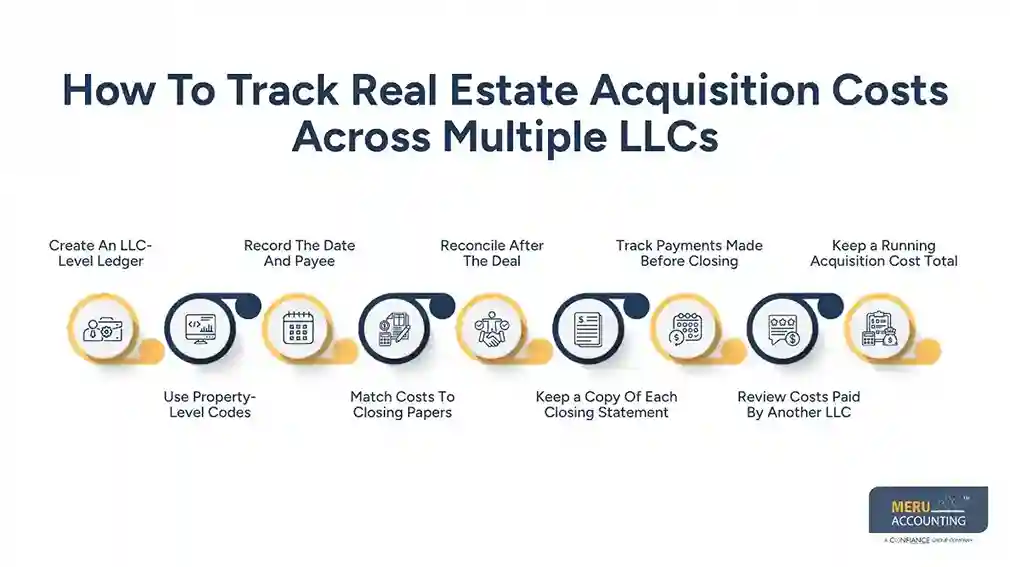
Keep a Copy Of Each Closing Statement
Store the closing statement with the related property records. The document can be used to check purchase costs, fees, credits, and other amounts recorded in the books.
Track Payments Made Before Closing
Some acquisition costs may be paid before the closing date, such as inspections, appraisals, or legal services. Record each payment with the property and LLC it relates to.
Review Costs Paid By Another LLC
When another LLC pays an acquisition cost, record the payment clearly between the two entities. The books should show which LLC paid and which LLC received the benefit.
Keep a Running Acquisition Cost Total
Maintain a running total of costs tied to each property purchase. A complete total gives the investor and tax team a clearer view of the funds spent on the acquisition.
optional anymore
on running the business
Which Acquisition Costs Should Real Estate Investors Record?
Purchase Price
The purchase price is the main cost of the property. Record the amount paid for the asset in the correct LLC rather than as a normal repair or operating cost.
Legal and Title Fees
Legal, title, and closing fees may be tied to the purchase. Real estate investor bookkeeping should keep these costs clearly linked to the related property so they can be reviewed when determining their appropriate treatment.
Inspection Costs
In bookkeeping for real estate investors, keeping inspection fees with the complete deal records makes it easier to identify the property and purpose of each cost. Some costs may be treated based on when and why the service was done, so the source bill matters.
Loan and Lender Fees
Loan fees need careful review because not every finance cost gets the same tax treatment. Keep lender statements and closing papers with the related property file.
Closing And Recording Fees
Recording charges, transfer costs, and other closing fees should be listed with the deal. The books should show enough detail for the tax preparer to review each item.
How To Separate Property And LLC Transactions
Use Separate Bank Accounts
Each LLC should have its own bank account where practical. Real estate investor bookkeeping becomes easier when each account clearly reflects the activity of one entity, reducing the risk of mixed funds.
Avoid Personal Payments
Personal cards should not be used for LLC purchases unless there is a clear process for recording the payment. If an owner pays a bill, the books should show the owner contribution or other proper entry.
Record Intercompany Payments
When one LLC pays a cost for another LLC, do not leave the payment without a clear note. Bookkeeping for real estate investors should show both sides of the amount due.
Check The Entity Name
Bills and closing papers should show the correct legal entity when possible. A wrong entity name can create extra work when records are checked later.
Reconcile Each LLC
Run a separate bank reconciliation for each LLC. Real estate investor bookkeeping should include entity-level reconciliations to identify unpaid costs, duplicate entries, or payments assigned to the wrong LLC.
How To Handle Shared Acquisition Costs Between LLCs
Find the True Beneficiary
First ask which property or LLC received the benefit from the cost. The answer should guide how the charge is split or assigned.
Use a Fair Split
If one bill covers two properties, real estate investor bookkeeping should use a fair basis such as actual use, unit count, square footage, or another sound method. Keep the reason for the split in the records.
Record Amounts Due
If LLC A pays a bill for LLC B, record the amount due between the entities. Do not treat the full payment as a cost of LLC A when LLC B received the benefit.
Keep a Shared-Cost Log
A shared-cost log can list the bill, total amount, entities involved, split method, and amount charged to each LLC. Such a log strengthens real estate investor bookkeeping by giving the tax team a clear audit trail.
Review the Split
Regular reviews are an important part of bookkeeping for real estate investors, especially when several LLCs share acquisition-related costs. Multi-LLC bookkeeping needs regular review because small errors can spread across more than one entity.
Capitalized Acquisition Costs Vs. Deductible Expenses
Understand The Difference
Not every cost linked to a property purchase is a current expense. Some costs may need to be added to the property’s basis and recovered over time under tax rules.
Add Proper Costs To Basis
Costs that form part of the property’s basis should be recorded as part of the asset when required. The exact treatment should be checked under the applicable tax rules.
Separate Repair Costs
A repair made after a property is placed in service may have a different tax treatment from a cost tied to buying the property. Real estate investor bookkeeping should keep the invoice and date so the nature of the work is clear.
Watch Loan Costs
Certain loan costs may be handled over time rather than charged at once. A tax professional should review lender fees before the final entry is made.
Ask Before Making Tax Entries
Bookkeeping for real estate investors records the facts, but tax treatment can require professional judgment. When a cost is unclear, retain the source document and ask a qualified tax adviser.
How Multi-LLC Bookkeeping Supports Accurate Tax Reporting
Keep Each Entity Separate
Each LLC needs records that match its own income, costs, assets, and debts. This makes it easier to prepare the right tax return or information report for each entity.
Build a Clear Audit Trail
A strong audit trail connects the bank payment to the invoice, property, LLC, and closing record. Accurate bookkeeping for real estate investors keeps these supporting records organized and makes past transactions easier to verify.
Track Owner Contributions
Owner funds put into an LLC should be recorded in the right account. Real estate investor bookkeeping should distinguish owner contributions from income to avoid distorting the books and financial picture.
Check Intercompany Balances
Balances between LLCs should be reviewed on a set schedule. Any amount due should have a clear source and a matching entry where required.
Review Tax Basis
The property basis should be built from the right purchase records and eligible costs. Accurate real estate investor bookkeeping gives the tax team a stronger base for this review.
How Meru Accounting Helps With Real Estate Investor Bookkeeping
Separate Books For Each LLC
Meru Accounting can maintain separate books for each LLC while keeping the investor’s full property portfolio organized. Our bookkeeping for real estate investors helps maintain clear records across multiple entities. Each entity can have its own income, costs, assets, debts, and bank activity.
Track Property Acquisition Costs
Our team can record purchase-related costs against the right property and LLC, which is an important part of accurate real estate investor bookkeeping. Closing statements, invoices, lender records, and payment details can be checked before entries are finalized.
Manage Shared Costs
When one LLC pays a cost for another entity, the transaction needs a clear record. Meru Accounting can track these entries and maintain proper balances between related LLCs.
Reconcile Bank And Card Records
Regular reconciliation can find missing, duplicate, or wrongly coded transactions. Keeping bank activity matched with the books gives investors a cleaner record for each entity.
Prepare Records For Tax Review
Meru Accounting can organize financial records so tax professionals have clear source data at filing time. The process can include property-level reports, acquisition cost records, and LLC-level account details.
Our Expert Perspective
Our experience shows that real estate investor bookkeeping works best when records follow each LLC’s legal structure from the beginning. Keeping closing statements, invoices, loan documents, and payment records together makes each deal easier to review, while tax treatment should be confirmed with a CPA or tax adviser rather than assumed. Related-party payments also require clear notes and matching entries, and regular monthly or quarterly reviews of acquisition costs, intercompany balances, and property records can help identify and correct errors before year-end.
Key Takeaways
- Keep a separate set of books for every LLC.
- Link every acquisition cost to the correct property and entity to maintain accurate real estate investor bookkeeping records.
- Keep closing statements, bills, loan records, and proof of payment.
- Do not mix personal, property, and LLC transactions.
- Record payments made by one LLC for another with clear intercompany entries.
- Use a fair and documented method for shared costs.
- Review whether a cost should be capitalized or treated as a current expense.
- Reconcile bank records after each property purchase.
- Keep an audit trail that connects each cost to its source document for stronger real estate investor bookkeeping controls.
- Ask a qualified tax professional when the tax treatment of a cost is unclear.
FAQs
Real estate investors should record each acquisition cost under the correct LLC and property while keeping invoices and closing records.
Track purchase price, title fees, legal fees, inspections, lender fees, recording fees, and other costs linked to the property purchase.
Assign every cost to the LLC and property that received the benefit, and document any shared or intercompany costs clearly for accurate real estate investor bookkeeping across entities.
Not always, because some acquisition costs may be added to the property’s tax basis instead of being deducted in the current year.
Multi-LLC bookkeeping keeps each entity’s income, expenses, assets, and acquisition costs separate for clearer financial and tax records.
optional anymore
on running the business