
Managing money flow in a business is more than tracking sales and expenses. One key part of bookkeeping is handling unsettled funds. A proper undeposited funds journal entry records payments received but not yet in the bank. If this is not done right, it can cause wrong balances, mismatched accounts, and errors during audits.
In this blog, we explain what uncleared funds mean, how journal entries work, whether undeposited funds debit or credit, and how to record them step by step.
What You Will Learn From This Blog
- What undeposited funds are and why businesses use them.
- How customer payment entries are recorded correctly before bank deposits.
- How debit or credit accounting applies when recording pending customer receipts before bank deposits.
- The step-by-step process of recording pending deposits.
- Common bookkeeping mistakes that create reconciliation issues.
- How outsourced bookkeeping services improve accuracy.
- Best practices for maintaining clean financial records.
- How Meru Accounting helps businesses manage undeposited funds efficiently.
Introduction to Undeposited Funds
Unsettled funds are payments that a business has received but has not yet deposited into its bank account. These payments can be in the form of cash, cheques, or online transfers. Until they are deposited, they are recorded in a temporary account often referred to as “uncleared funds” or “undeposited funds.” Recording a proper journal entry for these transactions helps maintain accurate financial records and ensures that all incoming money is properly tracked.
Organizations that batch customer payments before depositing them into the bank use a temporary receipt account to track collections. This reduces recording errors and ensures deposits match accounting records.
Understanding Undeposited Funds Journal Entry
Meaning of Undeposited Funds Journal Entry
A journal entry for undeposited funds is a record in your books that shows money received but not yet in the bank. It keeps track of incoming payments until they are deposited while maintaining proper debit or credit accounting in the financial records. This ensures the amount in your records matches the actual deposits made to your bank account.
Importance of Accurate Recording
Accurate recording of uncleared funds helps you:
- Avoid double-counting payments
- Keep your cash account and bank account reconciled
- Maintain correct income reporting
- Simplify end-of-month bank reconciliations
A journal entry for undeposited funds tracks money you have received but not yet deposited in the bank, making it easy to follow pending payments. It helps you track payments until they are deposited safely.
How Outsourced Bookkeeping Services Manage Undeposited Funds
Accurate Data Recording
Outsourced bookkeepers record every customer payment at the time it is received with proper classification. This ensures entries are not duplicated, and all transactions are captured correctly while maintaining proper debit or credit accounting records.
Bank Reconciliation and Tracking
Regular reconciliation matches undeposited funds with actual bank deposits. This keeps records aligned and reduces the risk of missing or incorrect entries.
Error Detection in Entries
Bookkeeping professionals review transaction records to identify mismatches before they affect reports. Each entry is verified against supporting documents to maintain accuracy in the books.
Organized Payment Documentation
All payment records, receipts, and deposit details are maintained in an organized manner. Proper documentation makes audits and future record verification much easier.
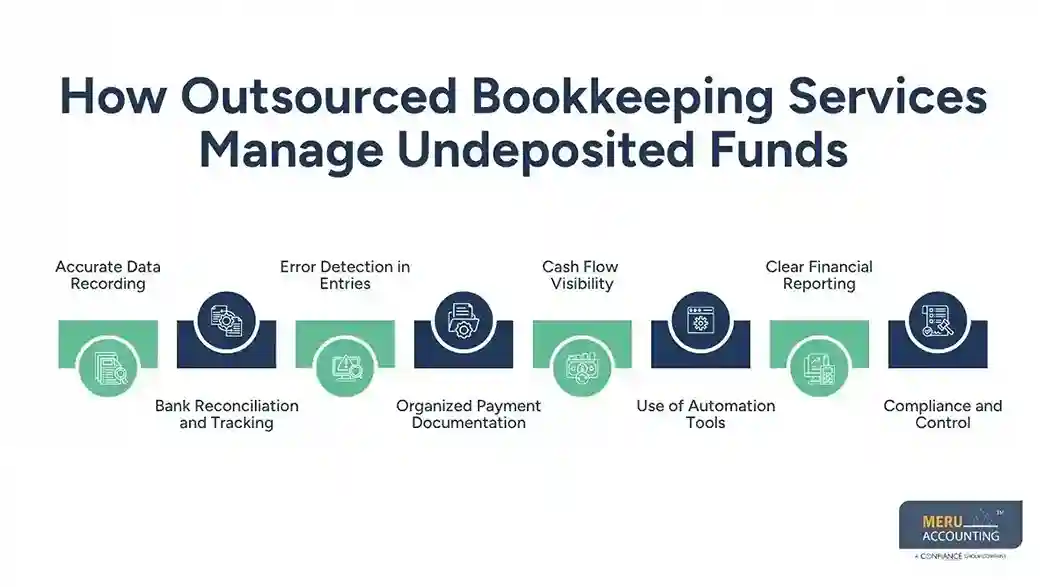
Cash Flow Visibility
Well-maintained records provide a clear picture of available cash and pending deposits. This allows businesses to make informed financial decisions with confidence.
Use of Automation Tools
Modern accounting systems automatically track payment entries and reduce manual work. These tools update records in real time and improve posting accuracy across ledgers.
Clear Financial Reporting
Structured reports provide a clear view of money collected but not yet deposited. This helps business owners understand their cash position and maintain transparency in financial data.
Compliance and Control
Proper handling of transactions ensures compliance with accounting standards and audit requirements. It also strengthens control over financial records and improves reliability during reviews.
Journal Entry for Undeposited Funds
Basic Structure of the Journal Entry
A typical journal entry for undeposited funds involves two main accounts:
Debit: Uncleared Funds (Asset account)
This temporarily holds the received amount until it is deposited in the bank, following standard debit or credit accounting principles. It acts as a holding account to ensure accurate tracking of receipts.
Credit: Accounts Receivable or Sales Revenue
This records the income earned or the reduction in customer balance. It ensures that all earned revenue is properly reflected in the books.
This shows that your business has received money but has not yet moved it to the bank. Once you make the bank deposit, the entry shifts from the uncleared funds account to your bank account, keeping your records accurate.
Examples of Recording Uncleared Funds
Example 1:
- A customer pays $500 in cash for services.
- Entry:
- Debit: Uncleared Funds $500
- Credit: Accounts Receivable $500
Example 2:
- Later, you deposit $1,500 from multiple customer payments into the bank.
- Entry:
- Debit: Bank Account $1,500
- Credit: Pending Funds $1,500
Example 3: Card Payment through Payment Gateway
- Imagine you receive $1,200 via an online gateway, but the funds are not yet in your bank account. You still record it as pending deposits. Later, when the gateway transfers money, you move it to your bank account.
This process ensures no gaps or duplicates occur between payment receipts and bank deposits.
Undeposited Funds: Debit or Credit?
When to Debit Uncleared Funds
- In debit or credit accounting, you debit pending deposits when customer payments are received but have not yet been deposited into the bank. This shows a rise in your temporary cash balance.
Example:
Payment received: $1,000
Journal Entry →
- Debit: pending Funds $1,000
- Credit: Accounts Receivable $1,000
When to Credit Uncleared Funds
- You credit the Uncleared funds when you move the money from the Uncleared funds account to your bank account. This shows that the holding account has reduced because the funds have been deposited.
Example:
- Deposit made: $1,000
- Entry: Credit Unsettled funds $1,000
Common Mistakes to Avoid
- Recording deposits directly to the bank account instead of using Uncleared funds first
- Forgetting to clear the Uncleared funds account after making a deposit
- Mixing customer payments with other sources of funds
Using proper undeposited funds journal entries prevents these issues and keeps your records clean.
How to Record Unsettled Funds Effectively
Record Each Payment
Each time a customer pays, log the amount in the Uncleared funds account instead of adding it straight to bank income. This keeps pending deposits separate and avoids wrong balances later.
Verify Payment Details
Check that every payment matches the invoice, including the amount, date, and method used. This avoids duplicate entries and keeps records clean and correct.
Group Payments into Batches
If you get many payments in one day, combine them into one batch deposit entry. This way, your records match the actual bank deposit, making reconciliation easy.
Create a Transfer to Bank
When you make the bank deposit, post a journal entry to move the total from uncleared funds to your bank account, completing the debit or credit accounting cycle accurately. This keeps your books updated and accurate.
Reconcile Often
Compare your bank statement with the uncleared funds account regularly. This helps you spot missing deposits, wrong amounts, or posting errors early on.
Use Accounting Software
Tools like QuickBooks or Xero make tracking uncleared funds simple. They automate entries, save time, and reduce mistakes from manual bookkeeping.
Tips to Avoid Errors in Entries
- Use accounting software to record uncleared funds quickly and accurately, ensuring proper tracking of all transactions.
- Verify each payment carefully before recording it to avoid mistakes in amounts or entries.
- Maintain receipts, slips, or other supporting documents for every cash or payment received.
- Avoid posting the same payment twice or missing any deposit while recording transactions.
By following these steps, your records for uncleared funds remain accurate, making bank reconciliation easier and reducing errors during audits.
Common Issues with Uncleared Funds and How to Resolve Them
Duplicate Transactions
This occurs when a payment is recorded twice, once in Uncleared funds and again directly in the bank account. It inflates income records. Always log payments first in Uncleared funds, then transfer after deposit.
Incorrect Debit or Credit Entries
Errors in debit or credit accounting for undeposited funds can create account imbalances and reconciliation issues. Debit the account for incoming funds and credit it only after you move the money to your bank.
Uncleared Balances in uncleared funds
Sometimes, entries are left uncleared even after a bank deposit is made. This shows false pending balances. Review this account weekly and clear all deposits to keep records accurate.
Mismatched Bank Deposits
If you deposit a different amount than what’s recorded in uncleared funds, your statements won’t match. Always check totals before batching payments to avoid confusion and extra work later.
Delayed Recording of Payments
Late posting of payments can create cash flow errors and make reconciliation harder. Record every payment as soon as you receive it to ensure real-time accuracy in your accounting system.
Lost or Missing Documentation
If you don’t keep receipts or payment details, it’s hard to track uncleared funds later. Always attach payment proofs or notes to each journal entry for clear audit trails.
Many businesses struggle with duplicate payments, wrong debit or credit postings, and uncleared balances.
How Meru Accounting Supports Your Business
At Meru Accounting, we ensure accurate journal entries so that every payment is recorded correctly. Our experts carefully track all transactions using accurate debit or credit accounting practices to avoid costly errors and maintain reliable financial records for your business.
We also manage debit and credit postings with complete precision, ensuring that all entries are properly balanced in your books and reducing the chances of mismatched accounts.
Our team handles bank reconciliation efficiently by making sure that uncleared funds always match your actual bank deposits, helping you maintain accurate and up-to-date financial statements.
We provide customized accounting solutions based on your specific business needs, whether you use QuickBooks, Xero, or any other accounting software, ensuring smooth and efficient financial management.
With Meru Accounting, you save valuable time as we handle the entire accounting process for you, allowing you to focus more on growing your business and improving overall operations.
Our Expert Perspective
From our professional experience, managing undeposited funds accurately is a fundamental part of effective bookkeeping and financial control. Businesses that do not properly record payments before they are deposited often face reconciliation discrepancies, duplicate transactions, inaccurate cash balances, and unreliable financial reports.
By following correct bookkeeping practices, including timely journal entries, regular bank reconciliations, and the use of modern accounting software, businesses can maintain accurate financial records, strengthen internal controls, and improve cash flow visibility.
Outsourcing bookkeeping to experienced professionals further enhances accuracy, ensures compliance with accounting standards, reduces administrative burden, and allows business owners to focus on strategic growth with confidence.
Key Takeaways
- Undeposited funds represent customer payments received but not yet deposited into the bank.
- Proper journal entries and accurate debit or credit accounting help prevent duplicate transactions and accounting errors.
- The temporary holding account is debited when customer payments are received and credited once the bank deposit is recorded.
- Regular bank reconciliation keeps financial records accurate and up to date.
- Accounting software simplifies the management of undeposited funds through automation.
- Organized documentation improves audit readiness and financial transparency.
- Outsourced bookkeeping services reduce manual errors and improve cash flow management.
- Accurate bookkeeping supports better business decisions and regulatory compliance.
FAQs
What are undeposited funds in accounting?
Undeposited funds are customer payments received but not yet deposited into the business bank account.
Why is an undeposited funds account important?
It helps track pending payments, prevents duplicate entries, and simplifies bank reconciliation.
Are undeposited funds a debit or credit?
Under debit or credit accounting, uncleared funds are debited when payments are received and credited once the related bank deposit is recorded.
Which accounting software supports undeposited funds?
Software like QuickBooks, Xero, Zoho Books, Sage, and NetSuite supports undeposited funds management.
What happens if undeposited funds are not cleared?
Uncleared balances can cause reconciliation issues and inaccurate financial reporting.
optional anymore
on running the business