
Running a restaurant is more than good food and good staff. You also need a clear view of sales, costs, cash, and profit. As a restaurant grows, basic accounts may no longer give you the data you need to keep the business running. This is when restaurant accounting solutions can add real value. They can help bring sales, costs, bills, payroll data, and bank data into one clear view. With the right setup, you can spend less time on books and more time on your guests, staff, and growth.
But when should you invest? Not every small restaurant needs a full set of tools or external help from day one. The right time is often when your accounting starts slowing you down, key costs become difficult to track, or you can no longer rely on your financial data to make decisions.
This blog looks at the key signs that show it may be time to change your accounting process. It also covers how restaurant accounting solutions can help with food and labor costs, when to seek external help, and how to find the return on your bookkeeping costs.
What You Will Learn From This Blog
In this blog, you will learn:
- How to tell if your accounts no longer fit your needs.
- When restaurant accounting solutions can help with your bookkeeping.
- How better accounts can help track food and labor costs.
- When accounting services for restaurants may be worth the cost.
- How to look at the time and cost saved from better accounting.
- What to look for when you pick an accounting setup.
Signs Your Restaurant Has Outgrown Basic Bookkeeping
Basic bookkeeping can work well for a small food shop with few sales, few staff, and one site. But as sales and work grow, the same setup can start to fall short.
You Spend Too Much Time In Bookkeeping
If you spend hours each week recording data, checking bills, or fixing books, that time has a real cost. Your time may be more valuable if used on staff, guests, sales, or new plans. A good accounting setup can cut down on manual tasks. It can also help you get all the accounting data in one place.
You Cannot See Your True Costs
Food cost and labor cost can take up a large part of a food shop’s sales. If you do not have a clear view of these costs, it can be hard to know where your profit goes. You may see strong sales and still have a weak profit. Good books can help you spot that gap.
Your Cash Flow Is Hard to Track
A restaurant can have high sales and still face cash flow stress. Bills, rent, wages, tax, stock buys, and other costs may all fall due at set times. If you do not have a clear view of cash in and cash out, it can be hard to plan ahead.
Your Month-End Work Takes Too Long
A lengthy month-end close can delay important business decisions. If your reports are late, you may not discover a cost issue until weeks after it begins. Accurate and up-to-date books can give you a clearer view of what happened and where your attention is needed next.
You Are Adding More Sites
A second site can bring more sales, staff, stock, bills, and bank data. It can also make it much harder to track each site by hand. This is a key point where restaurant accounting solutions can help you keep data neat and make site-to-site checks easier.
How Restaurant Accounting Solutions Help Control Food and Labor Costs
Food and labor are two key costs for most food shops. Small changes in these costs can have a big effect on profit.
Track Food Costs With More Care
Organized data can help you track what you spend on food and other stock. You can then look at costs over time and see if they rise more than sales.
For a food shop, this can help you ask key questions:
- Did food spend rise this month?
- Are stock purchases in line with sales?
- Did the cost of key items rise?
- Are waste or loss issues worth a closer look?
The goal is not just to track each bill. The goal is to use the data to make smart calls.
Keep a Close Eye on Labor Costs
Labor is also an important cost for a restaurant. Payroll, tax, and staff hours can add up fast. With the right records, you can track labor costs as part of your cost analysis. This can help you see if labor spend is in line with sales and your plan.
See Cost Trends
One month of data may not tell the full story. A trend can show more. For this reason, restaurant accounting solutions can be most useful when they help you look at data over time. You can see where costs rise, where sales shift, and where you may need to act.
When Should You Consider Accounting Services for Restaurants?
Not all restaurants need the same level of help. Some owners can keep day-to-day books in-house with good tools. Others need a bookkeeper or an external firm to help keep the work on track.
Accounting services for restaurants may make sense when the books have grown too hard to manage on your own. Here are some key situations when it is useful:
When Your Restaurant Is Growing
Growth is a good thing, but it can add more work. More sales mean more bills, more staff data, more bank activity, and more records. External help can let you keep your focus on growth while an expert helps keep the books in order.
When You Lack In-House Accounting Skills
Restaurant skills and accounting skills are not the same. You may know your menu, guests, staff, and daily flow very well without having the time or skill to manage all parts of your accounts. In this case, accounting services for restaurants can help fill that gap.
When Errors Keep Showing Up
Small bookkeeping errors can lead to bad reports. A missed bill, wrong entry, or account that is not checked can change the view of your profit and cash. If you keep finding errors, it may be time to bring in more support.
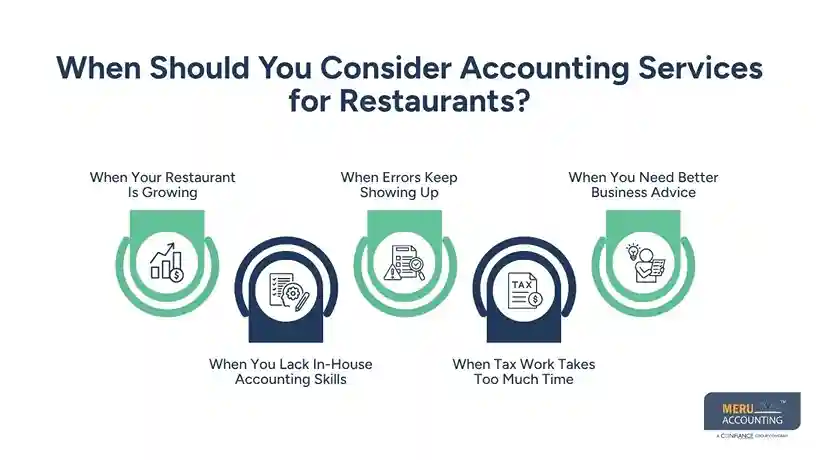
When Tax Work Takes Too Much Time
Tax work needs clean and well-maintained books. If your records are not up to date, tax preparation can take more time and may be harder to manage. A strong accounting process can help keep records ready for review and tax work.
When You Need Better Business Advice
As a restaurant owner, you may need support to understand your finances and use them to plan. That is where the value of outsourced accounting can go beyond basic bookkeeping.
optional anymore
on running the business
How to Calculate the ROI of Restaurant Accounting Solutions
Before you invest in restaurant accounting solutions, look at the full cost and benefits. The goal is not to pick the tool or service with the lowest price. The goal is to find the option that gives your business more value.
Start with the time you spend on books.
For example, if you spend 10 hours a month on work that could be cut down, ask what that time is worth. You may be able to use those hours for sales, staff, site work, or new plans.
Next, look at the cost of errors. Wrong data can lead to poor calls on food, labor, cash, and other costs. While it may be hard to put a set value on each error, you can track how often they occur and how much time they take to fix.
Then look at the value of faster reports. If you can see key data sooner, you may spot cost issues sooner as well.
A simple ROI check can include:
- Time saved each month.
- Fewer bookkeeping errors.
- Less time spent on fixes.
- Faster month-end reports.
- Better cost tracking.
- More time for core business work.
You should also look at the cost of growth. If you plan to add sites, staff, or sales channels, ask if your current setup can handle that growth. Using outsourced restaurant accounting solutions may fit all your needs while also giving you room to grow.
Meru Accounting's Restaurant Accounting Solutions
Meru Accounting helps restaurant owners keep their accounting work clearer and well-managed. Our restaurant accounting solutions are built to support the needs of food businesses, from day-to-day bookkeeping to key financial tasks.
Our goal is to give restaurant owners a better view of their books so they can spend less time on back-office work and more time on the business.
Our restaurant accounting solutions can help with key areas such as:
- Recording and sorting income and costs.
- Bank and account checks.
- Financial reports.
- Tracking key restaurant costs.
- Keeping books up to date.
- Support for tax-ready records.
- Ongoing bookkeeping and accounting needs.
The right level of help can vary by restaurant. A small single-site food shop may need a simple setup, while a growing group may need more hands-on support. Meru Accounting has successfully served restaurants of all types and sizes. Our solutions have made a significant impact on their business growth.
If your books are taking too much time or you are not getting the data you need, it may be worth reviewing your current process. Meru Accounting can help you assess your needs and build a better way for your restaurant’s accounting work.
Our Expert Insight
The best time to invest in better accounting is not based on sales alone. It is based on how well your current process serves the business. If you can maintain books, get timely reports, track key costs, and use your data with trust, your current setup may be enough. But if you are often late with books, unsure of your true profit, or spending too much time fixing data, waiting may cost more than making a change.
We also see value in making the move before growth puts too much stress on the process. It is much easier to build a sound accounting system before a second site, a larger team, or a sharp rise in sales makes the books much harder to manage.
The key is to view accounting as a business tool, not just a task that must be done. Modern restaurant accounting solutions can help you see where the business stands and make better calls for what comes next.
Key Takeaways
- Restaurant accounting solutions can help bring key financial data into one clear view.
- Basic bookkeeping may stop being enough as sales, staff, costs, or sites grow.
- Food and labor costs need close tracking because they can have a major effect on profit.
- Before you invest, review the time saved, fewer errors, faster reports, and better cost control.
- Choose a setup that fits your current needs and can grow with your restaurant.
- The right accounting support can give owners more time to focus on guests, staff, and growth.
FAQs
Consider professional restaurant accounting solutions when bookkeeping takes too much time, financial records become difficult to manage, or your restaurant is growing. Adding employees or opening another location can also be a good time to get support.
They can include bookkeeping, bank reconciliation, income and expense tracking, financial reporting, payroll records, and tax-ready financial records.
Costs vary based on transaction volume, payroll, number of locations, and the level of support needed. A small restaurant will typically have different needs than a multi-location restaurant group.
Not always. Small restaurants can often use accounting software for basic tasks, but professional help can be useful when the books become complex or take too much time.
Yes. Accurate financial records help owners review cash flow, costs, and profits before opening another location. This can support better budgets and growth plans.
optional anymore
on running the business