
Tax season doesn’t have to mean turning away new clients, pushing other work aside, or asking your accounting staff to work late every night. For many businesses and CPA firms, the bigger challenge is having enough qualified people to handle a sudden increase in tax returns. A seasonal tax preparer can help fill that gap without the cost and commitment of another full-time hire.
Outsourcing also gives businesses a way to handle tax work as demand changes. But is adding outside tax professionals enough to keep returns on schedule? Let’s look at how seasonal tax preparation services for businesses can help manage filing workloads, where they make the biggest difference, and what businesses should consider before hiring an outside team
What You Will Learn From This Blog
- Why tax returns fall behind during peak tax season.
- What an outsourced seasonal tax preparer does.
- How extra tax staff can help reduce filing delays.
- Which firms and businesses can gain from seasonal tax support.
- When to hire an outside tax team and how to choose one.
- How to plan tax work, review records, and meet key dates.
Why Businesses Experience Tax Filing Delays During Peak Tax Season
Tax filing delays rarely come from one issue. In most cases, they stem from a mix of staff gaps, poor records, slow reviews, and late client input. Knowing where work gets stuck can help a business fix the cause before it puts a filing date at risk.
1. Higher Workloads and Limited Staff
Tax season brings more work in a short time. A small team may need to handle many tax returns while still keeping up with daily books, payroll, and reports. When staff have too much to do, tax prep tasks can pile up.
2. Missing or Incomplete Tax Records
Tax returns rely on clear and full records. Missing bank data, sales reports, expense bills, payroll forms, or tax forms can slow down prep work. Staff may need to send more than one request to get the right data.
3. Delayed Book Reconciliation
If bank, card, and loan accounts are not up to date, the tax team may not have a clear view of the books. Open items and wrong entries can lead to more checks before a return is ready.
4. Slow Review and Approval
A tax return may be ready for review but still wait for a manager, CPA, or business owner to check it. If the review team has a large queue, even well-prepared returns can face delays.
5. Late Changes in Business Data
A late change in sales, costs, asset data, or owner details may affect a return. The tax team must check the new data and update the return before it can move ahead.
What Does an Outsourced Seasonal Tax Preparer Do?
An outsourced seasonal tax preparer gives a business extra tax prep support for a set time. They may work with the in-house finance team, a CPA firm, or a tax lead to help manage the rise in work during tax season.
Their tasks can vary based on the business, the type of return, and the terms of the work.
Common Duties of a Seasonal Tax Preparer
- Check tax records: Review books, bank data, sales records, and tax forms for gaps or errors.
- Prepare tax returns: Draft business tax returns based on the records and data made ready for tax work.
- Sort tax data: Group income, costs, payroll data, and asset records in a clear way.
- Flag open items: List missing data, odd entries, and items that need a closer look.
- Support tax reviews: Make changes based on review notes and help keep work files in order.
- Track return status: Update the team on work done, open items, and returns that still need review.
Which Tax Returns Can They Help Prepare?
Based on their skills and the scope of work, seasonal tax staff may help with:
- Sole proprietor tax returns.
- Partnership tax returns.
- S corporation tax returns.
- C corporation tax returns.
- Basic tax schedules and workpapers.
- Tax data for multi-entity businesses.
A seasonal preparer must have the right skills for the returns they handle. A CPA or other tax lead may still need to review complex tax issues, sign returns where required, and guide final filing steps.
Can Outsourced Seasonal Tax Preparers Help Businesses Avoid Tax Filing Delays?
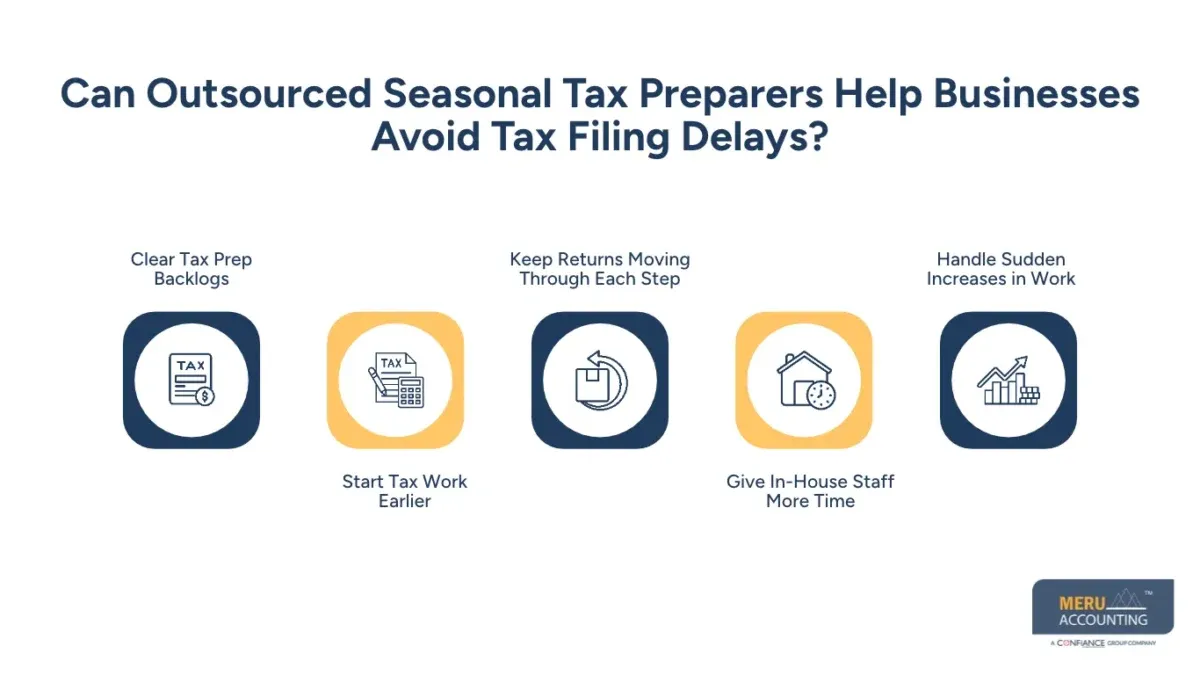
Yes. An outsourced tax team can help reduce delays by adding more hands to the work, clearing backlogs, and keeping each return on track. But this works best when the business has a clear process and shares the right records on time.
Here are five ways an outside tax team can help.
1. Clear Tax Prep Backlogs
When in-house staff have more returns than they can handle, work starts to pile up. A seasonal tax preparer can take on part of that load. This lets the core team focus on complex returns, client needs, and final checks.
2. Start Tax Work Earlier
An outside team can help sort records and flag missing data before the main tax rush. Early prep gives the business more time to fix gaps rather than deal with them close to a due date.
3. Keep Returns Moving Through Each Step
A clear work plan can show which returns are ready, which need more data, and which are waiting for review. This makes it easier to spot delays and act before they grow.
4. Give In-House Staff More Time
When outside staff handle routine prep tasks, in-house accountants can focus on work that needs their direct input. They can review key tax issues, speak with clients, and check the final numbers.
5. Handle Sudden Increases in Work
Some firms see a sharp rise in client demand near tax dates. Outsourced staff can add short-term support without the time and cost of a full hiring process for permanent roles.
An important point: Outsourcing tax prep does not mean a return will be filed on time by itself. The business must still share full records, check the return, give approval, and meet any filing steps that apply. A good outside team helps with prep and workflow, but it cannot replace these duties.
How Seasonal Tax Preparation Services for Businesses Improve Tax Season Efficiency
Good tax prep is not just about getting more returns done. It also needs a clear process, good records, and enough time for review. Seasonal tax preparation services for businesses can help improve each part of this process.
1. Add Staff Without Long-Term Hiring Costs
Hiring full-time staff for a short tax rush may not make sense for every business. Outsourcing lets firms add tax prep support for the months when they need it most. They can scale the team up or down based on the number of returns and the type of work.
2. Improve Document Checks
An outside tax team can use a set list to check the records needed for each return. This helps staff spot missing forms, wrong figures, and open items early. It also cuts the need for repeated requests near the due date.
3. Set Clear Work Steps
Each return should move through set steps, such as:
- Collect tax records.
- Check books and key figures.
- Prepare the return.
- Send it for review.
- Fix any issues found.
- Get client approval and file the return.
A shared task list can help both teams see what is done and what still needs work.
4. Support Better Teamwork
Outsourced tax staff can work with in-house bookkeepers, accountants, and CPAs. Clear roles help avoid duplicate work and make it easier to pass open items to the right person.
5. Make It Easier to Track Tax Work
A tax work tracker can show the status of each return, the person in charge, missing records, and due dates. This gives managers a clear view of the work and helps them act when a task falls behind.
optional anymore
on running the business
Which Businesses Benefit Most From Outsourced Seasonal Tax Preparers?
Not every business needs extra tax staff each year. But firms with a sharp rise in tax work or a small in-house team may gain the most from this model.
- Small and mid-sized businesses: They can get extra tax prep help without adding full-time staff.
- CPA and accounting firms: They can handle more client returns during peak months without overloading their core team.
- Startups: They can get help with tax records and return prep while keeping their own team lean.
- Multi-entity businesses: They can use extra support to sort records and prepare data across more than one entity.
- Growing companies: They can manage a rise in tax work as sales, staff, and business activity grow.
For CPA firms, outsourced support can be useful when client demand rises faster than the firm can hire and train new staff. The firm can keep control of client contact, tax advice, review, and filing while the outside team helps with agreed prep tasks.
Outsource Seasonal Tax Preparation Services for Businesses by Meru Accounting
A growing tax return backlog needs more than extra hands. It needs people who understand tax workpapers, financial records, return preparation, and the review process. Meru Accounting helps businesses and CPA firms add skilled tax preparation support during peak filing periods, so their in-house teams can focus on complex returns, client communication, and final reviews.
Our outsourced seasonal tax preparation support includes:
- Business Tax Return Preparation: Assistance with preparing returns for partnerships, S corporations, C corporations, and other business entities.
- Tax Workpaper Preparation: Organizing income, expenses, deductions, and supporting records for review.
- Tax Data Verification: Checking financial information and flagging missing records or discrepancies before return preparation.
- Bookkeeping and Account Reconciliation: Bringing financial records up to date so tax professionals can work with accurate figures.
- Tax Return Review Support: Addressing review notes, updating workpapers, and helping resolve open preparation items.
- Catch-Up and Cleanup Accounting: Helping businesses clear pending bookkeeping tasks that could hold up tax preparation.
Our team brings practical experience in business accounting and tax preparation, supported by structured review and quality-check processes. We work with your existing team and follow your preferred workflows, software, and reporting requirements.
Whether you need help clearing a backlog of business returns or additional preparation capacity throughout tax season, Meru Accounting can provide the support needed to keep work moving and reduce avoidable delays.
Our Expert Insight
A common mistake during tax season is treating every return as equally urgent. In practice, a business with a complex ownership structure, several state filings, or changes in its tax position may need more preparation and review time than a routine return. Assigning work based only on filing dates can leave complex returns until the last minute.
We recommend ranking returns by complexity as well as due date. For example, returns involving multiple entities, asset sales, changes in ownership, or unusual business expenses should be identified early and assigned to staff with the right experience. This helps prevent avoidable rework and gives reviewers enough time to address tax issues before filing.
Our view: The real value of an experienced seasonal tax preparer isn’t just getting more returns off the desk. It’s knowing which returns need closer attention, what information may affect the tax result, and when an issue needs to be escalated to a CPA or tax advisor.
Key Takeaways
- A seasonal tax preparer can help businesses manage peak-season workloads without hiring permanent staff.
- Outsourced tax teams can help clear prep backlogs, check records, and keep returns moving.
- Early document collection and book reconciliation can reduce last-minute tax work.
- CPA firms and growing businesses can use seasonal support to handle higher client demand.
- Outsourcing does not remove the need for proper review, client approval, and timely filing.
- A clear work plan and reliable tax preparation partner can make tax season easier to manage.
FAQs
Yes. A seasonal tax preparer can help manage extra returns, clear preparation backlogs, and keep tax work on schedule. Timely filing still depends on complete records and proper review.
Costs depend on the number of returns, their complexity, and the level of support needed. Providers may charge hourly rates, per-return fees, or fixed project fees.
Businesses should arrange support before tax season gets busy. Early planning gives the outsourced team time to review the workload and prepare for upcoming deadlines.
Yes. CPA firms can outsource return preparation, workpapers, and tax data entry while keeping control of client communication, tax advice, final review, and filing.
Common documents include prior-year tax returns, financial statements, bank statements, payroll records, expense reports, and fixed asset schedules. Additional records may be needed based on the business type.
optional anymore
on running the business