Shopify accountants do more than record sales and bank data. They may check payouts, refunds, fees, tax data, stock data, bills, and key reports. Clear KPIs help show if Shopify accountants do this work with care, meet due dates, and give owners sound data.
In 2026, online stores have more data from sales sites, payment tools, and book apps. Shopify finance reports can show sales, payment data, fees, and gross profit. The Shopify Payments activity report can show balance movements, fees, and payouts. These reports may use a set time or date that is not the same as the books. So, they should not be seen as the same book data.
The issue is not a lack of data. The real issue is the choice of KPIs. A poor KPI can make good work seem slow. It can also make poor work seem fast. This guide looks at key KPI errors and ways to set fair and useful goals for Shopify accountants.
What You Will Learn From This Blog
- Which KPIs matter most for Shopify accounting work in 2026.
- How poor KPI plans can cause errors, rushed work, and weak reports.
- How to set goals based on role, workload, and store size.
- Which book and report results to track each month.
- How Shopify accounting services can set a clear KPI plan.
- How to build a KPI plan that tracks both speed and care.
Why the Right KPIs Matter for Accounting Accuracy and Business Growth
A KPI should answer a clear work or business need. For example, “How many tasks were done?” tells us very little about the work. “What share of the month’s data was checked with no open major error?” gives a much better view.
For Shopify accountants, good KPIs can link day-to-day work with sound book control. They can show if reports are done on time, if bank and payout data match, and if errors are found before they affect key choices.
Good records also matter for tax work. The IRS says that firms should keep records that show income and costs and back the sums used on tax forms. So, KPI use is not just a staff check. It is also part of good book and tax control.
optional anymore
on running the business
What KPIs Should Shopify Accountants Track in 2026?
Accuracy and Error Rates
Accuracy should be a key KPI for Shopify accountants. Track wrong entries, wrong account codes, repeat entries, lost data, and wrong tax codes.
A good goal can be a low error rate, not just a set task count. Each error should also be checked to find its cause, not just added to a list.
Reporting Turnaround Time
A report can be right but still be late. That can cause a real issue for the firm. Track the time from the set cut-off date to the date the final report is sent.
For example, a store may set a goal of five work days after month-end. The goal should allow time to check the data and fix any gaps.
Reconciliation Completion
Reconciliation checks if book data fits bank, pay, or other source data. Shopify accountants should track both the work done and any open gaps.
Shopify notes that its Payments activity report can be used for period checks and month-end work. Its finance reports may show other totals or time spans. This is why the data must be checked with care.
Cash Flow and Financial Reporting Metrics
Cash flow KPIs can show if cash moves as planned. Useful data can include unpaid bills, pay delays, cash balance moves, and report status.
The aim is not to make an accountant own each cash move. The aim is to check if the book data gives owners a sound base for cash plans.
Tax and Compliance Accuracy
Tax work needs care. Track tax file readiness, missing data, tax code errors, late work, and review notes.
The right tax KPI will vary by store, state, and tax duty. A KPI should track book and tax control. It should not claim a tax result that may rely on facts the accountant does not own.
Common Mistakes When Setting KPIs For Shopify Accountants
Setting too Many KPIs at Once
A long KPI list can turn a good review into a box-checking task. Shopify accountants may spend more time on scorecards than on the work they are meant to check.
Start with four to six key KPIs. Add more only when there is a clear need to track them.
Choosing KPIs That are Hard to Measure
A KPI should use data that can be checked with ease. Terms such as “good reports” or “strong work” are too broad.
A better KPI is: “Monthly report sent within five work days with no major open error.” The result can be checked from the work log and report file.
Focusing Only on Speed Instead of Accuracy
Fast work is not good if the data needs major fixes later. This is a key risk when you measure Shopify accountants.
For example, closing 1,000 entries in one day may seem good. But a review may find repeat sales, missed fees, or wrong payout entries. Speed must be checked with work quality.
Using the Same KPIs for Every Shopify Accounting Role
Not all Shopify accountants do the same work. A bookkeeper, senior accountant, tax expert, and book check lead should not have the same KPI set.
A bookkeeper may focus on entry quality and bank checks. A senior accountant may also own month-end checks and key reports.
Ignoring Transaction Volume and Business Size
A store with 300 orders a month is not the same as one with 30,000 orders. One goal for both can lead to an unfair score.
KPI goals should take note of order count, pay tools, sales sites, refunds, cash types, stock needs, and the number of accounts that need checks.
Setting Unrealistic Targets
A goal should be hard enough to matter but still fair in normal work. Goals that are too hard can lead to rushed work or weak checks.
If an accountant must work late each month just to meet a goal, the goal may be a measure of stress, not work quality.
Tracking Activity Instead of Outcomes
A count of emails, entries, or closed tasks does not always show work value. Shopify accountants should be judged more on the end result.
For example, “500 entries posted” is an activity KPI. “99% of tested entries were right after review” gives a better view of book quality.
Failing to Define How Each KPI will be Calculated
Two managers may use the same KPI but work out the score in two ways. This makes the score hard to trust.
Each KPI should have a clear formula, data source, review time, owner, goal, and rule for special cases. This keeps the review fair.
How To Build An Effective KPI Framework For Shopify Accountants
Define the Accounting Goal
Start with the result the store needs. It may be clean month-end books, on-time reports, sound bank checks, or better tax file prep.
The KPI should then track that result. It should not just count how much work was done.
Select the Right Metric
Pick a metric that fits the goal. If the goal is clean books, error rate and bank check quality may be more useful than the count of entries posted.
For Shopify accountants, good KPIs often mix work quality, time, and control.
Set a Measurable Target
Use a number, time limit, rate, or clear status. For example: “Finish bank and payout checks by the fifth work day.”
Goals should use past data and real workload when that data is available.
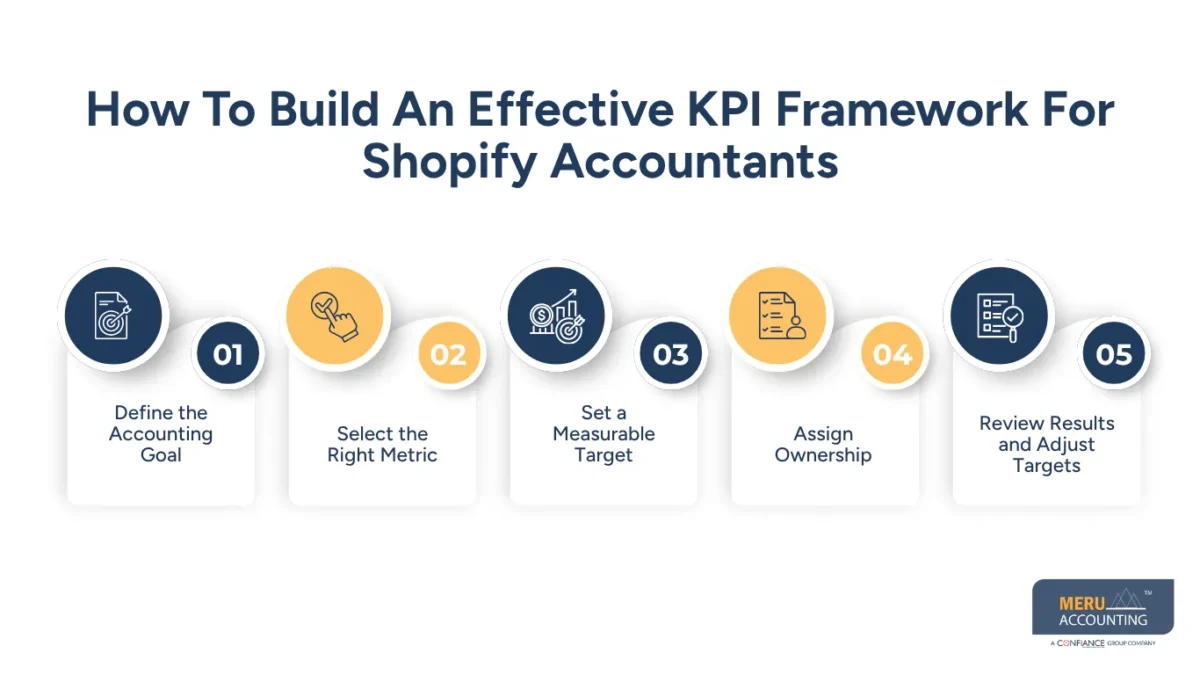
Assign Ownership
Each KPI needs one clear owner. That person should know what data is used and when the score will be checked.
This does not mean the accountant controls each part of the KPI. If a report is late because key data came in late, that fact should be noted in the KPI review.
Review Results and Adjust Targets
A KPI should not stay the same for all time. Review it each month or quarter and ask why the score went up or down.
If a store doubles its order count, its old goal may no longer fit. The goal is to keep the KPI fair as the store grows or changes.
KPI Examples for Shopify Accountants in 2026
Reconciliation Accuracy
Measure the share of bank, pay, and payout accounts checked with no major open gaps.
This is useful for Shopify accountants who work with stores that have many pay tools or a high order count.
Reporting Turnaround Time
Track the number of workdays needed to finish and send the monthly reports after the set close date.
Set a clear start and end point. This keeps the score based on facts, not on a manager’s view.
Error Rate
Track book errors found in a review or fix check. Split major errors from small format or code issues.
This gives a better view than just counting all fixes as the same type of error.
Accounts Receivable and Payable Metrics
Track late receivables, bill time, unpaid vendor bills, and the age of open balances when these tasks are part of the role.
The right KPI will depend on what the accountant can own and control.
Tax Filing Readiness
Track if key records, reports, and source files are ready before the set tax date.
The KPI should focus on file prep and record quality. It should not promise that a tax body will accept a tax file.
Financial Reporting Completion
Track if profit and loss reports, balance sheets, cash flow reports, and other agreed reports are done by the set date.
The report should also pass a set check before it is marked as done.
How Shopify Accounting Services Can Improve KPI Tracking
Standardizing Accounting Processes
Clear steps make KPI data more consistent and easy for Shopify accountants to check. Shopify accounting services can use set steps for entry checks, bank checks, month-end work, and report review.
This gives managers a fair way to check results over time without changing the rules each month.
Improving Financial Data Quality
A KPI is only as good as the data used to make it. Shopify accounting services can set rules for source checks, account maps, payout checks, and fix logs.
Shopify has finance reports and export tools that can serve as source data for review and report work.
Creating Regular KPI Reports
A monthly KPI sheet can show accuracy, work time, bank and payout status, open issues, and report status.
This gives Shopify accountants and managers one place to see trends. They do not have to wait for a large issue to grow.
Supporting Better Financial Decisions
Good KPI data gives owners a clear view of book quality. It can show where work is slow, where errors keep coming back, and where more checks are needed.
This makes Shopify accounting services more useful to the firm. The focus moves from task count to sound book control.
How Meru Accounting Approaches KPI Management for Shopify Businesses
Clear Accounting Goals
Meru Accounting sets book goals based on the store’s size, sales count, report needs, and book setup. This gives Shopify accountants a clear view of what needs to be checked and done each month.
Focus on Accuracy First
Meru Accounting puts a strong focus on clean books, right entries, account checks, and on-time bank and payout work.
This keeps KPI tracking tied to the quality of the work, not just the number of tasks done.
Practical Performance Measures
The KPI plan can cover bank and payout check rates, error rates, report status, open items, and report time.
These measures give store owners a clear view of how their book work is going.
Regular Financial Review
Meru Accounting checks book data at set times to find gaps and repeat errors.
This makes it easier to fix issues before they affect month-end reports, cash plans, or tax files.
Better Reporting for Business Owners
Clear reports give owners useful data on sales, costs, cash, and profit.
With well-run Shopify accounting services, KPI data can form part of the full finance review. It does not have to be a stand-alone staff score.
Our Expert Perspective
KPI tracking works best when it fits the real work done by Shopify accountants. A store with high sales, many refunds, many pay tools, and a large order count needs goals that may not fit a small store. In our view, the best KPI plan has few key measures, clear rules, and a fair mix of speed and accuracy. This gives staff a fair review and gives owners data they can use.
Key Takeaways
- Set KPIs for accuracy, report time, bank checks, and tax work.
- Do not judge Shopify accountants by speed alone.
- Match goals with order count and store size.
- Set the rule for each KPI before you start to track it.
- Use role-based KPIs for different accounting jobs.
- Review KPI results on a set plan and change goals when the store changes.
- Use Shopify accounting services with clear work steps when a store needs better book control.
- Keep source data complete because good records are needed for reports and tax work.
FAQs
Measure Shopify accountant performance with clear goals for accuracy, work time, bank checks, reports, and tax work.
A good accuracy KPI tracks the share of book work done with no major errors or open gaps.
Shopify accountant KPIs should be reviewed each month. Goals can be reset when workload, sales count, or store needs change.
Shopify accounting services should track bank and payout check rates, error rates, report time, open book items, and tax file readiness.
Set fair KPIs by looking at order count, store size, job role, past results, and the time needed for a full check.
optional anymore
on running the business