
A realtor gets 40 new leads in a week. Ten are not called on time. Six get no next call. Three have the wrong CRM status. By week-end, the virtual assistant for realtors may still say all tasks are done. But was the work good?
This is why hiring alone does not show if a virtual assistant for realtors is worth the cost. Realtors need to see what the work did, not just how many tasks were done. The right KPIs can show where time goes, where leads drop, and if the role adds enough value to meet its cost.
What You Will Learn From This Blog
- The right KPIs for measuring the actual work of a virtual assistant for realtors.
- Clear and fair targets that make performance easy to check.
- The role of CRM and task data in measuring real work results.
- The link between time saved, lead activity, and sales output.
- A practical way to calculate ROI without relying on guesses.
- The right steps to take when KPI results fall below the set target.
What is a Virtual Assistant for Realtors?
A virtual assistant for realtors takes on day-to-day work that can take time away from sales and client care. This can mean lead entry, follow-ups, calls, CRM updates, list data, email work, file checks, diary tasks, and basic client notes.
Real estate virtual assistant services can fit the needs of each firm. An assistant may take on a few admin tasks or a wider part of the sales flow. A missed call, late CRM update, or wrong list detail can affect the next step. Clear task rules are key.
Small tasks can add up fast. Record updates, file work, diary checks, and reports can take hours each week. A virtual assistant for realtors can take on these repeat tasks while the realtor works on calls, showings, deals, and client needs. Lead work can mean adding new leads to the CRM, set lead stages, send set follow-ups, and flag leads that need the realtor.
Booking a call is not just about adding a date to a diary. The assistant may check the time, send a note, and keep the slot up to date.
List and CRM work need care too. A wrong price, date, name, or lead stage can lead to more work later. Key data should be checked before a task is marked done.
A virtual assistant for realtors can also send set client notes, such as call times, file asks, and next-step notes. Sales talks and key client asks can go to the realtor. This makes real estate virtual assistant services more useful when each task has a set flow, clear rules, and a clear point where the realtor takes over.
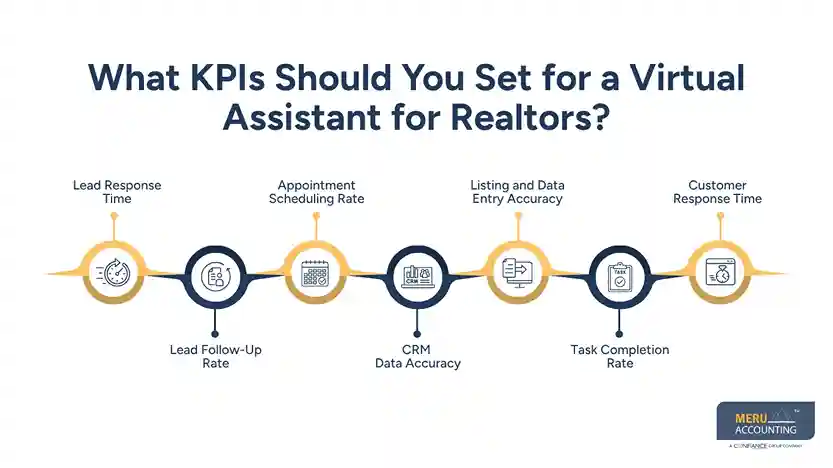
What KPIs Should You Set for a Virtual Assistant for Realtors?
The right KPI should match the work the assistant can own. For a virtual assistant for realtors, good KPIs can show speed, care, task flow, and lead work. This keeps real estate virtual assistant services tied to real work, not task count alone.
Lead Response Time
Track the time from a new lead to the first reply. Set a goal based on lead flow and work hours.
Lead Follow-Up Rate
Track the share of due follow-ups done on time. This shows if leads move through the full follow-up plan.
Appointment Scheduling Rate
Compare leads that can book with the number of calls booked. Check lead fit too, so poor lead flow is not seen as an assistant issue.
CRM Data Accuracy
Check names, phone data, lead stage, notes, and next tasks for errors. A virtual assistant for realtors should keep CRM data clear and up to date.
Listing and Data Entry Accuracy
Track errors in price, name, date, address, and key fields. Set a high goal for data where a small error can cause a client or sales issue.
Task Completion Rate
Compare tasks done on time with tasks due. Pair this KPI with a quality check, as fast work is not always good work.
Customer Response Time
Track how fast set client notes get a reply during work hours. Set one goal for urgent asks and one for tasks that can wait for the realtor.
How to Set SMART KPIs for a Real Estate Virtual Assistant
A KPI works best when the goal is clear. “Reply fast” is too vague. “Reply to 95% of new leads in 15 min during work hours” is clear.
For real estate virtual assistant services, SMART goals also make reviews clearer. The task, goal, and time frame are clear to both sides.
Set a Clear Goal
Start with the main work gap. If leads are missed, focus on lead reply time or follow-up rate.
Do not make ten KPIs just because a tool can track ten. A few key KPIs are much easier to check and act on.
Add a Measurable Target
Give each goal a set number. A virtual assistant for realtors may have a goal of 95% on-time task completion or 98% data accuracy.
Use real work data to set the goal when you can. Do not pick a random number just to make the KPI look strong.
Set a Time Frame
A KPI needs a set review time. Pick a day, week, or month for each goal. Lead reply time may need a weekly check. CRM data may work best with a month-end check based on a set sample.
Define Quality Rules
State what a done task means. If “follow-up sent” means only a note was sent, but no CRM note was added, the task is not done.
Clear rules help a virtual assistant for realtors and the realtor judge the same work in the same way.
Match KPIs to the Role
Do not give an assistant a sales goal if the assistant has no say in the sale. Track the part of the work the assistant owns.
This keeps real estate virtual assistant services fair and makes each KPI tied to the role.
How to Track Virtual Assistant Performance
A good review should not rely on memory. By Friday, a realtor may recall one missed task and miss the 30 tasks done well.
CRM data, task tools, calendars, and work logs can give a full view of what the virtual assistant for realtors did.
Use CRM and Task Management Data
CRM data can show when leads came in, when a reply was sent, and what stage each lead reached. Task tools can show due dates, done dates, and late work.
Use these records as the main source for KPI checks. Daily notes can add context but should not be the only proof of work.
Track Time and Task Completion
Time data has more value when you link it to output. If one task takes two hours each week, ask why.
The task may be too hard, the steps may not be clear, or the tool may slow the work. The goal is to find the cause, not just mark the number as bad.
Review Weekly Performance Reports
A weekly report can show five or six key stats: new leads handled, reply time, follow-ups done, calls booked, tasks closed, and errors found.
This gives the realtor a quick view of the work without a long report.
Compare Results With Set Targets
Check the gap between the goal and the real result. If the goal is 95% task work and the result is 84%, find out why.
The cause may be a rise in lead flow, not poor work. That point matters when you review real estate virtual assistant services.
Check Work Quality Through Samples
A sample check can find issues that task tools may miss. Pick a set number of CRM records, list entries, or client notes and check each one.
This gives the realtor a fair quality check without the need to check each and every task.
optional anymore
on running the business
How to Measure the ROI of a Virtual Assistant For Realtors
ROI turns KPI data into a clear work choice. The key question is not just, “Was the work done?” It is, “Did the value of the work beat its cost?”
For a virtual assistant for realtors, ROI can include time saved, more follow-ups, more calls booked, and less admin work.
Calculate the Total Cost
Start with the full cost of the role. Add pay, tools, training, and other direct costs tied to the work. A full cost gives a more true view of the role. It also keeps the ROI math from looking better than it is.
Measure Time Saved
Say a realtor spent 15 hours each week on admin work. After the assistant starts, that falls to five hours. The 10 hours saved have value. But do not count all 10 hours as new sales time. Check how the realtor uses that time.
Track Lead Activity
Compare lead reply time, follow-ups, and calls booked before and after the role starts. If reply time drops from two hours to 20 min and follow-up work goes up, that is a good sign. It still does not prove that each new sale came from the assistant.
Measure Appointment Results
If call booking is part of the role, track both call count and call fit. Ten calls mean less if most are poor-fit leads.
A virtual assistant for realtors should be judged on the part of the flow they own. Final sales can be a wider team result.
Use a Simple ROI Formula
A basic formula is:
ROI = (Value gained − Total cost) ÷ Total cost × 100
For example, if the total cost is $1,500 per month and the value gained is $3,000, the ROI is 100%.
The hard part is not the math. It is the value figure. Time saved, added work, and sales data should come from real records, not guesswork.
Common Mistakes When Measuring Virtual Assistant Performance
Even good real estate virtual assistant services can look weak when the wrong KPIs are used. A fair review must look at both the work and the work setting.
Tracking Only Task Volume
A person can close 100 tasks and still miss the work that has the most value. Task count should be checked with task type and work quality.
One missed high-value lead may have more impact than 20 small admin tasks.
Ignoring Work Quality
Fast work can lead to more work if records need to be fixed later. Check errors, missing data, and client note quality as well as speed.
This gives a fair view of the virtual assistant for realtors.
Setting Unrealistic Targets
A goal should fit lead count, work hours, tools, and task mix. If work doubles but the goal stays the same, the review may not be fair.
Check the workload first. Then decide if a missed KPI is a real work gap.
Mixing Different Roles
An assistant who does data entry cannot control if a lead buys a home. A virtual assistant for realtors should be judged on the work they own.
Keep sales data as a wider business goal unless the assistant has a clear role in the sale.
Measuring Revenue Too Soon
A lead that gets a call today may not close for weeks or months. Some work has a late result. Give the KPI time to show a trend before you link it to sales or revenue.
How to Improve Virtual Assistant Performance Based on KPI Results
KPI data should lead to action when the same gap keeps coming up. The answer is not always more training or more work pressure.
For real estate virtual assistant services, the issue may be the task flow, CRM, workload, or set rules.
Find the Main Gap
Look for a trend, not one bad day. If reply time is slow only on Monday, the issue may be high lead flow, not skill. If errors take place only in one type of list, check that task in more detail.
Fix the Process
A repeat error can point to a weak workflow. A list, set form, field rule, or short check may fix it. A virtual assistant for realtors should not need to guess how a task must be done.
Give Clear Feedback
Good feedback uses real cases. Show the task, point out the gap, state the right result, and set a date for the next check. This makes the review clear and useful, not personal.
Set Short Review Cycles
A weekly check can catch small gaps before they spread across many records. This is useful when lead flow often goes up or down. Short checks also give real estate virtual assistant services time to fix a gap before it grows.
Adjust Targets When Needed
A KPI should stay fair as the role grows. If the assistant takes on 30% more work, review the goal and work load at the same time. The goal is not to make the KPI easy. The goal is to make it fair and tied to real work.
Why Choose Meru Accounting For Real Estate Virtual Assistant Services?
- We provide real estate virtual assistant services based on your task list, work hours, tools, and report needs.
- Our team sets clear KPIs for task work, data accuracy, reply time, and work quality, which makes work easy to check.
- We use set reports to compare real work with set goals and find gaps that need action.
- A virtual assistant for realtors can handle day-to-day admin work, CRM updates, data entry, lead follow-ups, and other set tasks.
- Clear work rules keep tasks and client data on track.
- Real estate virtual assistant services can be checked as task load and work needs change.
- A virtual assistant for realtors can take repeat work off the daily list, so realtors have more time for clients, homes, and sales.
Our Expert Perspective
A virtual assistant for realtors should not be judged by how busy the person looks or by the task count alone. A good KPI should track work the assistant can control and link it to a clear goal. Key measures should cover data accuracy, reply time, task completion, and lead results tied to the role.
Good KPI checks can also show where time is lost, which tasks need better rules, and where goals need to change. A set review gives the realtor a clear view of daily work and shows if real estate virtual assistant services meet the set goals.
Key Takeaways
- A virtual assistant for realtors needs KPIs that match the work they can control.
- Lead reply time, follow-up rate, call rate, CRM accuracy, and task completion are key measures.
- CRM and task data can give a clear view of work.
- ROI should include the full role cost and the value gained.
- Time saved has more value when the realtor uses it for high-value work.
- KPI gaps can point to a need for new work rules, more training, or fair goal changes.
- Real estate virtual assistant services should be judged by real work data, not broad claims.
FAQs
Key KPIs include lead reply time, follow-up rate, call booking rate, CRM accuracy, task work rate, and client reply time.
Track CRM data, task work, reply time, follow-ups, data accuracy, and week-to-week results against set goals.
Compare the full cost of the role with real value from time saved, more lead work, booked calls, and other clear gains.
A good target is tied to the task, such as 95% on-time task work, 98% data accuracy, or a set lead reply time.
Weekly checks work well for reply time, follow-ups, and task work, while month-end checks can track data quality, trends, and ROI.
optional anymore
on running the business