Your startup has one office, but your tax work may already stretch across several states. Maybe your first employee works from home in Texas. Your software product has customers in California. A contractor works from New York. Then you start selling a taxable product to buyers in another state. None of these moves may feel like a major tax event on its own, yet together they can create new filing and registration duties. This is where a startup tax accountant becomes useful.
Instead of looking at tax only when a return is due, a startup tax accountant can look at what changed in the business and ask how that change affects state tax duties.
What You Will Learn From This Blog
- How a startup tax accountant can find state tax nexus.
- Why a new worker, sale, or office can change tax duties.
- How income, sales, use, and payroll taxes fit into multi-state compliance.
- Why state tax records need regular review as a startup grows.
- How an accountant for startup companies can bring these tasks into one process.
- When a startup should seek tax advice before expanding into another state.
What Is Multi-State Tax Compliance
Multi-state tax compliance means following the tax rules that apply when a business has taxable activity in more than one state. A startup may have employees, offices, property, or sales in different states, and each can affect its tax duties. Tax nexus is the connection between a business and a state that may create a tax obligation, but the rules can vary by state and tax type.
Once nexus is found, the startup may need to register with the state, open tax accounts, file returns, and make tax payments. One federal return does not always mean one state return, so a business with activity across several states may have separate filing duties.
Accurate records make this work easier. Sales by state, worker locations, payroll data, invoices, and registration records give a startup tax accountant the facts needed to review state tax duties and keep filings aligned with the business activity.
Why Multi-State Tax Compliance Gets Complicated for Startups
Remote Employees
A startup can hire someone who lives hundreds of miles from its office. That employee’s work location may create new payroll and registration duties that the founder did not expect.
Online Sales
An online store can reach buyers in many states without opening a store there. Sales volume and other facts may create sales tax duties under state rules.
Fast Growth
Growth can change the tax picture quickly. A startup may enter a new state through one hire or a rise in sales before its finance team has updated its tax records.
Different State Rules
There is no single state tax rulebook that covers every situation. Filing dates, tax rates, nexus tests, and registration rules can vary, so a startup tax accountant must review the states involved.
More Filing Work
Five states can mean more than five tax forms. A startup may also face payroll returns, sales tax filings, annual reports, estimated payments, and state notices.
7 Ways a Startup Tax Accountant Can Help With Multi-State Compliance
Determine Where Your Startup Has Tax Nexus
Review Physical Presence
Start with the places where the business has a clear presence. Offices, stores, equipment, inventory, and property can all be relevant when a startup tax accountant reviews nexus.
Check Employee Locations
A founder may know where the office is but overlook where employees actually work. A worker who moves to another state should trigger a fresh tax review.
Review Sales Activity
Sales can matter even when the startup has no traditional office in a state. A startup tax accountant can compare sales data with the state’s current nexus rules.
Track Business Activity
Client visits, service work, agents, contractors, and other activity may also matter. The answer depends on the state and the type of tax being reviewed.
Update the Nexus Map
Nexus should not be treated as a one-time check. As the company hires, sells, or opens locations, the startup tax accountant can update its state-by-state tax picture.
Register Your Business in the Right States
Check State Registration
A startup formed in one state may need to register or qualify to do business in another state. The need depends on the company’s activity and the state’s rules.
Set Up Tax Accounts
Tax registration and business registration are not always the same thing. A startup may need separate tax accounts for sales, payroll, or other state duties.
Check Local Rules
State compliance may not cover every local tax duty. Some cities and local areas have their own requirements, so these should be checked when relevant.
Track State Fees
Registration can bring fees, annual reports, or renewal tasks. Missing a small state filing can create an avoidable compliance issue later.
Keep Records Current
State records should match the company’s current legal and operating details. An accountant for startup companies can keep registration data with the wider tax file.
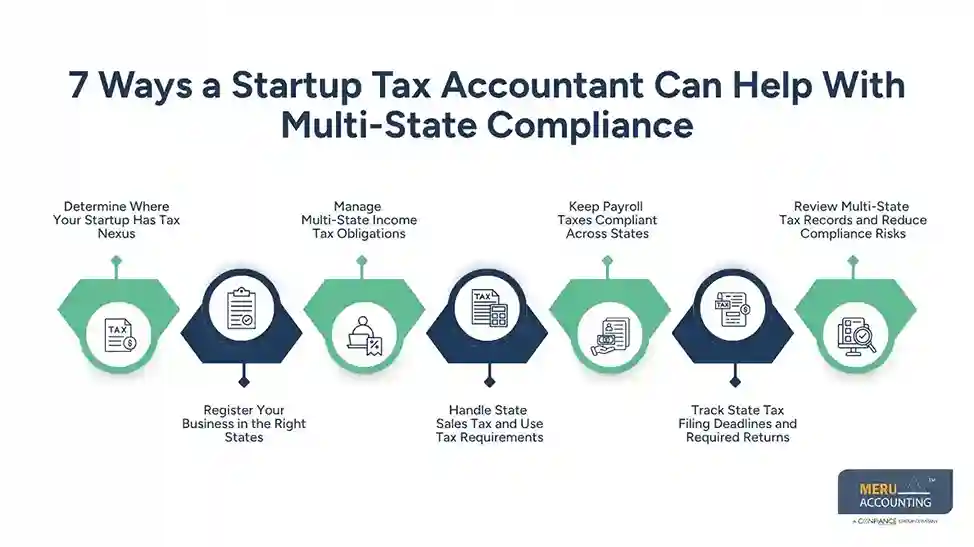
Manage Multi-State Income Tax Obligations
Identify State Income Tax
A startup should first know which states may tax its business income. A startup tax accountant can review the company’s activity and the rules that apply.
Review Business Structure
The company’s legal and tax structure can affect its filing duties. A corporation, partnership, LLC, or sole proprietorship may face different federal and state treatment.
Track State Apportionment
When income is linked to more than one state, state rules may require income to be assigned or apportioned. The formula and factors can differ by state.
Prepare State Returns
State returns need figures that agree with the company’s books and other filings. A startup tax accountant can review the numbers before returns are submitted.
Review Estimated Tax
Some businesses need estimated state tax payments during the year. Reviewing these amounts ahead of the due date can reduce last-minute tax work.
Handle State Sales Tax and Use Tax Requirements
Check Taxable Sales
Not every product or service is taxed in the same way. A startup tax accountant can review what the company sells, who buys it, and where the sale takes place.
Review Economic Nexus
A startup does not always need a physical office to create a sales tax duty. State economic nexus rules can apply when sales or transactions reach certain levels.
Set the Right Tax Rate
A taxable sale may involve state and local tax rules. The correct rate should be based on the transaction and the rules that apply to that location.
Track Tax Collected
Sales tax collected from customers is not ordinary business income. Keeping it separate in the books makes reconciliation and state filing work easier.
Check Use Tax
A startup can owe use tax when it buys taxable items and the correct sales tax was not charged. A startup tax accountant can check purchase records for these gaps.
Keep Payroll Taxes Compliant Across States
Track Worker Locations
Payroll starts with a basic question: where did the employee perform the work? A startup tax accountant can keep worker locations aligned with payroll records.
Review Withholding
State withholding rules can differ from one state to another. Payroll should reflect the employee’s work facts and the rules that apply to the situation.
Register as an Employer
Hiring in a new state may require new employer registrations before payroll begins. An accountant for startup companies can add these steps to the hiring process.
File Payroll Returns
Payroll compliance does not end with withholding. State payroll returns and payments may have their own schedules, forms, and requirements.
Check Worker Status
Worker classification also matters. A startup should not assume that calling someone a contractor settles the tax question; the working relationship and applicable rules matter.
Track State Tax Filing Deadlines and Required Returns
Build a Tax Calendar
A startup tax accountant can put state returns, payments, registrations, and renewals into one calendar. This makes it easier to see what is due and when.
Match Each Filing
A startup may have different filing dates for sales tax, payroll tax, income tax, and other state duties. Each item needs its own deadline.
Track Extensions
An extension may give more time to file, but it does not always delay the payment deadline. The state rules should be checked before relying on an extension.
Confirm Filed Returns
Keep copies of returns, payment records, confirmations, and state notices. These records can be useful if the state later asks about a filing.
Review the Calendar
The tax calendar should change when the business changes. A startup tax accountant can review it after a new hire, new state registration, or change in sales activity.
Review Multi-State Tax Records and Reduce Compliance Risks
Compare Books and Returns
The numbers in the books should make sense against filed tax returns. A startup tax accountant can compare sales, payroll, income, and tax amounts to find gaps.
Check Missing States
A state can be missed simply because the startup grew faster than its tax process. Reviewing worker and sales data can show where a new state needs attention.
Review Past Filings
Past returns should not be ignored after filing. An accountant for startup companies can flag unusual figures, missing returns, or items that may need further review.
Keep Source Records
Invoices, payroll reports, sales reports, tax registrations, and payment proof give context to tax filings. They also make it easier to answer questions later.
Update for Growth
Tax compliance should move with the company. When a startup enters a new state, the startup tax accountant can review the change before it becomes a filing problem.

How an Accountant for Startup Companies Supports Ongoing Tax Compliance
An accountant for startup companies can make state tax checks part of the regular finance cycle rather than a task that appears only at tax time.
For example, an accountant for startup companies can review new hires, sales by state, new offices, tax notices, and upcoming filing dates. This gives the finance team a way to spot changes before a return is due.
An accountant for startup companies can also connect payroll, bookkeeping, and tax records. When these records agree, it becomes easier to see where a new state duty may have started.
optional anymore
on running the business
Common Multi-State Tax Mistakes Startups Should Avoid
Ignoring Remote Workers
A startup may focus on its main office and forget that employees work elsewhere. That can leave payroll and state registration duties unchecked.
Waiting Until Year-End
By year-end, a startup may already have months of missed registrations or filings. A regular startup tax accountant review gives the business more time to act.
Using One State Rule
A rule that works in one state may not work in another. State-specific checks are needed for nexus, sales tax, payroll, and income tax.
Mixing Sales Tax With Revenue
Sales tax collected from customers should not be treated like business income. Separate records make the amount easier to track and report.
Missing Filing Dates
A missed filing can lead to interest, penalties, or state notices. A tax calendar reduces the chance that a deadline gets lost among other startup tasks.
When Should a Startup Hire a Tax Accountant for Multi-State Compliance?
Multi-state tax issues can start before a startup realizes it has a new filing duty. It is better to review tax needs when the business changes, rather than wait for a state notice.
- A startup should consider tax advice when it hires a remote employee, as a worker in another state may create new payroll withholding, registration, and filing duties.
- A review is useful when the business starts selling in new states, as sales activity can create sales tax duties once the required state threshold is reached.
- A startup should seek advice when it opens another location, since a new office, store, or business site can create additional state tax and registration requirements.
- A tax review is important when the business reaches a state sales threshold, as higher sales or transaction counts may create economic nexus and new sales tax obligations.
- A startup should act after receiving a tax notice, as the notice may point to issues with registration, returns, payments, or past records.
- A review also makes sense when the startup is planning business expansion, because a startup tax accountant can identify tax steps before the company begins operating in another state.
A timely review gives the startup more time to register, organize records, and meet filing dates. An accountant for startup companies can also spot new tax duties before they lead to missed filings or payment issues.
How Meru Accounting Provides Startup Tax Support
Meru Accounting provides accounting and tax services for startups with employees, customers, and business activity across different states. Our work keeps tax records connected with the company’s day-to-day financial records.
- Meru Accounting reviews state tax records to identify filing and registration needs based on the company’s business activity.
- We organize sales, payroll, and other financial data needed for state tax filings.
- When a startup adds employees or customers in another state, our startup tax accountant reviews the related business activity and tax records.
- We keep payroll data linked with tax records when employees work across different states.
- Meru Accounting tracks relevant state tax requirements and filing information as the startup grows.
- We review available records to identify gaps that may need attention before filing or during regular tax reviews.
This approach gives startups a clearer view of their multi-state tax work and related records. Meru Accounting keeps the focus on accurate records, state requirements, and timely tax compliance.
Our Expert Perspective
Multi-state compliance rarely becomes difficult because of one huge tax task. It often starts with a small change that no one flags: one remote hire, one new sales channel, or one new state. In practice, these small changes can affect several records at once, including payroll, sales reports, registrations, and tax filings.
That is why a startup tax accountant should look at business changes as part of tax work. The question is not only, “What return is due?” It is also, “What changed since the last review?” A good review connects those changes with the right state rules before they turn into missed filings, wrong tax amounts, or avoidable notices.
Key Takeaways
- A startup tax accountant can review nexus as the business adds workers, sales, and locations.
- State registration may be needed when a startup begins doing business in another state.
- Income, sales, use, and payroll tax rules can vary across states.
- Remote employees can change a startup’s state tax and payroll duties.
- A state tax calendar can keep filing and payment dates visible.
- An accountant for startup companies can connect tax work with payroll and bookkeeping records.
- Regular reviews can find missing registrations, returns, or records before they become larger issues.
FAQs
A startup tax accountant reviews state nexus, registrations, income tax, sales tax, payroll tax, and filing duties for startups operating across states.
A startup can determine tax nexus by reviewing its employees, offices, property, sales, and other business activity in each state.
Yes, a startup may owe sales tax in multiple states when its sales or other activity meet the applicable state nexus rules.
A startup should consider hiring a startup tax accountant before hiring workers, opening locations, or reaching sales thresholds in new states.
An accountant for startup companies can track state tax returns, payments, registrations, and filing deadlines in one compliance calendar.
optional anymore
on running the business