Tax Accountant vs CPA is a common question for small business owners who want the right tax care. Both can prepare tax returns, give tax advice, and work with business records. Yet, their training, license, and scope of work may differ.
A small firm may need a tax pro who can file returns and give clear tax tips. A growing firm may need a CPA who can also review accounts, plan cash flow, and guide key finance choices. The right choice depends on the size, needs, risks, and plans of the firm.
The IRS says paid tax return preparers need a valid PTIN. CPAs have state licenses and can have broad rights before the IRS.
What You Will Learn From This Blog
- When to Choose a Tax Accountant: Learn when a Tax Accountant vs CPA may be the right choice for simple returns, routine tax work, and basic tax planning.
- When to Choose a CPA: Understand when a CPA may be better for complex tax needs, financial reviews, business growth, or IRS matters.
- Key Differences: Compare the training, credentials, services, and work scope of a tax accountant and CPA.
- Cost and Services: Learn how fees can vary based on business size, tax needs, and the services offered by each professional.
- Hiring Questions: Find out what to ask about experience, credentials, fees, tax support, and IRS representation before hiring a small business accountant.
- Meru Accounting Support: Learn how Meru Accounting can provide tax and accounting services based on your business needs.
When Should You Hire A Tax Accountant?
Basic Tax Filing Needs
When comparing Tax Accountant vs CPA options, simple tax needs may favor a tax accountant. The main need may be a correct return, good records, and clear tax advice.
Simple Business Structure
A sole owner or small firm with one main entity may not need broad accounting work. A tax accountant can focus on income, costs, deductions, and tax forms.
Routine Tax Work
Routine tax work can also make the Tax Accountant vs CPA decision easier for a small firm. A tax accountant can prepare returns, check records, and flag key tax dates.
Need For Tax Planning
Tax work is not just about filing forms. A good tax accountant can review planned sales, costs, asset purchases, and other tax items before year-end.
Limited Finance Needs
A firm that has good books and only needs tax care may not need full CPA work. Paying for more service than needed can raise the total cost.
When Is A CPA Better For Small Business Taxes?
Complex Business Needs
When comparing a Tax Accountant vs CPA, a CPA may be better suited to firms with many accounts, staff, assets, or more than one entity. CPA work can cover tax as well as wider accounting needs.
Financial Review Needs
Some firms need more than tax filing. A CPA can review financial data and give insight on reports, cash use, and key business choices.
Business Growth Plans
A growing firm may need a wider view of its numbers. A CPA can work with tax data and financial reports as the firm adds staff, assets, or new units.
IRS Representation
IRS matters can also influence the Tax Accountant vs CPA decision, especially when representation is needed. CPAs have unlimited representation rights before the IRS, along with enrolled agents and attorneys.
Need For Wider Advice
A CPA may suit owners who want one small business accountant for tax and accounting work. Such a setup can reduce the need to split work among many firms.
Tax Accountant Vs CPA: Which One Does A Small Business Need?
Start With Your Tax Work
Tax Accountant vs CPA should begin with the work you need done. List the returns, tax tasks, records, and advice you need each year.
Check Your Business Size
A small firm with few transactions may need less help. A firm with staff, stock, assets, or many sales may need broader accounting care.
Look At Risk
Tax risk can rise when a firm has many tax rules or complex records. In such cases, a CPA or other qualified tax pro may offer a stronger fit.
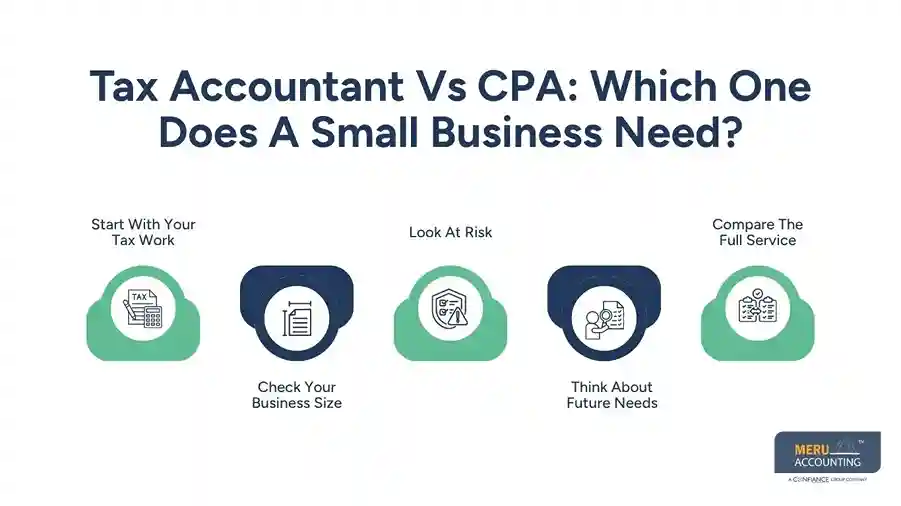
Think About Future Needs
The best choice should fit both current and near-term needs. A firm that plans to grow may gain value from a provider that can handle more work later.
Compare The Full Service
When comparing Tax Accountant vs CPA, do not compare titles alone. Compare what each provider will do, who will review the work, what support is offered, and what the fee covers.
optional anymore
on running the business
Small Business Accountant Vs CPA: What Should You Consider?
Training And Credentials
A small business accountant can have strong tax skills without being a CPA. A CPA has met state licensing rules and passed the Uniform CPA Examination.
Tax Experience
Tax experience is an important factor when comparing a Tax Accountant vs CPA for your business. A person with direct experience in your type of business may be a better fit.
Service Scope
A small business accountant may focus on books and tax work. A CPA may offer tax, accounting, review work, and wider finance advice.
Communication Style
Communication can also influence a tax accountant vs CPA decision. Ask who will handle your file, how often you can reach them, and how they deal with tax notices. A small business accountant should also explain who will answer questions outside the filing period.
Year-Round Support
Tax questions can arise after filing season. The IRS advises taxpayers to consider whether their tax pro will remain available after filing.
Tax Accountant Vs CPA: Comparing Costs And Services
Tax Preparation Fees
In a Tax Accountant vs CPA comparison, tax fees can vary based on return type, records, business size, and service level. A simple return may cost less than a return with many forms or complex tax items.
CPA Service Fees
CPA fees may be higher when the work includes tax, accounting, review, planning, or other finance tasks. The higher fee may make sense when the firm needs that wider scope.
Hourly Or Fixed Fees
Ask if the fee is fixed, hourly, or based on the work done. A clear fee plan can make it easier to track the real cost.
Extra Service Costs
Some firms charge extra for tax notices, amended returns, payroll work, or special reports. Ask for these costs before you agree to the service.
Value Beyond Price
The lowest fee is not always the best deal. A provider who spots an error, plans for a tax bill, or gives sound advice may offer more value than a low-cost filing-only service.
Tax Accountant Vs CPA: Pros And Cons Of Each Option
Tax Accountant Pros
In a Tax Accountant vs CPA comparison, a tax accountant can be a good choice for firms that mainly need tax filing and tax planning. Such providers may offer focused tax work at a lower cost.
Tax Accountant Cons
Not every tax accountant has the same training or rights. Some may have limited IRS representation rights, so owners should check credentials before hiring.
CPA Pros
A CPA can offer tax work plus wider accounting skills. CPAs also have unlimited rights to represent clients before the IRS when properly licensed and in good standing.
CPA Cons
CPA work can cost more when the firm uses a wider set of services. A very small firm may pay for skills it does not need.
Best Fit Depends On Need
Tax Accountant vs CPA is not a choice where one title always wins. The better choice is the provider whose skill, scope, fee, and service fit your firm.
Questions To Ask Before Hiring A Small Business Accountant Or CPA
What Credentials Do You Hold?
Ask about licenses, PTIN status, tax training, and work history. The IRS advises taxpayers to check qualifications before hiring a tax preparer.
Have You Worked With Firms Like Mine?
The right choice between a Tax Accountant vs CPA may also depend on your business type, tax needs, and the level of accounting support required. Ask for examples of similar firms and the tax issues they often handle.
Who Will Prepare My Return?
Know who will do the work and who will review it. Clear roles can reduce errors and avoid gaps in service.
What Does The Fee Cover?
Ask about return prep, tax advice, notices, amendments, and year-round support. A clear scope can prevent surprise bills.
Can You Represent Me Before The IRS?
Do not assume every tax preparer has the same rights. CPAs, attorneys, and enrolled agents have unlimited representation rights before the IRS.
Why Choose Meru Accounting For Small Business Tax Support?
Tax And Accounting Under One Roof
Meru Accounting offers tax and accounting services for firms that want one trusted small business accountant and tax team. Our work can cover tax returns, bookkeeping, payroll, financial reports, and related accounting needs.
Clear Tax Work
Our approach starts with clean records and a clear review process. We focus on accurate data, proper tax forms, and timely work based on the needs of each client.
Support For Growing Firms
Changes in business size and tax needs can also affect the Tax Accountant vs CPA decision. Our team can work with owners as records, staff, income, and reporting needs become more complex.
Practical Tax Guidance
Good tax service should be easy to understand. Our team aims to explain key tax points in plain terms so owners can make sound choices.
A Focus On Long-Term Service
Tax filing is only one part of good tax care. Meru Accounting aims to give year-round accounting and tax support that fits the needs of each small firm.
Our Expert Perspective
Our view is simple: Tax Accountant vs CPA should be based on the work, not just the title. A small firm with clean books and routine tax needs may do well with a skilled tax accountant.
A firm with complex tax work, wider accounting needs, or IRS concerns may gain more from a CPA. The key is to check credentials, experience, service scope, fees, and support before you hire.
The IRS also makes clear that the owner remains responsible for the return, even when a tax pro prepares it. Review the return before signing and never sign a blank or incomplete form.
Key Takeaways
- Choose based on your actual tax needs.
- Check credentials before hiring any tax preparer.
- Ask about experience with firms like yours.
- Compare the full service, not just the fee.
- Check who will prepare and review the return.
- Ask about year-round tax support.
- Confirm IRS representation rights when needed.
- Review every tax return before signing.
- Never sign a blank tax form.
- Pick a provider that can fit future needs.
FAQs
Not always. A tax accountant may be enough for simple tax work, while a CPA may fit firms with wider accounting or tax needs.
A CPA is a licensed accounting professional who meets state rules. A tax accountant may focus mainly on tax work and may not hold a CPA license.
It depends on the person’s credentials and rights. CPAs, attorneys, and enrolled agents have unlimited IRS representation rights.
There is no single set fee. Cost can vary by business size, return type, records, tax issues, and the services included.
Check the person’s PTIN, credentials, tax experience, service scope, fees, and support. The IRS also advises taxpayers to review the return before signing it.
optional anymore
on running the business