
It is January. You open your bank app and see months of charges: $480 for listing ads, $225 for MLS dues, $1,140 on fuel, several client lunches, a new phone, software fees, and dozens of small card payments. You know many of these costs were for work. The problem is simple: can you prove it? This is where Tax Deductions for Real Estate Agents become less about finding expenses and more about keeping the right records.
A charge on a bank statement may show that you spent money, but it may not show what you bought, why you bought it, or how much of the cost was for business.
The IRS says taxpayers should keep records that support the income and expenses reported on their returns, which is especially important when documenting Tax Deductions for Real Estate Agents.
For a real estate agent, the goal is not to keep every piece of paper forever. It is to build a simple trail from expense → receipt → payment → business purpose → tax record.
What You Will Learn From This Blog
- How to build a receipt system that supports accurate Tax Deductions for Real Estate Agents.
- Eight practical ways to organize receipts during the year.
- Which realtor tax deductions need stronger records.
- How to deal with mixed personal and business expenses.
- Why mileage logs need more than fuel receipts.
- Which common receipt habits can create problems when documenting Tax Deductions for Real Estate Agents.
- How to create a simple monthly receipt review system.
Why Receipt Organization Matters for Real Estate Agent Tax Deductions
Two agents who each spend $8,000 on valid business costs during the year.
Agent A has receipts, bank records, mileage logs, and notes showing the business purpose of key expenses.
Agent B has a bank statement, a folder full of faded receipts, and a few charges marked “work.”
Both may have spent the same amount. But their records tell very different stories.
A Bank Statement Is Not The Whole Record
A bank statement can confirm that a payment took place. It may not tell you whether a $300 charge was for advertising, personal shopping, a client event, or something else.
That is why Tax Deductions for Real Estate Agents should be backed by more than payment data when the nature of the expense is not clear.
The Business Purpose Adds Context
Consider a $175 restaurant bill. The receipt shows the date and amount, but it may not explain why the meal took place, which can matter when documenting realtor tax deductions.
A note such as “lunch with buyer to discuss property offers” gives the transaction much more context.
Mixed Costs Need A Fair Split
Some costs are used for both work and personal needs. A phone plan is a common example.
If only part of the use is for business, the records should show how the business share was worked out rather than treating the whole bill as a business cost when calculating Tax Deductions for Real Estate Agents.
Small Costs Can Add Up
A $25 sign order may not seem important. Neither may a $40 parking bill or a $35 client lunch.
But dozens of small costs can become a large annual total, making careful tracking an important part of managing tax deductions for real estate agents. A good system catches them before they disappear into a pile of statements.
Strong Records Make Review Easier
Accurate records are also useful before the tax return is prepared. An agent can see which costs are missing receipts, which entries need more detail, and which expenses may need a tax professional’s review.
8 Smart Ways to Organize Receipts for Real Estate Tax Deductions
The best receipt system is one that you can keep using after the first busy week. It does not need to be complex. It needs clear rules.
Keep Business And Personal Spending Apart
If possible, use a business bank account and business card for business spending.
This does not make an expense deductible by itself, but it creates a cleaner record for reviewing tax deductions for real estate agents. If a personal card is used for a business cost, save the receipt and mark the transaction when you record it.
Build Categories Around Real Spending
Do not create twenty categories that you will never use.
Start with groups that match your work, such as advertising, MLS fees, software, professional fees, office costs, travel, meals, and vehicle expenses.
When categories match your books, realtor tax deductions are easier to sort and review.
Add The Property Or Deal When It Matters
A clear property or transaction reference can also make Tax Deductions for Real Estate Agents easier to verify when an expense needs to be traced back to a specific deal.
Add the property address, listing name, client, or transaction ID when that detail adds value. This can make a receipt much easier to understand months later.
Scan Receipts As Soon As You Get Them
That tiny paper receipt from a parking meter may not look important today. Six months later, you may not remember what the charge was for.
Take a scan or clear photo and give the file a useful name, such as:
2026-05-18_Parking_123MainStreet_$16
A simple file name can save time when records supporting realtor tax deductions need to be checked.
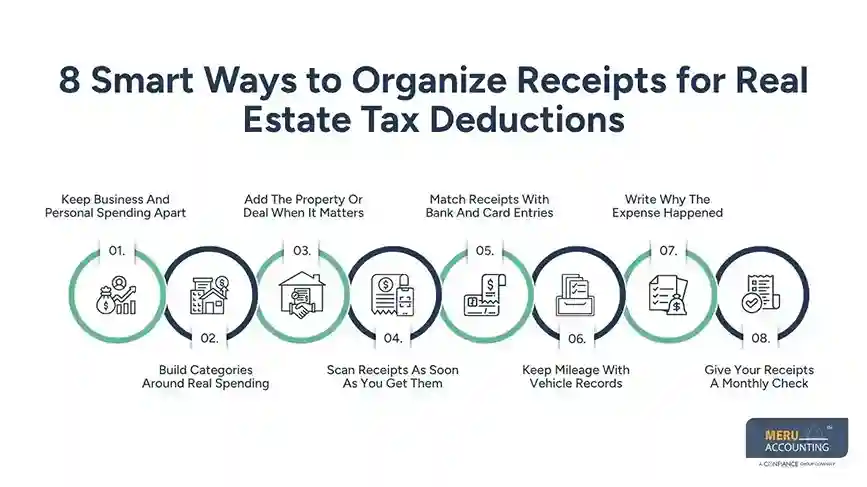
Match Receipts With Bank And Card Entries
Once a month, compare your receipts with your bank and card records.
Look for four things:
- Does the amount match?
- Does the date make sense?
- Is the expense recorded in the right category?
- Is there a receipt or other proof?
Regular matching also gives you a cleaner record of the expenses that may qualify as tax deductions for real estate agents.
Keep Mileage With Vehicle Records
A gas receipt does not show how many miles you drove for business.
For vehicle use, keep a mileage log that records the date, destination, business reason, and mileage. The IRS has specific rules for vehicle expense records, so fuel receipts should not be treated as a substitute for a proper mileage record.
Write Why The Expense Happened
“Business” is not a useful note. “Drove to property inspection with buyer” is much clearer.
The goal is not to write a long explanation. A short, factual note can preserve the reason for the expense while the details are still fresh.
Give Your Receipts A Monthly Check
Set aside a short period each month to review expenses. You may find a missing invoice, an uncategorized card charge, a duplicate entry, or a receipt that needs a business-purpose note.
Ten minutes each month can be far easier than trying to rebuild a full year’s spending in January.
optional anymore
on running the business
Common Realtor Tax Deductions That Require Strong Documentation
When reviewing Tax Deductions for Real Estate Agents, it is important to recognize that not every business cost has the same documentation requirements.
Advertising And Marketing
Online ads, listing photos, signs, flyers, mailers, website costs, and other marketing expenses can create a large paper trail when documenting realtor tax deductions.
Keep invoices and payment records together so the costs can be properly reviewed when preparing realtor tax deductions. If an expense relates to a specific listing, note that connection.
MLS And Association Fees
MLS access and qualifying professional association costs may be business expenses, depending on the facts and tax rules that apply.
Keep renewal notices, invoices, and payment records rather than relying only on the card statement.
Professional Services And Software
Accurate records for accounting fees, legal services, CRM tools, accounting software, and cloud services can make Tax Deductions for Real Estate Agents easier to substantiate.
For recurring subscriptions, keep the invoice or billing record for each period.
Office And Communication Costs
Printing, supplies, phone service, internet, and other office costs can be easy to overlook.
The key issue is often business use. When an expense also has a personal purpose, keep records that show the business portion.
Travel, Meals, And Vehicle Costs
These categories need extra care. For example, a meal receipt may show the amount but not the business reason. A fuel receipt may show fuel purchased but not business mileage.
The IRS has specific substantiation rules for travel, meals, transportation, and vehicl
How To Organize Realtor Tax Deductions By Expense Category
A folder called “Tax Receipts” is better than nothing, but it can still become hard to use.
A better system gives each type of expense a clear place.
Advertising
Keep ad invoices, sign orders, photography bills, mail costs, and online campaign charges together so these costs can be reviewed easily when sorting realtor tax deductions.
If the cost relates to one listing, add the property or listing name.
Professional Fees And Software
Keeping these records together makes it easier to separate deductible professional expenses when reviewing tax deductions for real estate agents.
For software, record the vendor, billing period, and amount so recurring charges do not become mystery transactions.
Travel And Vehicle
Keep mileage logs with travel-related records. Store tolls, parking, airfare, lodging, and other qualifying travel records with the related trip.
A trip note can state the date, location, and business reason.
Meals
These details provide the supporting documentation needed when reviewing meal-related tax deductions for real estate agents.
If another person was part of the meeting, noting the business relationship can add useful context to the record.
Office And Home-Use Costs
Office supplies are usually easy to sort. Home-use costs can be more complex because special rules may apply.
Do not assume that every household bill becomes a business deduction simply because some work is done at home.
Receipt-Tracking Mistakes That Can Weaken Tax Deduction Records
Treating Every Card Charge As A Deduction
When tracking tax deductions for real estate agents, remember that a card charge proves payment but does not establish that the expense qualifies as a business deduction.
The nature and business purpose of the expense still matter.
Writing “Work” On Everything
A note that says “work” gives little useful detail.
Use a short phrase that says what the expense was for, such as “listing photos for 18 Oak Street.”
Losing Receipts For Small Purchases
Small purchases often get ignored because each one seems minor.
The issue is not one $20 purchase. It is the total of many small costs across a full year.
Recreating Records Months Later
Memory gets weak with time. If you wait until tax season to explain every meal, trip, and client cost, some details may be hard to recall.
Ignoring Special Rules
Meals, vehicles, travel, gifts, and some other expenses have rules beyond basic receipt storage.
When an expense falls into one of these areas, review the current IRS guidance or ask a qualified tax professional before claiming it.
Tax Deductions for Real Estate Agents: A Practical Receipt Checklist
Before closing each month, ask:
Is There A Receipt?
If yes, save it with the transaction. If no, check whether another document can support the expense, since proper documentation is an important part of Tax Deductions for Real Estate Agents.
Is The Amount Correct?
Compare the receipt with the bank or card entry. Fix differences before the month is closed.
Is The Business Purpose Clear?
Write a short note if the reason is not clear from the receipt itself.
Is The Expense In The Right Category?
A marketing bill should not sit in an office-supply category simply because both were paid by card; accurate categorization makes Tax Deductions for Real Estate Agents easier to review.
Is There A Personal Portion?
If the cost has both personal and business use, record the business portion and the basis used to work it out.
Does The Expense Need Extra Proof?
Travel, meals, vehicle use, and similar costs may need more detail than a normal purchase.
How Meru Accounting Provides Accounting Services For Real Estate Agents
Managing receipts is only one part of keeping tax records in order. The information also needs to flow into the accounting records in a clear way.
Meru Accounting provides bookkeeping and accounting services for businesses that need organized financial records. For real estate agents, this can include transaction recording, expense classification, bank and credit card reconciliation, and financial reporting.
A structured review can bring missing receipts, unusual entries, duplicate transactions, and unclear expense categories to attention before tax filing.
For agents with a high volume of listings and transactions, keeping these records current can also make it easier to track expenses relevant to tax deductions for real estate agents throughout the year.
Our Expert Perspective
The best receipt system is not the one with the most folders. It is the one an agent can follow every week without breaking the routine.
For Tax Deductions for Real Estate Agents, three details matter again and again: what was paid, why it was paid, and how the payment connects to the business.
If those details are captured near the time of the expense, tax review becomes a record-checking task rather than a memory test.
Key Takeaways
- Real estate agents should keep business and personal spending separate whenever possible to maintain clear financial records and properly document tax deductions for real estate agents.
- Receipts should be saved as soon as expenses are incurred so important details are not lost over time.
- Using simple expense categories that match the accounting records makes it easier to review and classify business costs.
- Adding the property, client, or transaction name to relevant receipts can provide useful context when records are reviewed later.
- Each receipt should be matched with the related bank or credit card transaction to confirm the amount and payment details.
- Real estate agents should maintain a proper mileage log for business driving because vehicle records can be important when documenting tax deductions for real estate agents
- Expenses that need more context should include a short note explaining their business purpose.
- Real estate agents should review the IRS rules that apply to meals, travel, vehicle expenses, and other costs before claiming them as deductions.
- When the tax treatment of an expense is unclear, it is best to seek advice from a qualified tax professional before claiming tax deductions for real estate agents.
FAQs
Keeping receipts for advertising, MLS fees, software, travel, meals, vehicle costs, and office supplies is an important recordkeeping step for Tax Deductions for Real Estate Agents.
Organize receipts by tax year and expense type, then match them with bank or credit card records and add the business purpose when needed.
Realtors should record the date, amount, vendor, type of expense, payment method, and business reason for each expense that may be claimed.
Real estate agents should keep a mileage log that records the date, miles driven, trip details, and business purpose instead of relying only on fuel receipts.
A bank statement shows that a payment was made, but it may not provide enough detail to prove what was purchased or why it was a business expense.
optional anymore
on running the business