Tax write offs for real estate agents can lower taxable business income when a cost meets the tax rules. Independent agents may spend money on cars, ads, office space, software, meals, training, and client work. Knowing which costs may qualify is only one part of the task. Accurate records also matter because each expense should have a clear business reason and proof of payment. For this reason, tax write offs for real estate agents should always be based on actual business costs rather than estimates.
What You Will Learn From This Blog
- How tax write offs for real estate agents work and which expenses may qualify for a deduction.
- Common business costs that independent real estate agents may be able to claim.
- How 1099 realtor tax deductions work and which records agents should maintain.
- Ways to track mileage, receipts, professional fees, and other business expenses.
- Common tax deduction mistakes that can lead to missed deductions or filing issues.
- Situations where working with a tax professional may help review business expenses.
Understanding Tax Write-Offs
What A Tax Write-Off Means
A tax write-off is a business cost that may be deducted from business income when the tax rules allow it. Tax write offs for real estate agents do not mean the full cost comes back as a refund. The actual tax savings depend on the agent’s taxable income and tax rate.
Ordinary And Necessary Costs
A business cost should be common and proper for the trade. Advertising, work software, and certain travel costs may meet this test for an agent. Each cost still needs a clear link to the real estate business.
Business And Personal Use
Some expenses have both business and personal use. Only the part that meets the tax rules should be claimed. For example, an agent using a phone for both work and personal calls may need to split the cost.
Proof For Each Cost
Keep the receipt, date, amount, seller, and reason for the purchase. A short note can also show why the cost was needed for business when the receipt alone does not give enough detail.
Tax Year Rules Matter
Tax rules can change from one year to the next. Certain costs may also have special limits or methods. Agents should use the rules that apply to the tax year being filed.
10 Tax Write Offs For Real Estate Agents
Mileage And Vehicle Expenses
Driving to showings, listing visits, inspections, client meetings, and other work stops can create a business vehicle expense. An agent must use an allowed method and keep records of business use. Tax write offs for real estate agents often include vehicle costs, but personal driving should not be included.
Home Office Expenses
A home office may qualify when the space and its use meet the required tax tests. Agents should keep records of the space and related costs. A room used for both business and family needs may not qualify for a full deduction.
Marketing And Advertising Costs
Signs, flyers, business cards, listing photos, online ads, mailers, websites, and other promotional costs may qualify when they are tied to the business. These tax write offs for real estate agents can be missed when small advertising bills are spread across many months.
Business Meals And Client Entertainment
Some business meals may qualify, but meal deductions can have limits. Entertainment costs have different rules and may not be deductible. Keep the receipt, date, people present, amount, and business reason for each meal.
Real Estate Education And Training
Courses, books, classes, and training related to an agent’s current trade may qualify in some cases. Education that meets the tax rules for an existing business is treated differently from education that prepares someone for a new trade. Keep proof of payment and course details.
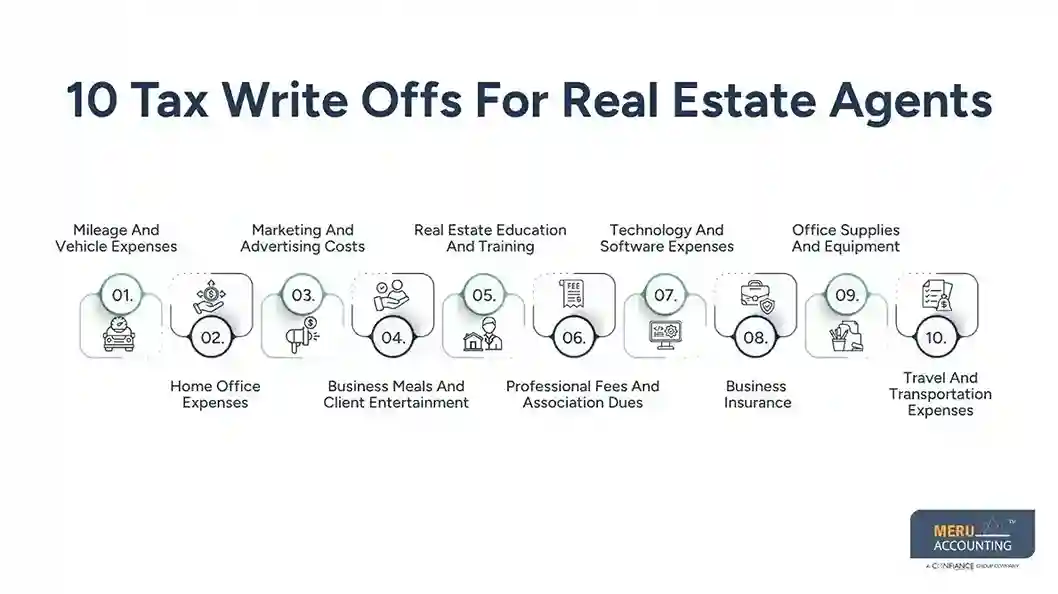
Professional Fees And Association Dues
Agents may pay tax professionals, bookkeepers, lawyers, MLS services, and trade groups. Some fees may qualify as business expenses, while others may have special rules. Review each fee before adding it to 1099 realtor tax deductions.
Technology And Software Expenses
CRM tools, accounting apps, cloud storage, e-sign tools, email services, and other work software may qualify as tax write offs for real estate agents when used for business. When a tool has both personal and work use, only the proper business share should be claimed.
Business Insurance
Insurance bought for business risks may qualify as a business expense when it meets the applicable rules. Agents should keep the policy, invoice, and proof of payment. Personal insurance should not be placed in the business expense list.
Office Supplies And Equipment
Paper, folders, printer supplies, signs, and other office items may qualify as tax write offs for real estate agents when bought and used for business. Larger equipment may need different tax treatment, such as depreciation or another allowed method. Keep the purchase record and note the business use.
Travel And Transportation Expenses
Business trips may include qualifying costs for lodging, airfare, local transport, and other travel needs. The trip must meet the tax rules, and personal parts of a trip should be kept separate. Travel is one area where complete records are especially important.
How 1099 Realtor Tax Deductions Work
Start With Business Income
An agent should first keep a full record of commission income and other business payments. The income record gives the starting point for working out business profit and loss. 1099 realtor tax deductions are then reviewed against valid business costs.
Sort Each Expense
Place costs into useful groups such as vehicle, ads, meals, software, travel, and office costs to make tax write offs for real estate agents easier to identify and review. Clear categories make it easier to review 1099 realtor tax deductions before the tax return is filed.
Check The Business Link
Ask what the cost was for and how it relates to the real estate trade. A clear business reason is key when reviewing 1099 realtor tax deductions. Personal spending should not be changed into a business expense.
Apply Any Limit
Some deductions have special limits or rules. Meals, vehicles, home offices, travel, and equipment may need extra review. A tax professional can check the facts before the deduction is claimed.
Keep The Tax Record
Save receipts, bills, mileage logs, bank records, and notes. Strong records give an agent proof for 1099 realtor tax deductions and make later review much easier.
How To Track Tax Write Offs For Real Estate Agents
Use A Separate Business Account
A separate bank account can make business spending easier to find. It also lowers the chance that personal costs will get mixed with tax write offs for real estate agents.
Keep A Mileage Log
Record work trips close to the date they happen. Add the date, route, miles, and work reason so the record is clear. Accurate mileage records can make vehicle expense deductions easier to review.
Save Digital Receipts
Save photos, PDFs, invoices, and online bills in one place. Name each file by date and type so records can be found when tax write offs for real estate agents are reviewed.
Review Costs Each Month
A monthly review can find missing bills, duplicate entries, and mixed personal charges. Regular checks also make it easier to spot 1099 realtor tax deductions before the tax deadline.
Match Books To Bank Records
Compare bookkeeping records with bank and card activity. This can find costs that were missed or entered twice and gives a cleaner record of 1099 realtor tax deductions.
Common Tax Deduction Mistakes 1099 Realtors Should Avoid
Claiming Personal Costs
A personal trip, meal, or home item should not be claimed just because an agent is self-employed. 1099 realtor tax deductions must come from costs that meet the tax rules.
Guessing Mileage
A rough guess of yearly miles is not a strong substitute for a mileage log. Tax write offs for real estate agents can include eligible business mileage, but agents should record work trips as they happen and keep enough detail to show the business reason.
Claiming Every Client Meal
A meal with a client is not automatically fully deductible. The business purpose, amount, date, people present, and tax limit should be reviewed before adding it to 1099 realtor tax deductions.
Ignoring Mixed-Use Costs
A car, phone, laptop, or home may have both business and personal use. Claiming the full amount without a valid split can lead to an incorrect deduction.
Losing Small Receipts
Small costs can add up over a year. Missing receipts for signs, apps, print work, parking, or supplies can mean valid tax write offs for real estate agents are left out.
How A Tax Professional Can Help Real Estate Agents Maximize Deductions
Review Business Income
A tax professional can review commission reports, 1099 forms, and other income records. A complete income record also helps a tax professional determine which tax write offs for real estate agents may apply based on the agent’s business income and expenses.
Check Expense Categories
A tax professional can check whether costs are placed in the right group. This matters when an agent has many payments across cards, banks, and online services.
Review Special Rules
Vehicle, meal, travel, home office, and equipment costs may have special rules. Understanding the rules can help real estate agents claim eligible tax write offs for real estate agents while avoiding expenses that do not qualify.
Find Record Gaps
A review may show that a receipt, bill, or mileage entry is missing. Finding gaps before filing gives the agent time to gather the needed proof.
Plan For Future Tax Years
Tax planning can take place during the year, not just before filing. A tax professional can review expected income, spending, and record needs so the agent is better prepared to track potential tax write offs for real estate agents throughout the year.
Our Expert Perspective
Real estate agents can have many deductible business costs, but understanding tax write offs for real estate agents also requires proper recording and classification. Mileage, marketing, software, meals, home office costs, and professional fees may have different tax rules and documentation requirements. Regular bookkeeping helps 1099 agents maintain clear records, separate business and personal spending, and identify valid expenses before tax season. Accurate records also give tax professionals the information needed to determine which expenses qualify, have limits, or require further review.
Key Takeaways
- Tax write offs for real estate agents can reduce taxable business income when eligible expenses meet IRS requirements.
- Keep business and personal expenses separate to maintain accurate records and support your deductions.
- Track business mileage with a clear and consistent mileage log.
- Save receipts, invoices, bills, and proof of payment for your business expenses.
- Review home office and mixed-use expenses carefully to determine the deductible portion.
- Check the applicable limits and requirements for meals and other special expense categories.
- Make sure 1099 realtor tax deductions are connected to legitimate and necessary business expenses.
- Review and organize your bookkeeping records each month instead of waiting until tax time.
- Consult a qualified tax professional when dealing with complex expenses or uncertain deductions.
- Always apply the tax rules and deduction limits that are relevant to the correct tax year.
FAQs
Understanding tax write offs for real estate agents can help agents identify qualifying business costs such as mileage, marketing, home office expenses, software, professional fees, and certain travel costs.
Common deductions for 1099 agents include vehicle expenses, advertising, business meals, education, software, insurance, office costs, and professional fees.
Yes, a 1099 real estate agent may deduct eligible business mileage when the trips qualify and proper mileage records are kept.
Realtors may deduct qualifying home office expenses when their workspace and business use meet the applicable tax requirements.
Real estate agents should track each expense with its date, amount, business purpose, receipt, and payment record while keeping personal costs separate.