A buyer sends a note at 8:15 AM. A seller wants a list changed. Two leads need a call, an ad needs a check, and the CRM still has old work in it. For a busy real estate team, the issue is not always a lack of leads. It is the pile of small tasks that grows as each lead moves ahead. This is where a virtual assistant for real estate can fit into the day-to-day work.
The assistant can take on repeat admin tasks while agents stay on calls, meet clients, show homes, and work on deals. But not all work should be sent out. The key is to pick the right tasks, set clear rules, and check the work.
What You Will Learn From This Blog
- What a virtual assistant for real estate can do for an agent, broker, or real estate firm.
- Which tasks are best to send out and which need in-house staff.
- How real estate virtual assistant costs can vary by skill and workload.
- Which tools can be used for CRM, listings, cash work, calls, and task flow.
- How to set up an outsourcing plan with clear steps and checks.
What is a Virtual Assistant for Real Estate?
A virtual assistant for real estate is a remote worker who takes on set tasks for an agent, broker, investor, or real estate firm. These tasks can include lead entry, CRM updates, file work, listing updates, data entry, and calendar work. By taking care of these daily jobs, the assistant can free up time for agents to focus on clients, calls, showings, and deals.
Still, not every task should be sent out. Legal terms, tax work, deal terms, price advice, and other high-risk work may need a trained or licensed expert. The firm should set clear work limits, give only the access needed, and review key work before it is used.
Which Real Estate Tasks Should You Outsource to a Virtual Assistant?
Lead Entry and Follow-Up
New leads may come in from forms, email, ads, calls, and web chat. A virtual assistant for real estate can add the lead to the CRM, fill in key data, use the right tag, and set a task for the next step.
Listing Data Management
A list may need a new price, photo, note, or field. An assistant can make set edits, check key fields, and flag any gap. Final facts should be checked by the agent or the staff member in charge.
Calendar and Appointment Work
A real estate team may have calls, home tours, site checks, and staff meets all on one day. An assistant can set, move, or check these slots based on rules set by the team.
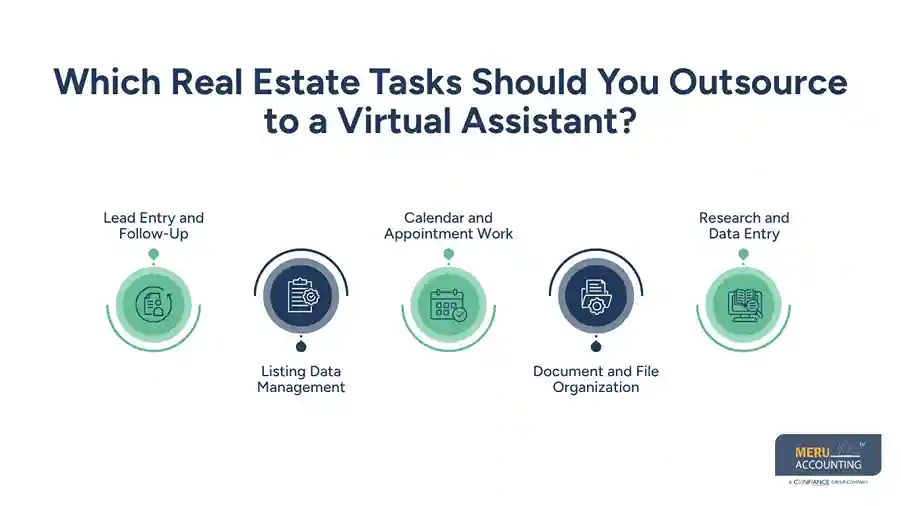
Document and File Organization
Files can get hard to find when names and folders are not kept in a set way. A virtual assistant for real estate can sort files, use set file names, check for gaps, and flag files that need a staff check.
Research and Data Entry
Basic real estate data work can take time when done by sales staff. An assistant can do set web checks, fill sheets, update data, and find key facts from approved sources. If two sources do not match, the issue should be sent back for review.
optional anymore
on running the business
Benefits of Hiring a Virtual Assistant for Real Estate
More Time for Revenue Work
An agent may spend the first hour of the day on CRM work rather than calls. A virtual assistant for real estate can take on repeat admin work, so the agent has more time for leads, clients, tours, and deal work.
Lower Fixed Staff Cost
A full-time staff role can add pay, tools, office space, leave, and other costs. Outsourcing can use a set hour or task plan, which may suit firms that do not need a full-time admin role.
Better Task Coverage
Work can rise and fall from week to week. A virtual assistant for real estate can take on a set list of tasks when the team has more admin work than its in-house staff can fit into the day.
Cleaner Work Records
A clear workflow makes it easy to see what is done, what is due, and what is late. This is key when more than one person works on the same lead, list, or file.
Wider Access to Skills
A real estate virtual assistant company may have staff with skills in CRM work, list work, data entry, book work, or client care. The best fit will depend on the tasks that need to be done.
How Much Does a Real Estate Virtual Assistant Cost?
Hourly Pricing
The cost of a virtual assistant for real estate can vary based on skill, work type, location, hours, and past work. Basic data entry may cost less than work that needs strong CRM or real estate skills.
Monthly Plans
Some firms sell a set block of hours each month. This can work well when a team has a set flow of admin work and wants a known cost each month.
Skill-Based Rates
A real estate virtual assistant with strong CRM, deal, or finance skills may cost more than a basic data entry worker. The higher rate may still be worth it if the work needs less training and fewer fixes.
Provider Fees
A real estate virtual assistant company may add fees for staff hire, team lead work, training, QA, or back-up staff. Ask what is part of the fee before you pick a plan.
Total Cost Matters
When comparing a virtual assistant for real estate, do not judge the cost by the hourly rate alone. Count the time spent on training, task checks, fixes, tools, and team review. This gives a fair view of the true cost.
What Tools Does a Real Estate Virtual Assistant Use?
CRM and Lead Management Tools
A virtual assistant for real estate may work in HubSpot, Salesforce, Follow Up Boss, or a CRM picked by the firm. Give access only to the parts of the CRM that the role needs.
Property Listing and MLS Tools
MLS and listing tools hold key data on homes and other real estate. An assistant can do set edits and checks, while the agent or lead staff member checks data that may affect a client or list.
Communication and Scheduling Tools
Email, chat, calls, and online calendars keep remote work on track. Tools such as Gmail, Outlook, Google Calendar, Microsoft Teams, and Zoom are often used for this work.
Accounting and Payment Tools
Some assistants may sort bills, add receipts, enter pay data, or post set finance records in tools such as QuickBooks. Tax work and key finance calls should stay with a trained finance pro.
Task and Project Management Tools
Tools such as Asana, Trello, and ClickUp can show who owns each task, when it is due, and if it is done. This cuts the need for long email chains and repeat chats.
How Does Real Estate Virtual Assistant Outsourcing Work?
Step 1: Define the Tasks and Scope
Start with work that is done often and has set rules. Write down what the assistant will do, what is out of scope, when the work is due, and who will check it.
Step 2: Set Access and Security Rules
Do not share all firm logins with a remote worker. Use a new login for each user, set the least access needed, use multi-factor login, and take back access when the role ends.
Step 3: Choose the Right Assistant or Provider
Check skills, past work, work hours, reply time, and QA rules. A real estate virtual assistant company may be a fit when a firm wants a team lead or backup staff along with the main worker.
Step 4: Create SOPs and Task Instructions
A good SOP should tell the worker what to do at each step. Add sample work, file rules, screenshots, checklists, and notes on what to do when a task is not clear.
Step 5: Start With a Trial or Small Workload
If you are testing a virtual assistant for real estate, do not send all admin work out at once. Start with a few tasks and check the work for speed, care, data gaps, and the need for fixes.
Step 6: Review Work and Track KPIs
Do not rate a virtual assistant for real estate only by task count. Track error rate, lead entry time, tasks done on time, hours saved, and missed work.
Step 7: Scale the Outsourced Workflow
When the first tasks run well, add more work in small sets. Keep SOPs up to date and leave key legal, tax, deal, and client calls with the right staff.
Real Estate Virtual Assistant Outsourcing Workflow: A Practical Example
Think of a small firm that gets 80 new leads each week. Before outsourcing, an agent adds each lead, writes notes, sends the first reply, sets a due date, and updates the CRM after each call.
The firm hires a virtual assistant for real estate to take care of the admin side. The assistant adds approved lead data, checks key fields, adds tags, and sets follow-up tasks based on the set rules.
The agent still speaks with leads, gives home or price advice, talks with sellers, and works on deals. The assistant takes care of the repeat work around those talks.
After one month, the firm checks the old and new work flow. Lead data is more up to date, entry takes less time, and the agent has more time for client work. The firm can now judge the service with real numbers.
How to Measure the ROI of a Virtual Assistant For Real Estate
Track Hours Saved
Write down how much time the team spent on the tasks before the change. Then track the time spent after the change and see how the saved hours are used.
Track Error Rates
Count wrong data, missed tasks, gaps, and other fixes. A high task count has little value if staff must spend a lot of time fixing the work.
Track Lead Response
If the assistant works on lead intake, track how long it takes from lead entry to the next set step. This can show if the new flow cuts delays.
Track Cost Per Task
Compare the cost of outsourced work with the cost of the same work done in-house. Add the cost of training, checks, tools, and fixes to get a fair result.
Track Business Output
A virtual assistant for real estate should not be judged by task count alone. Check if the saved time goes to more calls, meets, listings, client work, or other tasks that bring value to the firm.
Why Choose Meru Accounting for Real Estate Virtual Assistant Services?
Real Estate Admin Support
Meru Accounting provides remote support for real estate firms that need help with repeat admin work. A virtual assistant for real estate can handle tasks such as data entry, record updates, file work, and other set tasks based on the firm’s needs.
Bookkeeping and Finance Support
Real estate firms also deal with bills, rent records, payments, expenses, and account data. Meru Accounting provides bookkeeping and finance support so these records stay up to date and ready for review.
Clear Work Processes
Each task can follow set steps, checks, and work rules. This gives the team a clear way to assign work, review results, and spot gaps before they affect day-to-day work.
Tools and Data Handling
At Meru Accounting, we provide services using tools such as QuickBooks, Xero, Zoho Books, NetSuite, Odoo, and Power BI. Access can be set based on the tasks assigned to the remote team.
Support as Work Grows
A small real estate firm may start with a few admin tasks and need more support as its work grows. We provide services that can cover bookkeeping, AP-AR, payroll, and other back-office needs along with virtual assistant work.
Our Expert Perspective
The best outsourcing plan is not the one that sends out the most work. It is the one that sends out the right work. Start with repeat tasks that have clear rules, keep client and finance data safe, and set a review point for each key task. A real estate virtual assistant company can be a good fit when a firm needs a managed team, but the firm should still ask how staff are trained, how data is kept safe, how work is checked, and what takes place if a worker leaves.
Key Takeaways
- A virtual assistant for real estate can take on repeat admin work from a remote setup.
- Lead entry, CRM work, calls, list admin, data work, and file work are good tasks to review for outsourcing.
- Cost can vary by skill, work hours, place, task type, and provider plan.
- A low hourly rate does not always mean a low total cost.
- Use new user logins, set limits, and use strong login checks.
- Start with a small task set before you move more work out.
- Track time saved, error rate, lead time, task cost, and work output.
- Keep legal, tax, deal, and other high-risk work with the right pro.
- A real estate virtual assistant company can offer a team model when a firm needs more task coverage.
FAQs
A virtual assistant for real estate handles tasks such as lead entry, CRM updates, listing work, data entry, scheduling, file work, and basic research.
The cost of a virtual assistant for real estate depends on the work type, skill level, work hours, location, and whether you hire a person or a service firm.
Real estate teams can outsource lead entry, CRM updates, listing admin, calendar work, data entry, file checks, research, and other repeat tasks with clear rules.
Real estate virtual assistant outsourcing starts with task selection, access rules, staff choice, SOPs, a small trial, KPI checks, and then a wider work plan.
A real estate virtual assistant may use CRM, MLS, email, calendar, accounting, payment, and task tools based on the firm’s work and access rules.
optional anymore
on running the business