
The demand for virtual bookkeeping services has grown strongly as businesses look for better financial control and flexible support systems. In 2026, these services are not only a cost choice but also a structured way to manage records, reporting, and compliance with more clarity. Many firms now prefer this model because it reduces manual effort and gives better access to real-time financial data.
Modern businesses handle complex transactions, remote teams, and digital payments. In this situation, virtual bookkeeping provides a structured method to keep accounts clean, accurate, and ready for review. This shift is also influenced by increasing adoption of outsourced bookkeeping, where firms move away from full in-house teams to external experts.
What You Will Learn From This Blog
- How virtual bookkeeping services work in modern business settings
- Why Remote Bookkeeping Is Becoming Important In 2026
- Key benefits and practical use cases across industries
- Difference between internal accounting and virtual bookkeeping services
- How outsourced bookkeeping supports better financial control
- How firms like Meru Accounting deliver structured bookkeeping support
Introduction to Virtual Bookkeeping Services in Modern Business
Virtual bookkeeping services refer to remote financial record management that uses cloud tools and skilled professionals to handle core accounting tasks such as invoices, expenses, payroll records, and financial summaries without the need for a physical office setup.
Many companies choose this model to reduce workload pressure and improve accuracy in daily financial entries, especially as financial operations become more data-driven.
The growing shift also aligns with increasing demand for outsourced bookkeeping solutions across global markets, where businesses prefer flexible financial support instead of maintaining large in-house teams.
Businesses today rely heavily on digital records instead of paper-based systems, making this approach an important part of modern financial systems. These services allow faster access to financial data from any location, which directly supports better decision-making.
With cloud accounting tools becoming more advanced, this system now offers stronger data backup, access control, and automation features that reduce manual errors. This makes it especially useful for small and medium firms that need expert financial support without high staffing costs.
Many businesses also combine remote bookkeeping models with outsourced financial support to maintain cost control along with clear reporting and better transparency through structured insights.
Why Virtual Bookkeeping Services Are Becoming Essential In 2026
Rising Cost Pressure On Businesses
Businesses face higher operational costs in 2026, making virtual bookkeeping services a practical option for reducing overhead expenses.
Many firms are shifting to outsourced bookkeeping to avoid full-time staffing costs while maintaining financial accuracy.
Demand for Real-Time Data
Decision-making now depends on quick access to financial data. Remote bookkeeping systems offer real-time reporting that supports faster financial review. This speed is often achieved through structured outsourced bookkeeping systems supported by cloud platforms.
Global Work Models
Remote work has become common, and digital accounting support fits naturally into this model. Teams can work across different regions without delays. This global setup is strengthened by outsourced bookkeeping, which connects skilled professionals across borders.
Compliance And Accuracy Needs
Tax rules and reporting standards are more detailed in 2026. Financial records must stay updated and aligned with compliance rules. Many firms rely on external accounting experts to manage complex reporting needs correctly.
Reduced Human Error Risk
Manual accounting often leads to errors. Structured workflows and automated checks reduce this risk significantly. This accuracy is one reason businesses trust external financial management support for better control over records.
Key Advantages of Virtual Bookkeeping Services For Businesses
Cost Control And Budget Stability
Remote accounting support reduces the need for in-house accounting teams, which lowers salary and training costs. Many companies also use external financial support models to maintain flexible budgets.
Access To Skilled Professionals
Businesses gain access to trained experts without long hiring cycles. This access is further improved through external professional networks that offer specialized skills.
Better Financial Organization
Records are structured and easy to access, helping businesses stay organized during audits and reviews. Structured systems also support cleaner financial data and reduce confusion in reporting.
Time-Saving Operations
Routine tasks like data entry and reconciliation are handled faster through remote accounting systems. This saves time for growing firms and allows better focus on core operations.
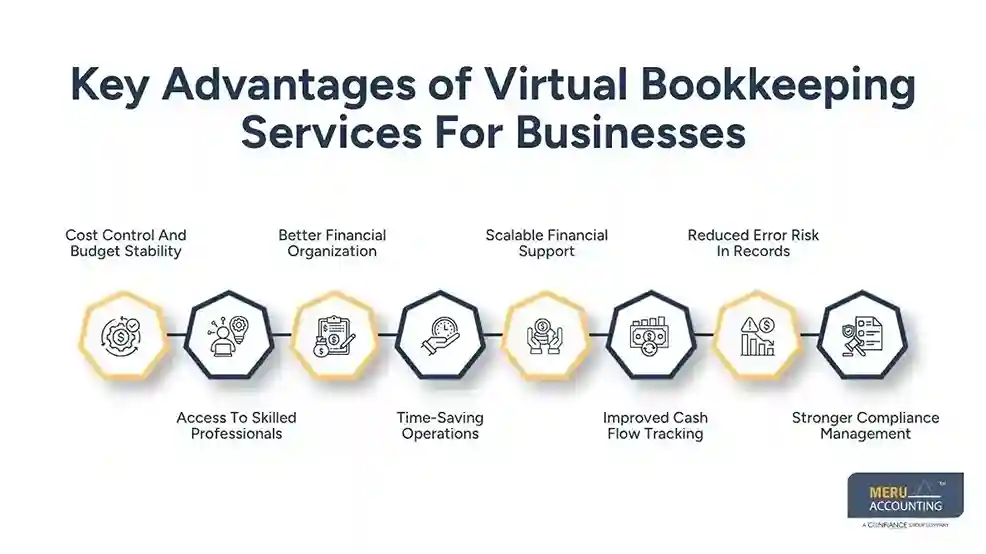
Scalable Financial Support
As businesses grow, virtual bookkeeping services can scale easily without system changes. Scalability is also a strong feature of outsourced bookkeeping models used by expanding companies.
Improved Cash Flow Tracking
Regular updates of income and expenses allow clearer monitoring of cash movement. Better visibility supports stronger control over payments, collections, and financial planning.
Reduced Error Risk In Records
Automated tools combined with expert review reduce manual mistakes in financial entries. Accurate records lower the risk of issues during audits and compliance checks.
Stronger Compliance Management
Updated financial records make tax filing and reporting easier to manage. Timely documentation reduces the chances of penalties and compliance-related issues.
Virtual Bookkeeping Services Vs Traditional In-House Accounting
Comparison Area | Virtual Bookkeeping Services | Traditional In-House Accounting |
Cost Structure Differences | Reduces costs by removing office setup and full-time staffing needs, which makes virtual bookkeeping services more budget-friendly in modern businesses | Involves high fixed costs like salaries and infrastructure |
Flexibility in Operations | Allows access from anywhere using cloud systems | Limited to office-based operations |
Technology Integration Level | Uses automation and cloud tools for better efficiency | Depends mainly on manual processes |
Speed of Reporting | Provides faster reports using real-time data | Reporting is slower due to manual work |
Accuracy and Control | Reduces errors through automated systems and structured workflows, while outsourced bookkeeping can further enhance financial accuracy | Higher chance of errors due to manual entries |
Improving Business Decision-Making With Virtual Bookkeeping Services
Real-Time Financial Visibility
Remote accounting systems give business owners updated financial data at any time. This visibility is strengthened when combined with external financial management systems.
Better Cash Flow Management
Tracking income and expenses becomes easier through remote accounting systems, allowing better cash flow control. Many firms rely on external financial support to monitor cash movement accurately.
Strategic Planning Support
Financial reports from remote accounting systems help in planning budgets and growth strategies. These insights are often delivered through structured financial analysis and reporting methods.
Risk Reduction in Decisions
Financial records from virtual bookkeeping services reduce financial risks during decision-making. This is also a key benefit of structured outsourced bookkeeping support.
Performance Tracking
Businesses can track performance trends using remote accounting reports. Such tracking is often enhanced by dashboard-based financial monitoring systems.
Industries Benefiting Most From Outsourced Bookkeeping
E-Commerce and Retail
Online stores use remote accounting systems to manage high transaction volumes. Many of these businesses rely heavily on external financial support for daily updates.
SaaS And Tech Startups
Subscription models require detailed tracking, which is managed through virtual bookkeeping services. Startups often depend on external financial support for scalable reporting and flexible operations.
Healthcare Services
Hospitals and clinics use remote accounting systems to manage billing and expenses. They also adopt external financial support for compliance-heavy reporting.
Real Estate Firms
Property transactions require accurate records, managed through remote accounting systems. These firms often choose external financial support for cost efficiency.
Consulting And Service Firms
Service firms use remote accounting systems to track project-based income. They also rely on external financial support for client-level reporting.
Why Choose Meru Accounting?
Meru Accounting provides structured financial management solutions designed to improve accuracy and clarity in reporting. We follow a well-organized approach that also integrates outsourced bookkeeping methods to support cost efficiency and global financial operations. This combination helps businesses maintain consistent records and better financial control across different regions.
Industry-specific solutions are tailored to meet the needs of sectors such as IT, retail, healthcare, and more. Virtual bookkeeping services from Meru Accounting are customized based on business requirements and supported by strong professional expertise. Our skilled team ensures accurate reporting through structured review processes, which improves reliability in financial data handling.
Technology-driven reporting is another key strength, where cloud tools are used to deliver real-time financial insights and smoother workflows. These systems are further supported by outsourced bookkeeping practices that enhance operational efficiency. Overall, Meru Accounting focuses on supporting business growth by aligning financial systems with long-term stability and clear financial visibility.
Key Takeaways
- Virtual bookkeeping services reduce operational costs and improve financial clarity
- Businesses in 2026 depend on remote accounting systems for real-time data access
- Outsourced bookkeeping offers flexible and scalable financial support
- Decision-making improves with structured financial reporting systems
- Many industries now rely on remote accounting systems for better control
- Meru Accounting provides structured and reliable bookkeeping support for global clients
FAQs
Virtual bookkeeping services refer to accounting work done online by trained professionals who manage financial records like income, expenses, invoices, and reports using cloud-based tools instead of an office setup.
Yes, financial data is protected through secure software systems, password access, and encrypted storage, along with strict data protection practices followed by service providers.
Small businesses gain access to skilled accounting support without hiring full-time staff, which reduces costs while keeping financial records accurate and well organized.
In many cases, businesses use remote bookkeeping for daily financial tasks, reporting, and record-keeping, which reduces reliance on large in-house accounting teams.
Businesses are adopting virtual bookkeeping services due to faster reporting, lower costs, and easy access to financial data from any location at any time.