Choosing the right bookkeeping support can have a direct impact on how well you manage your business finances. With growth, every business comes across more sales, bills, invoices, and other operations. Such frequent or sudden changes can sometimes become difficult to manage. Mostly, bookkeeping is the most difficult part of business and becomes harder to deal with as the business grows. Virtual bookkeeping services can help business owners manage their books without hiring an in-house bookkeeper. These services allow qualified professionals to maintain financial records remotely through secure cloud accounting tools.
However, choosing the best virtual bookkeeping services for your business is not always the lowest-cost option. This blog explains the key factors to consider so you can choose the right virtual bookkeeper service for your business.
What You Will Learn From This Blog
- Understand how virtual bookkeeping services work for different businesses.
- Learn why choosing the right bookkeeping provider affects long-term financial success.
- Recognize the common signs that indicate your business needs professional bookkeeping.
- Explore the main factors to compare before selecting a bookkeeping company.
- Discover useful questions to ask before signing a service agreement.
- Learn how Meru Accounting delivers dependable bookkeeping solutions for growing businesses.
What Are Virtual Bookkeeping Services?
Virtual bookkeeping services help businesses get all the bookkeeping support without on-site hiring. Virtual bookkeepers work remotely through cloud-based accounting software and have secure access to your financial records.
The service may include recording sales and expenses, reconciling bank and credit card accounts, tracking bills and payments, and preparing key financial reports. These reports can include the Profit and Loss Statement, Balance Sheet, and Cash Flow Statement.
The scope of work can vary by provider and the business choosing it. Some virtual bookkeeping services also support payroll-related records, while others focus only on bookkeeping. For this reason, business owners should review the exact services included before choosing a provider.
Why Choosing the Right Virtual Bookkeeping Services Matters
The Quality of Your Financial Data Depends on the Work
Bookkeeping is only useful when transactions are recorded, reviewed, and updated correctly. An experienced provider can follow a clear process and help maintain records that reflect the actual financial activity of the business.
Service Scope Can Differ Between Providers
Not all virtual bookkeeping services include the same work. One provider may handle only basic transaction entry, while another may also manage reconciliations, reports, or accounts payable and receivable. Reviewing the scope helps prevent gaps in support.
Errors Can Affect Business Decisions
Outdated or incorrect books can give owners the wrong view of income, costs, or available cash. Choosing the right provider can help identify errors that need review before financial information is used for business decisions.
Good Communication Supports Better Oversight
Business owners still need to understand what is happening in their books. A reliable provider should explain important issues, request missing records when needed, and provide clear updates on the work being completed.
A Better Fit Supports Changing Business Needs
Bookkeeping needs can change as transaction volume, staff, or business activity grows. The right virtual bookkeeping service should have a process and level of support that fit the business now and can be reviewed as its needs change.
Signs Your Business Needs Virtual Bookkeeping Services
Your business may need virtual bookkeeping services when your current bookkeeping process can no longer keep up with daily financial activity. This often happens as transaction volume grows and business owners have less time to manage the books themselves.
Your Books Are Frequently Behind
If you frequently spend weeks or months to record transactions or reconcile accounts, your financial records can never be up-to-date with the current state of your business. Virtual bookkeeper support can help establish a more consistent process.
Bookkeeping Takes Too Much of Your Time
When you cannot manage time for serving your customers, managing operations, or growing the business due to bookkeeping, it could be a warning sign that the business needs a dedicated approach.
You Cannot Easily Find Key Financial Information
If finding basic details about income, expenses, unpaid invoices, or cash on hand means going through receipts, bank statements, or spreadsheets, you may need more support.
Your Business Has Outgrown Its Current Process
As sales and transaction volumes increase, your normal bookkeeping process may not be sufficient. More vendors, customers, accounts, and business activity can add to the workload. Virtual bookkeeping services can provide added support when managing the books becomes too time-consuming.
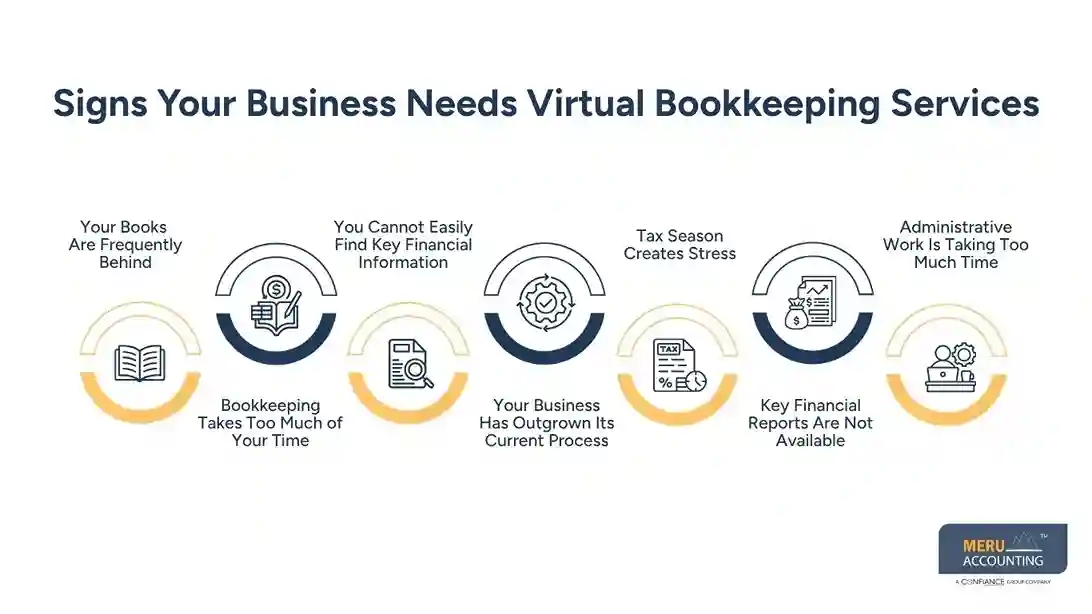
Tax Season Creates Stress
If tax time means sorting through months of receipts, bank records, and missing documents, your books may not be updated. Regular bookkeeping can help keep financial records organized and reduce the work needed to prepare information for tax filing.
Key Financial Reports Are Not Available
If you cannot review current financial reports when needed, it may be harder to understand how the business is performing. Updated reports can help you track income, expenses, and other key financial data before making business decisions.
Administrative Work Is Taking Too Much Time
When bookkeeping and other financial tasks take up too much of your workday, they can limit the time available for customers, operations, and planning. Virtual bookkeeping services can provide added support for these tasks while you remain involved in key financial decisions.
Key Factors to Consider When Choosing Virtual Bookkeeper Services
Choosing a virtual bookkeeper services provider is a business decision, so it helps to compare each option using the same set of questions. Look beyond sales claims and ask how the provider will handle your books in day-to-day work.
Experience With Similar Businesses
Ask whether the provider has worked with businesses of a similar size or type. The goal is not to find a provider that works with every industry, but one that understands the type and volume of work your business has.
A Clear Point of Contact
Know who you will speak with when you have a question or need to provide more details. A clear point of contact can make it easier to resolve issues and avoid delays.
A Defined Review Process
Ask how the provider checks completed work before your books are closed for the month. A defined review process can help you understand how errors or missing items are handled.
Access to Your Own Records
Confirm that you can access your accounting records and know what happens to your data if the service ends. This is an important point to review before you agree to work with a provider.
Clear Expectations From Both Sides
Bookkeeping works best when both parties know their role. Ask what records you must provide, when they are due, and what may happen if key information is missing.
Proof of Relevant Work
Client feedback and case examples can provide added context when they show work similar to what you need. Consider these details along with your own review of the provider’s process and experience.
Clear Service Terms
Review the agreement before you sign. Make sure you understand the scope of work, payment terms, added fees, and how the service can be changed or ended.
Virtual Bookkeeping Services Pricing
There is no single price for virtual bookkeeping. Providers may set fees based on the amount of work, number of accounts, transaction volume, or service level.
What Affects Virtual Bookkeeping Services Pricing?
- Transaction volume: More sales, bills, and payments mean more work.
- Number of accounts: More bank and card accounts can add to the work.
- Service scope: Reconciliation, A/R, A/P, and month-end work can affect the fee.
- Book condition: Past-due or messy books may need extra clean-up work.
What Should You Check?
When you get a quote, check what is included in the fee and what costs extra. Also ask if the fee can change when your business or book needs change.
The right price is one that matches the work your business needs, with no unwanted charges.
Questions to Ask Before Hiring a Virtual Bookkeeper
Before you sign a deal with a virtual bookkeeper, ask how the work will flow in the real world. These checks can help you spot gaps, set rules, and pick a team you can trust with your books.
Who Will Work on My Books?
Ask who will do the day-to-day work and who will review it. You should know who has the task, who can fix an issue, and who you can reach when you need help.
What Do You Need From Me?
Ask what files and data you must send and how often. A clear list can help you stay on track and keep work from being held up by missing data.
What Is Not Part of the Fee?
Do not ask only what you get. Ask what is not in the fee. Some tasks may cost more, such as past due work, new account set-up, or book clean-up.
How Do You Close Each Month?
Ask what the team does at the end of each month. A good close can help find old items, odd sums, and gaps before the next month starts.
How Do You Deal With Book Errors?
Ask what the team does when data does not match. Their reply can show if they have a set way to find the cause, fix the issue, and note the fix.
What Happens If I Stop the Service?
Ask how your data and book files will be sent back if you leave. You should be able to keep your full book record and move to a new team with less risk of lost data.
Why Businesses Trust Meru Accounting
Choosing the right bookkeeping partner means working with a team that delivers accurate financial records, timely reporting, and dependable support. At Meru Accounting, our virtual bookkeeping services are designed to simplify financial management and support your business as it grows.
Experienced Accounting Professionals
Our experienced accountants work with businesses across a wide range of industries and business sizes. We tailor our bookkeeping services to match your financial requirements and goals.
Cloud-Based Bookkeeping Solutions
We use trusted cloud accounting software such as QuickBooks Online, Xero, Zoho Books, Sage, and NetSuite. This allows you to access secure and up-to-date financial information whenever you need it.
Accurate Financial Reporting
We provide timely financial reports that give you a clear view of your income, expenses, cash flow, and profitability. These reports support better planning and informed business decisions.
Secure And Reliable Service
We protect your financial information through secure cloud systems, controlled access, and established data security practices. Your business records remain safe, confidential, and easily accessible.
Long-Term Business Partnership
We build lasting relationships by providing responsive support and consistent bookkeeping services. As your business grows, our virtual bookkeeping services grow with your changing financial needs.
Meru Accounting’s Virtual Bookkeeping Services
At Meru Accounting, we help businesses keep their books current and ready for review. We offer one of the best virtual bookkeeping services that can cover day-to-day bookkeeping as well as month-end tasks, based on the needs of each business.
Day-to-Day Bookkeeping
We record income, costs, bills, payments, and other key entries. Keeping these records up to date gives you a sound base for your reports.
Bank and Card Reconciliation
We match bank and card data with the entries in your books. This helps find items that are missing, entered twice, or placed in the wrong account.
Accounts Payable and Receivable
We can help track bills due to vendors and funds due from clients. This gives you a clearer view of what you owe and what you are due to collect.
Month-End Bookkeeping
We review key accounts at the end of each month and help clear open items. This helps keep your books in good shape for reports and tax work.
Financial Reports
We can prepare key reports such as the Profit and Loss, Balance Sheet, and Cash Flow Statement. These reports can help you review results and plan next steps.
Clean-Up and Catch-Up
If your books are behind or have old issues, we can review past entries and bring the records up to date. The clean-up and catch-up work needed will depend on the age and state of the books.
Our Expert Insight
The best virtual bookkeeping setup is not the one that does the most tasks. It is the one that keeps your books current and gives you useful financial data when you need it. Before you choose a provider, think about how often your business has new sales, bills, payments, and bank activity.
A business with daily activity may need more frequent book work than a business with few monthly transactions. Your service plan should match that workflow, rather than use the same plan for every business.
Key Takeaways
- Keep your financial records current so you have reliable data for key business decisions.
- Choose a provider based on the work your business needs, not price alone.
- Review the services included, fees, and terms before you sign an agreement.
- Ask who will manage your account and who will review the completed work.
- Make sure you retain access to your accounting records and financial data.
- Ask how the provider handles errors, missing records, and overdue bookkeeping.
- Choose a provider that can provide consistent support as your bookkeeping needs change.