Accounts payable automation for real estate can make invoice work easier for property managers, real estate investors, developers, and accounting teams. Real estate firms often process vendor bills, utility charges, repairs, maintenance costs, taxes, insurance bills, and property expenses across many properties. Manual entry can cause slow approvals, missed bills, duplicate payments, and weak records.
The best accounts payable automation for real estate brings invoice capture, coding, approval, payment checks, and record storage into one workflow. Real estate AP automation also gives accounting teams a clearer view of unpaid bills and property-level costs.
The right system should fit the firm’s property count, accounting system, approval rules, vendor base, and reporting needs. Cost alone should not decide the choice. Accuracy, controls, audit records, ease of use, and accounting fit are just as important.
What You Will Learn From This Blog
- How accounts payable automation for real estate works across property accounting workflows.
- Why real estate firms need stronger AP controls in 2026.
- Which AP features matter most for property managers and investors.
- How real estate AP automation affects property-level accounting.
- How to compare software based on workflow, controls, cost, and fit.
- How to choose accounts payable automation for real estate for long-term use.
Introduction To Accounts Payable Automation For Real Estate
Accounts payable automation for real estate brings invoice capture, data entry, property coding, and approval into one structured process. The system can capture key invoice details such as vendor name, invoice date, invoice number, and amount, which reduces repeated manual entry.
Real estate firms can also assign bills to the right property, unit, project, or expense account during invoice review. For example, a plumbing bill can be linked to the correct property and repair account before approval, keeping property-level expenses more accurate.
Approval routing is another key part of the process. Each real estate firm can set approval rules based on the bill amount, property, vendor, or expense type. A property manager can approve routine repair bills, while larger expenses can go to an owner or finance team for review.
Real estate AP automation can also show bills that are ready for payment, allowing finance staff to check due dates, amounts, vendors, and approval status before payment is released. Human review remains important because automation does not remove the need for financial controls.
Record storage also plays an important role in an automated AP process. The IRS states that businesses should keep records that support income, expenses, and items reported on tax returns, while electronic records should remain complete and accurate.
Accounts payable automation for real estate should therefore retain invoices, approvals, payment details, and related documents in an easy-to-find format. A well-planned AP workflow gives real estate firms better control over bills while keeping key financial records organized for accounting, reporting, and review.
Why Real Estate Businesses Need AP Automation In 2026
More Properties Mean More Bills
A firm with ten properties can have hundreds of bills each month. A larger portfolio can create thousands of invoices from vendors, utilities, contractors, insurers, and service firms.
Manual AP work becomes harder as invoice volume rises. Real estate AP automation gives teams one structured process for handling those bills.
Better Control Over Property Costs
Property expenses need correct coding to produce useful financial reports. A wrong property code can distort the profit results for one building while making another look more profitable.
Accounts payable automation for real estate can add required property and account fields before an invoice reaches final approval.
Fewer Duplicate Payments
Duplicate invoices can occur when the same bill arrives by email and paper mail. They can also occur when staff enters the same invoice twice.
AP software with duplicate invoice detection can flag matching invoice numbers, vendors, amounts, or dates for review before payment.
Faster Invoice Review
Invoices often wait in inboxes or on desks before approval. Delays can lead to late fees and strained vendor relationships.
Real estate AP automation places bills into a visible queue. Staff can see which invoices need review and which bills are ready for payment.
Stronger Financial Records
The IRS notes that supporting documents such as invoices, receipts, bills, and payment records form part of a business record system.
Accounts payable automation for real estate can keep these records linked to transactions, which makes later review more orderly.
Essential Features Of Accounts Payable Automation For Real Estate
Automated Invoice Capture
Invoice capture should be one of the first features to review. The tool should read invoice details and reduce manual entry.
OCR can extract basic fields, but users should review extracted data before posting. Accuracy should be tested with real vendor invoices.
Property And GL Coding
Real estate firms need more than basic vendor coding. The system should allow property, entity, department, project, class, and general ledger coding when required.
This makes accounts payable automation for real estate more useful for property-level reporting.
Multi-Level Approval
Approval rules should match the firm’s internal control policy. The software should route bills based on value, property, department, or vendor.
For example, a $500 repair can follow one path while a $25,000 project bill follows another.
Duplicate Invoice Detection
Duplicate checks are important for any AP process. A strong system can compare invoice number, vendor, date, amount, and other fields.
Real estate AP automation should flag possible duplicates before payment rather than relying only on manual review.
Audit Trail
Every major action should leave a clear record. The audit trail should show who entered, changed, reviewed, approved, or rejected an invoice.
This feature is important during internal reviews, owner reporting, tax work, and financial audits.
Payment Controls
Payment controls should include approval checks, user permissions, bank controls, and payment status tracking.
Accounts payable automation for real estate should not allow convenience to weaken financial control.
How Real Estate AP Automation Improves Property Accounting
Accurate Expense Posting
Correct invoice coding affects property income statements. A bill assigned to the wrong property can distort operating results.
Real estate AP automation can require property and GL fields before final posting.
Better Cash Flow Planning
Accounts payable data shows upcoming bills and due dates. Finance teams can use approved and unpaid invoices when reviewing expected cash needs.
Accounts payable automation for real estate gives managers a better view of bills waiting for payment.
Clear Vendor Records
Property firms often use the same vendor across several buildings. Vendor records should show invoices, payments, and related property data.
An automated AP system can bring these details into one view instead of separate email chains and spreadsheets.
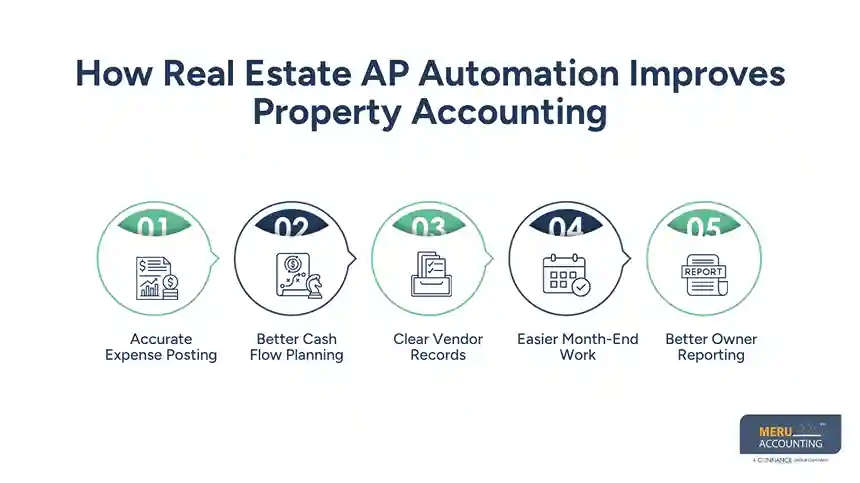
Easier Month-End Work
Month-end work can slow down when invoices sit in inboxes or arrive after the close. A structured AP workflow creates a clearer list of posted and pending bills.
Accounts payable automation for real estate can also make missing invoices easier to spot during close review.
Better Owner Reporting
Property owners often want clear expense reports by building or portfolio. Accurate AP coding gives accounting teams cleaner source data for those reports.
Real estate AP automation can also show approval status and unpaid vendor bills when managers review property results.
optional anymore
on running the business
How To Compare Real Estate AP Automation Software
Workflow Fit
Start by mapping the current AP process. List how invoices arrive, who reviews them, who approves them, and how payments are made.
Real estate AP automation should match the firm’s actual workflow rather than forcing staff into a process that does not fit.
Accounting Integration
Check whether the software connects with the firm’s accounting platform. Review how invoices, vendors, payments, properties, and GL codes move between systems.
Accounts payable automation for real estate has limited value if staff must re-enter data into accounting software.
Security And User Controls
Review user roles, approval rights, payment permissions, login controls, and audit logs. Different users should receive only the access needed for their work.
Strong controls reduce the risk of unauthorized invoice changes or payments.
Reporting Options
Check whether reports can be filtered by property, vendor, date, account, entity, and payment status. Reports should be easy to export when needed.
The AP system should provide useful financial data rather than only basic invoice lists.
Total Cost
Compare subscription fees, setup costs, transaction fees, payment charges, integration costs, and user fees.
Accounts payable automation for real estate should be judged by total cost and practical value, not by the monthly software price alone.
Vendor Support
Review the vendor’s service terms, response process, training material, and product updates. Ask how issues are handled when invoices fail or integrations stop working.
A clear service process matters when AP becomes a core accounting workflow.
How To Choose The Best Accounts Payable Automation For Real Estate
Start With Invoice Volume
Estimate monthly invoices across every property. Include recurring bills, repairs, contractors, utilities, taxes, insurance, and other vendors.
Accounts payable automation for real estate becomes more valuable when invoice volume and approval steps increase.
Map Approval Rules
Write down who approves each type of bill. Include dollar limits, property rules, emergency repairs, and owner approval where needed.
Real estate AP automation should reflect these rules before the system goes live.
Test Real Invoices
Ask vendors to test actual invoices from different formats. Include utility bills, repair bills, recurring charges, and large contractor invoices.
This gives the accounting team a better view of extraction accuracy and coding needs.
Review Integration
Check how the AP tool works with the current accounting system. Review data fields, sync timing, error handling, and reconciliation steps.
Accounts payable automation for real estate should reduce duplicate work rather than move it to another system.
Check Internal Controls
Review who can create vendors, edit invoices, approve bills, and release payments. Separation of duties should remain clear.
Automation should strengthen the workflow without removing human review where financial risk is high.
Measure Results
Set clear measures before adoption. Useful measures include invoice processing time, approval time, duplicate invoices flagged, late payments, and manual entry volume.
Real estate AP automation should produce measurable gains that can be reviewed after implementation.
Accounting And Bookkeeping Services From Meru Accounting
Property Accounting Records
Meru Accounting provides accounting and bookkeeping services for real estate businesses. Our work can include recording property expenses, maintaining financial records, and organizing accounting data.
AP Transaction Recording
Accounts payable transactions need proper entry and account coding. Our accounting team can maintain records based on the client’s approved accounting process.
Expense Classification
Property expenses need consistent classification for useful financial reports. Meru Accounting can record and classify transactions based on the required chart of accounts.
Reconciliation Work
Bank and account reconciliation can identify differences between recorded transactions and financial activity. Regular reconciliation keeps accounting records aligned with source data.
Financial Reporting
Clean transaction records form the base for useful financial reports. Meru Accounting provides accounting and bookkeeping services that can keep property financial data organized for reporting needs.
Accounting Workflow Review
A review of the current AP and bookkeeping process can show areas where duplicate entry, delayed coding, or weak record flow occurs. Meru Accounting can provide accounting and bookkeeping services based on the firm’s needs.
Our Expert Perspective
The best accounts payable automation for real estate should match the firm’s invoice volume, property structure, approval rules, and accounting system rather than simply offer more features. Human review should remain for large payments, unusual invoices, vendor changes, and exceptions, while invoices and payment records should stay complete and easy to retrieve. Property coding also needs close review because errors can affect property reports. As portfolios grow, firms should review user access, approval rules, vendor data, and payment controls to keep the AP workflow accurate and effective.
Key Takeaways
- Accounts payable automation for real estate should cover invoice capture, coding, approvals, payment checks, and record storage.
- Real estate AP automation works best when property-level coding is part of the workflow.
- Duplicate invoice checks can reduce the risk of paying the same bill twice.
- Strong audit trails provide a clear record of invoice actions and approvals.
- Accounting integration should be checked before choosing an AP system.
- Accounts payable automation for real estate should preserve strong user and payment controls.
- The AP software should be tested with real invoices before full implementation.
- The best system depends on property count, invoice volume, accounting software, and approval rules.
- Meru Accounting provides accounting and bookkeeping services for real estate businesses.
FAQs
Accounts payable automation for real estate uses software to capture, code, approve, track, and record property-related bills.
AP automation captures invoices, routes them for approval, records expenses, and tracks payments across properties and vendors.
Real estate AP automation should include OCR, property-level coding, duplicate checks, approval rules, audit trails, reporting, and accounting system integration.
Real estate AP automation costs vary by software, invoice volume, users, payment needs, integrations, and property portfolio size.
AP automation can be worthwhile for property managers handling high invoice volumes, multiple properties, frequent approvals, and recurring vendor payments.
optional anymore
on running the business