
A virtual CFO for business startups plays an important role in helping founders manage finances before fundraising pressure starts affecting business stability. Many startups begin with strong ideas and market demand, but poor financial planning often creates cash shortages during early growth stages.
Founders usually focus on product development, customer acquisition, hiring, and operations. Financial planning sometimes receives less attention until expenses begin rising quickly. Without proper runway planning, startups may enter fundraising discussions from a weak financial position.
A virtual CFO for business startups gives founders better control over budgeting, forecasting, burn rate tracking, and cash flow management. Financial visibility allows businesses to make careful decisions before funding pressure builds.
CFO services for startups also give founders access to financial expertise without the cost of hiring a full-time CFO. Startups can build stronger financial systems while keeping operating expenses under control.
What You Will Learn From This Blog
- Why startup founders need financial planning early
- How a virtual CFO for business startups manages runway
- Common financial mistakes startups make before fundraising
- Why forecasting matters during startup growth
- How CFO services for startups guide better decisions
- Benefits of outsourced CFO services for startups
- Important startup financial KPIs founders should monitor
- How Meru Accounting assists growing startups
Why Early-Stage Founders Need a Virtual CFO for Their Business
Cash Flow Planning
Many startups face irregular cash flow during the first few years. Revenue may not arrive consistently while operating expenses continue every month. A virtual CFO for business startups creates structured cash flow plans that help founders understand future financial needs clearly.
Burn Rate Monitoring
Burn rate tracking shows how quickly the startup is using its available capital. Regular monitoring ensures spending remains aligned with available runway and prevents uncontrolled cash depletion.
Financial Visibility
Founders need accurate financial reports to understand where money is being spent. Organized reporting allows faster decisions and reduces financial confusion during periods of rapid growth.
Budget Control
Poor budgeting can shorten startup runway quickly. A virtual CFO for business startups builds realistic budgets based on business goals, revenue expectations, and operational costs.
Investor Readiness
Investors expect structured financial reporting before funding discussions begin. Clean records, projections, and financial models increase investor confidence during fundraising stages.
Risk Identification
Financial risks often remain unnoticed during early expansion. Proper monitoring identifies cash shortages, rising costs, and weak revenue trends before they become serious business problems.
How Virtual CFO for Business Startups Supports Smarter Financial Planning
Revenue Forecasting
Revenue projections help founders estimate future income based on sales activity, customer growth, and market demand. Forecasting reduces uncertainty and allows better planning decisions.
Expense Management
Startups frequently overspend during growth periods. A virtual CFO for business startups tracks operational expenses carefully and identifies unnecessary spending areas.
Hiring Decisions
Many startups hire too quickly after early success. Financial planning helps founders understand when new hiring fits within available runway and future revenue expectations.
Scenario Planning
Startups operate in uncertain environments. Scenario planning prepares founders for different outcomes such as slower revenue growth, delayed funding, or unexpected cost increases.
Pricing Analysis
Incorrect pricing affects both revenue and profitability. Financial analysis allows startups to evaluate whether pricing structures support long-term sustainability.
Financial Discipline
Strong financial discipline becomes important before investor discussions. Organized records and structured planning show that the company understands its financial position clearly.
Key Financial Mistakes Startup Founders Make Before Fundraising
Ignoring Burn Rate
Many founders focus only on revenue growth while ignoring monthly spending trends. High burn rates reduce runway quickly and increase fundraising pressure.
Weak Financial Reporting
Poor bookkeeping creates inaccurate financial reports. Investors often lose confidence when startups cannot provide reliable financial statements.
Overestimating Revenue
Some startups create unrealistic growth projections. Overestimated revenue expectations can lead to poor budgeting and excessive spending.
Delayed Financial Planning
Waiting too long to establish financial systems creates reporting problems later, which a virtual CFO for business startups helps prevent through early-stage financial structuring. Early financial planning gives startups stronger operational control.
Uncontrolled Expansion
Rapid expansion without stable financial planning creates cash pressure. Founders sometimes increase expenses faster than revenue growth.
Poor Fund Allocation
Startup funding should be allocated carefully across product development, hiring, marketing, and operations. Weak fund management reduces business stability.
How Virtual CFO for Business Startups Supports Runway Management Before Fundraising
Monthly Cash Forecasting
Monthly forecasting shows how long current funds can support operations. A virtual CFO for business startups tracks cash movement regularly to prevent sudden shortages.
Spending Prioritization
Not every expense creates immediate business value. Financial review helps founders prioritize essential spending that supports long-term growth.
Fundraising Timeline Planning
Fundraising requires careful preparation time and proper financial documentation before investor discussions begin. Financial planning ensures founders start investor discussions early, before runway becomes critically short.
Operating Cost Reduction
Expense analysis identifies areas where costs can be controlled without damaging business performance. Lower operating costs can extend the runway significantly.
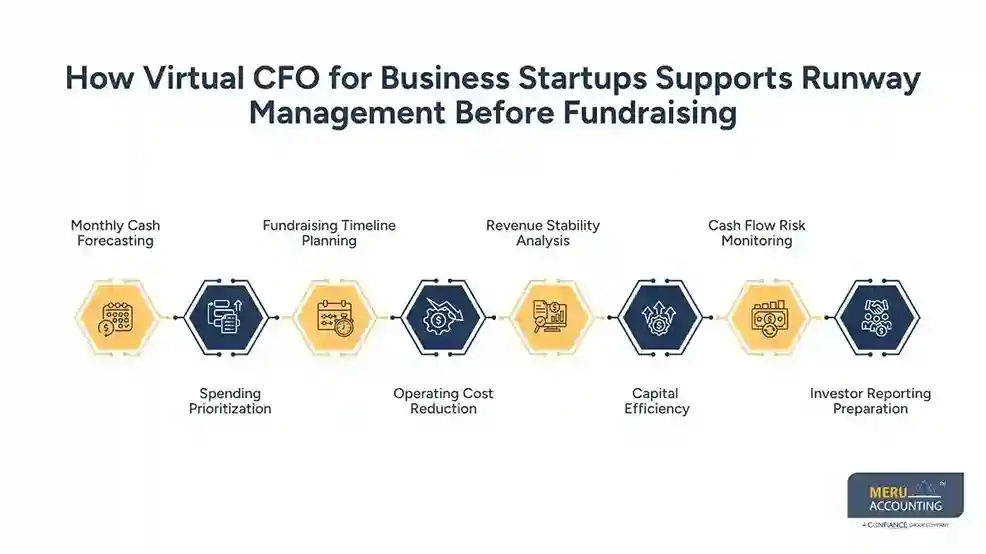
Revenue Stability Analysis
Revenue consistency matters during fundraising discussions with investors and external financial stakeholders regularly. Financial monitoring identifies whether customer revenue supports future business growth and long-term operational sustainability effectively.
Capital Efficiency
Investors often evaluate how efficiently startups use available capital. Controlled spending and financial discipline create stronger investor confidence.
Cash Flow Risk Monitoring
A virtual CFO for business startups tracks cash inflows and outflows to identify early warning signs of liquidity pressure. This helps founders take corrective action before cash shortages impact daily operations or growth plans.
Investor Reporting Preparation
Clear and structured financial reporting is required during investor discussions. Financial experts prepare financial statements, dashboards, and performance summaries that improve transparency and build trust with potential investors.
How CFO Services for Startups Improve Decision-Making During Growth
Data-Based Decisions
Financial reporting gives founders real numbers instead of assumptions, especially when supported by a virtual CFO for business startups, guiding interpretation and decision-making. Better financial visibility allows more informed business decisions.
Expansion Planning
Growth planning becomes safer when financial projections support expansion decisions. CFO services for startups guide founders during scaling stages.
Profitability Tracking
Revenue growth alone does not guarantee sustainability. Profitability analysis shows whether the business model remains financially healthy.
Financial Goal Setting
Clear financial goals create stronger operational focus. Startups can monitor revenue targets, expense levels, and growth expectations more effectively.
Vendor Negotiation Support
A financial review helps startups negotiate vendor agreements carefully. Better cost management protects the runway during growth periods.
Strategic Resource Allocation
Every startup operates with limited resources. Financial oversight helps founders allocate funds toward activities with higher business impact.
Benefits of Outsourced CFO Services Compared to In-House CFO Hiring
Lower Operating Cost
Hiring a full-time CFO can become expensive for early-stage startups. Outsourced services provide financial expertise at a lower cost.
Flexible Financial Support
Different startups require different levels of financial involvement. Outsourced CFO arrangements provide flexibility based on business size and growth stage.
Access To Experienced Professionals
Startups gain access to professionals with experience across multiple industries and business models through a virtual CFO for business startups, improving overall financial decision-making quality. That experience often improves financial planning quality.
Faster Financial Setup
Outsourced teams usually implement financial systems faster because they already work with structured processes and reporting methods.
Scalable Financial Services
As businesses grow, financial requirements also change. CFO services for startups can expand based on company growth and funding stages.
Founder Focus
Financial management requires significant time and attention. Outsourced support allows founders to focus more on operations, customers, and product development.
Financial KPIs Every Startup Founder Should Track
Burn Rate
Burn rate measures how quickly a startup spends available cash. Monitoring this KPI helps founders understand runway length accurately.
Runway Duration
Runway shows how many months the business can continue operating with current cash reserves. Strong runway planning reduces fundraising pressure.
Customer Acquisition Cost
This metric measures how much the company spends to acquire each customer, and a virtual CFO for business startups helps optimize it for better marketing efficiency and profitability. High acquisition costs can affect long-term profitability.
Gross Margin
Gross margin indicates how much profit remains after direct costs. Strong margins create healthier business sustainability.
Monthly Recurring Revenue
Subscription-based startups often track recurring monthly revenue closely. Stable recurring revenue increases investor confidence.
Cash Conversion Cycle
The cash conversion cycle measures how quickly businesses convert spending into incoming cash flow. Faster cycles improve financial stability.
Why Startups Choose Meru Accounting For Virtual CFO Services
Startup-Focused Financial Guidance
Meru Accounting understands the financial challenges faced by growing startups. Financial planning strategies are designed around startup growth stages and funding timelines.
Structured Financial Reporting
Reliable reporting gives founders clear visibility into revenue, expenses, profitability, and runway management, especially when guided by a virtual CFO for business startups. Organized financial reports also support investor readiness.
Budgeting and Forecasting Support
Meru Accounting assists startups with budgeting, forecasting, and cash flow planning. Better planning allows founders to make careful business decisions before financial pressure increases.
Experienced Financial Team
Our team works with startups across different industries and business models. That experience allows businesses to build stronger financial systems from the early stages.
Long-Term Financial Planning
Meru Accounting focuses not only on current reporting but also on future financial stability. Strong planning helps startups prepare for scaling and fundraising activities.
Our Expert Perspective
From our experience working with early-stage startups and as a virtual CFO for business startups, many founders assume financial management becomes important only after revenue increases, but in reality, financial discipline is most important at the early stage when every spending decision directly impacts runway and business stability.
Startups that maintain accurate financial reporting, controlled spending, and realistic forecasting usually approach fundraising discussions with stronger investor confidence and clearer financial readiness, while also experiencing lower operational stress during growth phases.
Over the years, we have observed that fundraising difficulties are often linked more to weak runway planning and delayed financial tracking than to product performance, and early financial discipline consistently leads to stronger cash control and more stable long-term growth outcomes.
Key Takeaways
- Virtual CFO for business startups gives founders better control over runway and spending
- Strong financial planning reduces fundraising pressure
- Burn rate monitoring is important during early growth stages
- Accurate financial reporting increases investor confidence
- CFO services for startups guide budgeting and forecasting decisions
- Outsourced CFO services reduce operating costs compared to full-time hiring
- Financial KPIs help founders monitor business stability regularly
- Early financial discipline creates stronger long-term business sustainability
FAQs
A virtual CFO for business startups manages budgeting, forecasting, cash flow planning, financial reporting, and runway monitoring for growing businesses.
Runway management helps startups understand how long available cash can support operations before additional funding becomes necessary.
CFO services for startups prepare financial reports, projections, and forecasts that investors usually review before making funding decisions.
Yes, outsourced CFO services usually cost less because startups pay only for the level of financial support they need.
Burn rate and runway are among the most important KPIs because they show how long the startup can continue operating with current funds.