
In today’s fast-moving business world, companies need a clear view of how money moves through their systems. Leaders want to know where cash comes from, where it goes, and how it impacts growth. This is where financial systems and review methods play a key role. One important idea in this space is understanding what is financial management analysis and how this process improves overall business control.
Financial management analysis is not just about checking numbers. When we break down what is financial management analysis, it becomes clear that it is about turning financial data into useful insights that help leaders make better decisions. It shows how strong a business is, how stable cash flow remains, and how well costs are managed over time.
For firms that rely on outsourced accounting teams, financial management analysis becomes even more important. It builds structure, improves reporting speed, and supports better decision-making across the business. It also helps standardize reporting used in areas like real estate financial reporting, where accuracy and timing are critical.
In this blog, we will break down what is financial management analysis, why it matters, and how it supports scalable outsourced accounting operations in real business environments.
What You Will Learn From This Blog
By reading this blog, you will learn:
- What is financial management analysis, and why is it important for modern businesses?
- How financial management analysis helps companies understand their financial performance and business health.
- The key benefits of using financial management analysis are better decision-making, cost control, and growth planning.
- How financial management analysis strengthens outsourced accounting operations and improves reporting accuracy.
- The role of financial management analysis in supporting specialized processes such as real estate financial reporting.
- The most important financial metrics used to evaluate business performance and financial stability.
- Best practices for implementing financial management analysis within outsourced accounting environments.
What Is Financial Management Analysis?
To clearly understand what is financial management analysis, it can be defined as the process of studying financial data to understand how a business is performing. In simple terms, what is financial management analysis focuses on reviewing income, costs, assets, debts, and cash flow to build a complete view of business health.
The main goal of what is financial management analysis is to convert raw financial data into clear, usable insight. These insights help owners plan budgets, manage spending, reduce risk, and support long-term growth.
Financial management analysis often includes:
- Reviewing income statements and balance sheets
- Tracking revenue and cost trends
- Monitoring cash inflow and outflow
- Checking financial risks
- Comparing performance across time periods
It helps answer simple questions like:
- Is the business growing?
- Are costs under control?
- Is cash flow stable enough for future plans?
In simple terms, what is financial management analysis works like a financial health check for a company’s money system.
Why Businesses Need Financial Management Analysis
Every business depends on money flow every day. Without a clear review, it becomes hard to understand performance or plan ahead. This is why financial management analysis is a key part of modern business work.
Here are the main reasons companies rely on it:
Better Decision Making
It gives leaders real data instead of guesses. This leads to safer and smarter choices. It also helps reduce uncertainty in daily business planning.
Cost Control
It shows where money is being wasted. Businesses can then cut extra costs and improve profit levels. This also helps improve spending discipline across teams.
Clear Profit Tracking
It shows real profit after all costs. This helps track true business results. It also gives a clear view of how each unit is performing.
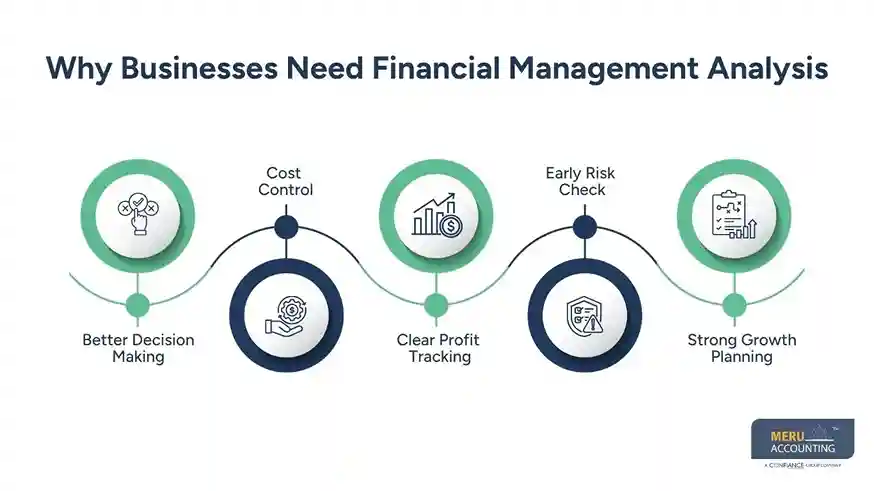
Early Risk Check
It helps find money risks early so companies can act before problems grow. This also supports faster response to financial issues.
Strong Growth Planning
With clear data, companies can plan growth in a safe and steady way. This also helps align budgets with long-term business goals.
Without financial management analysis, many firms work without clear direction. This can lead to cash flow stress and weak planning.
How Financial Management Analysis Supports Outsourced Accounting Operations
Outsourced accounting is now a strong choice for many growing firms. It helps reduce costs, save time, and bring expert support. But it only works well when financial management analysis is used to structure and interpret data correctly.
It also plays a key role in improving systems like real estate financial reporting, where businesses must manage rent flows, expenses, and asset values with high accuracy.
Key improvements include:
Improves Data Accuracy
Outsourced teams handle large data sets. Financial management analysis helps find errors and keeps records clean. This also helps reduce issues that can impact reporting quality.
Supports Fast Reporting
When financial management analysis is applied, reports can be made faster and with fewer mistakes. This helps leaders get timely insights for quick action.
Improves Team Alignment
Clear financial insight helps clients and accounting teams stay on the same page. This also reduces miscommunication and improves workflow efficiency.
Supports Business Growth
As firms grow, financial data becomes more complex. Financial management analysis helps outsourced teams manage this growth with ease. This also ensures systems stay stable as volume increases.
Helps Industry Reporting Needs
For example, in property work, real estate financial reporting needs tracking of rent, costs, and asset value. Financial management analysis helps organize this data in a clear and simple way. This also improves visibility across multiple properties and assets.
This turns outsourced accounting into a key part of business growth, not just back-office work.
Key Financial Metrics Used in Financial Management Analysis
To make financial management analysis useful, companies track key numbers. These numbers show how the business is performing and where changes are needed.
Revenue Growth
This shows how income changes over time. It helps measure business growth. It also shows whether sales efforts are working well.
Net Profit Margin
This shows profit after all costs. It is a key sign of business health. It also helps compare performance across time periods.
Operating Costs
These are daily costs to run the business. Tracking them helps control spending. It also helps identify areas where savings are possible.
Cash Flow
Cash flow shows money in and money out. Positive flow means strong stability. It also helps ensure the business can meet short-term needs.
Return on Investment (ROI)
This shows how well the money spent is working. It helps guide future plans. It also supports better investment decisions over time.
Debt Ratio
This shows debt compared to assets. It helps measure risk levels. It also shows how dependent the business is on borrowed funds.
Together, these metrics give a full view of business performance and strengthen financial management analysis results.
Best Practices for Implementing Financial Management Analysis in Outsourced Accounting
To get strong results, companies must follow clear steps for financial management analysis. These steps help improve accuracy, control, and long-term financial stability.
Keep Clean Data
Good analysis starts with correct data. Records must be updated and free from errors. Clean data also helps avoid wrong insights that can affect business decisions.
Set Clear Goals
Companies should know what they want, such as higher profit or lower cost. Clear goals also help teams stay focused and measure progress more easily.
Use Simple Report Formats
This helps outsourced teams read data faster and avoid confusion. Simple formats also reduce mistakes and improve overall reporting speed.
Review Reports Often
Weekly or monthly checks help find issues early. Regular reviews also help businesses respond faster to changes in performance.
Work Closely With Teams
Good communication between teams improves speed and accuracy. Strong teamwork also helps align financial understanding across all stakeholders.
Use Modern Tools
Software helps automate work and reduce manual errors. Modern tools also improve data tracking and make reporting more consistent.
These steps help build a strong and scalable accounting system.
Meru Accounting’s Real Estate Accounting Services
At Meru Accounting, we help businesses manage financial systems in a clear and simple way. Our focus is to improve accuracy, reduce confusion, and support better financial decisions that guide steady long-term growth.
We work with a wide range of industries, with a strong focus on real estate. This sector needs detailed tracking, tight control, and accurate reporting due to complex activity across properties, tenants, and vendors.
Key Services We Provide
- Rent tracking and tenant payment management
- Cost control and expense monitoring
- Vendor payments and reconciliation support
- Property-based accounting and reporting
- Structured support for real estate financial reporting
- Scalable outsourced accounting for growing portfolios
Our team manages these areas in a structured way so financial data stays clean, consistent, and easy to use for decision-making.
Through our outsourced accounting services, we help businesses scale without losing control over their financial systems. Our approach is built on clear reporting, stable processes, and long-term financial consistency that supports steady and confident growth.
Key Takeaways
- Financial management analysis helps turn raw financial data into clear business insight.
- It supports better planning, cost control, and long-term growth decisions.
- Understanding what is financial management analysis helps businesses improve financial clarity and performance tracking.
- It plays a key role in making outsourced accounting more structured and efficient.
- Strong financial metrics like profit margin, cash flow, and ROI help measure real business health.
- It improves accuracy, speed, and alignment between internal teams and outsourced accountants.
- It is especially useful for complex needs like real estate financial reporting, where detailed tracking is required.
FAQs
It is the study of financial data to understand business performance and support better decision-making.
It helps control costs, improve profit, reduce risk, and support long-term business growth.
It organizes financial data, improves reporting speed, and helps teams work with more clarity and accuracy.
Revenue, profit margin, cash flow, operating costs, ROI, and debt ratio are key metrics.
Meru Accounting supports structured reporting and outsourced accounting, especially in real estate and growing businesses.