
Managing business finances is one of the most important parts of running a successful organization. Yet, many business owners struggle with daily accounting work, payroll handling, financial reporting, and tax preparation. This is where understanding what does a full charge bookkeeper do becomes essential for making informed financial decisions. A full charge bookkeeper is responsible for managing the complete accounting cycle of a business. Unlike basic bookkeeping roles that focus only on data entry, this position covers end-to-end financial management, including reporting, reconciliation, and compliance support.
As businesses grow and operations become more complex, many companies also start exploring outsourced financial support such as an offshore bookkeeper to reduce costs while maintaining accuracy and efficiency. In this blog, we will explore what does a full charge bookkeeper do, why this role is important, and how hiring an offshore bookkeeper can improve financial performance and scalability.
What You Will Learn From This Blog
By reading this blog, you will understand:
- What does a full charge bookkeeper do in real business operations
- Core responsibilities and daily financial tasks
- Skills and qualifications required for the role
- Difference between full charge and regular bookkeeping
- Why businesses consider an offshore bookkeeper
- Benefits of outsourcing bookkeeping functions
- How remote financial support improves business efficiency
- Whether hiring outsourced accounting support is right for your company
What Is a Full Charge Bookkeeper?
To understand what does a full charge bookkeeper do, we must first define the role clearly.
A full charge bookkeeper is an advanced accounting professional who handles a company’s entire bookkeeping process from start to finish. This includes recording transactions, managing accounts, reconciling bank statements, preparing reports, and supporting tax filing processes.
In many small and medium-sized businesses, one professional manages all financial records independently. This is exactly what does a full charge bookkeeper do—they take full responsibility for maintaining accurate financial data and ensuring business compliance.
In modern business environments, companies often combine in-house expertise with an offshore bookkeeper to improve cost efficiency while maintaining high-quality financial reporting.
Key Responsibilities: What Does a Full Charge Bookkeeper Do Daily?
To fully understand what does a full charge bookkeeper do, it is important to break down their daily responsibilities. Their role is broad, detail-oriented, and essential for maintaining financial stability and accuracy within a business.
Recording Financial Transactions
A full charge bookkeeper records all business transactions, including sales, purchases, receipts, and payments. This forms the foundation of what does a full charge bookkeeper do on a daily basis. Accurate recording ensures that every financial activity is properly tracked and categorized for reporting purposes. It also helps prevent discrepancies that could affect future financial analysis or compliance.
Many businesses also rely on a remote bookkeeping professional or offshore accounting support team to ensure real-time data entry and accuracy across multiple systems. This approach improves efficiency and reduces delays in financial reporting, especially for growing or multi-location businesses.
Managing Accounts Payable and Receivable
They track money coming in and going out of the business. This includes ensuring vendors are paid on time and customer invoices are collected efficiently, which directly impacts cash flow management. Proper handling of these processes ensures the business maintains healthy liquidity and avoids unnecessary financial stress.
Timely follow-ups on outstanding payments are also part of maintaining strong vendor and client relationships. This responsibility plays a major role in understanding what does a full charge bookkeeper do in maintaining operational stability.
Bank Reconciliation
A full charge bookkeeper regularly reconciles company records with bank statements to ensure financial accuracy. This step helps identify discrepancies and maintain clean financial books. It also ensures that all transactions are properly recorded and no missing entries affect financial reporting.
Regular reconciliation also helps detect fraud, unauthorized transactions, or banking errors at an early stage. This makes it a critical part of what does a full charge bookkeeper do for financial control and risk management.
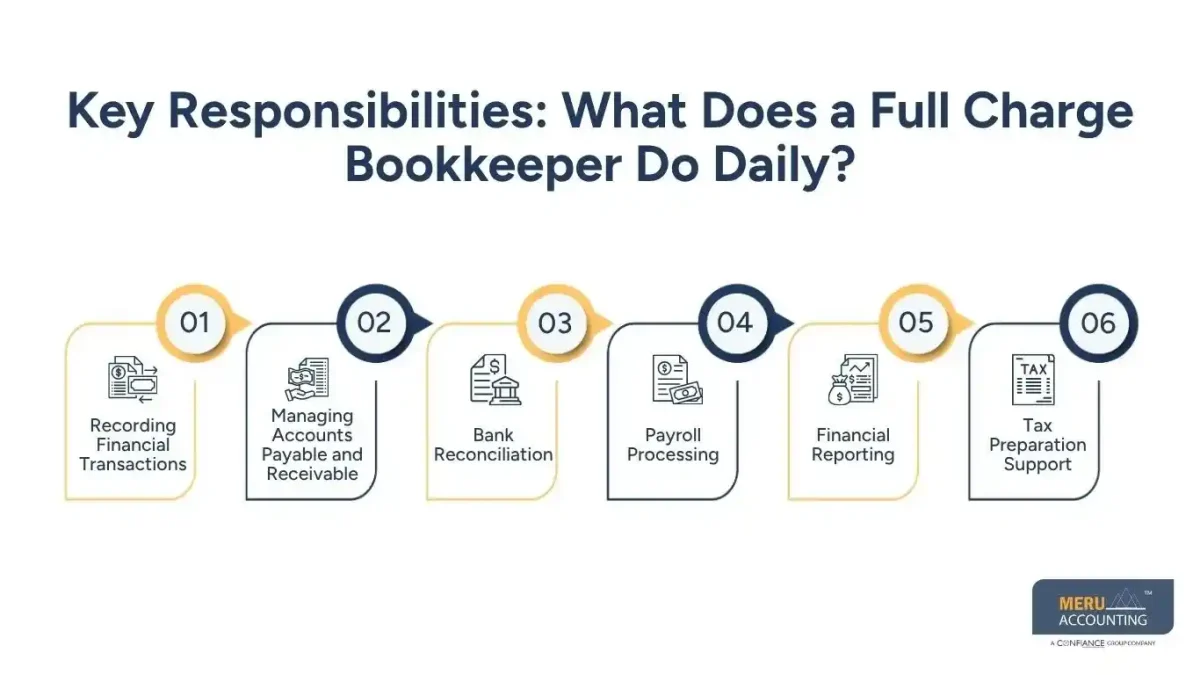
Payroll Processing
Handling employee payroll is another important responsibility. This includes salary calculations, deductions, bonuses, and compliance with tax regulations. Ensuring accurate and timely payroll builds employee trust and maintains smooth internal operations.
They also manage payroll records and ensure compliance with labor laws and tax requirements. This is another key area that defines what does a full charge bookkeeper do in day-to-day business management.
Financial Reporting
Preparing financial statements such as profit and loss reports, balance sheets, and cash flow reports is a core part of what does a full charge bookkeeper do. These reports help business owners make strategic decisions based on real-time financial performance.
They also analyze financial data to identify trends, expenses, and profit margins. This insight helps management plan budgets, control costs, and improve overall business efficiency.
Tax Preparation Support
Although they may not file taxes directly, they organize all financial records required for tax filing. This ensures smooth coordination with accountants or tax professionals. Proper documentation reduces the risk of errors during audits or tax assessments.
They also ensure that all financial data is categorized correctly throughout the year, making tax season more efficient and less stressful. This supporting role is an important part of what does a full charge bookkeeper do in maintaining compliance readiness.
Skills and Qualifications of a Full Charge Bookkeeper
Understanding what does a full charge bookkeeper do also requires knowing the skills needed for the role.
A qualified professional typically has:
- Strong understanding of accounting principles
- Experience with software like QuickBooks, Xero, or Zoho Books
- High attention to detail and accuracy
- Ability to manage full-cycle bookkeeping
- Knowledge of financial reporting standards
- Strong organizational and analytical skills
Many businesses today also expect similar skills from an offshore bookkeeper, especially when outsourcing financial operations to global teams.
Difference Between a Full Charge Bookkeeper and a Regular Bookkeeper
To fully understand what does a full charge bookkeeper do, it is important to clearly compare this role with a regular bookkeeper. While both contribute to maintaining financial records, the scope, responsibility, and decision-making authority differ significantly.
A regular bookkeeper typically focuses on routine financial data entry and maintaining basic ledgers. In contrast, a full charge bookkeeper manages the complete accounting cycle, often acting as the primary financial controller for a business. This expanded responsibility is exactly what defines what does a full charge bookkeeper do in real business operations.
Below is a detailed comparison to help clarify the differences:
Aspect | Regular Bookkeeper | Full Charge Bookkeeper |
|---|---|---|
Primary Role | Records daily financial transactions and maintains basic books | Manages complete accounting system and oversees full financial cycle |
Scope of Work | Limited to data entry, invoice recording, and ledger maintenance | End-to-end financial management including reporting, reconciliation, and payroll |
Financial Reporting | Assists in preparing basic reports under supervision | Prepares detailed financial statements such as profit & loss, balance sheet, and cash flow reports |
Decision-Making Role | No financial decision-making authority | Provides financial insights that support business decision-making |
Accounts Payable & Receivable | May assist in recording invoices and payments | Fully manages payables, receivables, and cash flow tracking |
Bank Reconciliation | Basic or assisted reconciliation tasks | Independent and complete bank reconciliation responsibility |
Payroll Processing | Rarely involved or limited support role | Fully handles payroll calculations, deductions, and compliance |
Tax Preparation Support | Minimal involvement | Organizes complete financial data for tax filing and audit readiness |
Software Usage | Basic usage of accounting tools | Advanced use of accounting systems like QuickBooks, Xero, or Zoho Books |
Level of Responsibility | Entry-level financial role | Senior-level financial management role |
Business Impact | Supports recordkeeping accuracy | Directly impacts financial stability and strategic planning |
Operational Ownership | Works under supervision of accountant or manager | Often operates independently as the main accounting professional |
Why Consider an Offshore Bookkeeper for Your Business?
As companies expand, financial management becomes more complex. This is where an offshore bookkeeper becomes a valuable solution.
An offshore bookkeeper performs all responsibilities of a full charge bookkeeper but works remotely, often from a different country, offering cost-effective financial expertise.
Businesses choose this model because:
- It reduces operational and staffing costs
- It provides access to skilled global talent
- It ensures continuous bookkeeping support across time zones
- It improves scalability during business growth
- It reduces administrative workload for internal teams
When businesses understand what does a full charge bookkeeper do, they often realize that outsourcing to an offshore bookkeeping team delivers the same value at a significantly lower cost.
Meru Accounting’s Offshore Bookkeeping Services
At Meru Accounting, we provide professional and reliable offshore bookkeeping solutions designed for growing businesses worldwide.
Our experienced offshore accounting professionals handle complete bookkeeping responsibilities, ensuring accuracy, compliance, and financial transparency. Whether you need full-cycle bookkeeping or ongoing financial support, our team is trained to deliver high-quality results.
We help businesses clearly understand what does a full charge bookkeeper do by offering real-world financial management services that mirror in-house expertise while reducing operational costs.
With Meru Accounting, you benefit from:
- Dedicated offshore bookkeeping professionals
- Accurate financial reporting and reconciliation
- End-to-end accounting support
- Cost-efficient financial management solutions
- Scalable bookkeeping services for growing businesses
Hiring an offshore bookkeeping team from Meru Accounting allows businesses to focus on growth while we manage financial accuracy and reporting.
Key Takeaways
- Understanding what does a full charge bookkeeper do is essential for financial control
- They manage complete accounting cycles, not just basic bookkeeping tasks
- Their responsibilities include reporting, payroll, reconciliation, and tax support
- An offshore bookkeeper provides the same expertise at a lower cost
- Outsourcing improves efficiency, scalability, and financial accuracy
- Businesses benefit from combining in-house strategy with offshore execution
FAQs
A full charge bookkeeper manages all financial records, reporting, payroll, and reconciliations for a business. This defines what does a full charge bookkeeper do in practical terms.
A regular bookkeeper handles basic data entry, while a full charge bookkeeper manages complete financial operations and reporting.
An offshore bookkeeper helps reduce costs while providing full accounting support, including tasks involved in what does a full charge bookkeeper do.
Yes, a skilled offshore professional can manage full-cycle bookkeeping, including reporting, payroll, and reconciliation.
Yes, when managed by a trusted firm, offshore bookkeeping ensures secure, accurate, and compliant financial operations.