QuickBooks has long been a popular choice for small and medium-sized businesses when it comes to accounting software. With a wide range of features, flexibility, and extensive integrations, it is an industry leader in the financial software space. However, as businesses evolve, so do their accounting needs. In some cases, QuickBooks may no longer meet those needs due to limitations in specific features, pricing structures, or user interface complexities. This is where exploring alternatives to QuickBooks becomes crucial.
In this blog, we will discuss why businesses should consider QuickBooks options, the challenges that QuickBooks gives, and highlight some viable options that can suit your business better.
Why Businesses Should Consider Alternatives to QuickBooks
QuickBooks has been a reliable accounting tool for many years and frequent choice. But as business grows, their financial requirements change, and QuickBooks may no longer be best suited for those developed requirements.
1. Hidden Costs Add Up Quickly
While QuickBooks appears affordable at first glance, the extra cost may increase quickly. Pararoll services, advanced reporting, and many users come with each add-on at an additional fee. Over time, it seemed like a minor investment could greatly affect your budget. Many business owners are now turning to QuickBooks options that offer transparent, omnipotent pricing.
2. Outgrowing Its Capabilities
QuickBooks works well for freelancers and micro-businesses, but scaling companies often face boundaries. Managing inventory, handling several revenue streams, or expanding operations can highlight the gaps in the capabilities of QuickBooks. This occurs when businesses start looking for a choice of QuickBooks that grows with them, not against them.
3. Customer Support Issue
Reliable support is important when dealing with accounting issues. However, many users report slow response time and general issues with QuickBooks. Businesses that prioritize responsive, knowledgeable support often find better satisfaction with other platforms.
4. Lack of Flexibility
Every business is different, but QuickBooks often forces users into fixed workflows. Alternatives offer more flexibility, letting you customize the system to fit your way of working.
5. Weak Integrations with Other Tools
The modern business depends on a network of tools, such as CRM systems, e-commerce platforms, project management apps, and more. While QuickBooks provides integration, it can be difficult and often requires expensive third-party connectors. Many options for QuickBooks Smooth, with more native integration that simplifies operations.
6. Performance and Security Concerns
QuickBooks Online made it easy to do accounting in the cloud, but it still has problems like slow loading and sometimes even shutting down. For businesses that need strong security and strict compliance, this can be a big worry. Newer cloud accounting options are now available that run faster and offer better security.
The Most Popular Alternatives to QuickBooks
If you’re considering a switch, here is an overview of the top-rated options:
Meru Accounting
- We specialize in helping businesses make a smooth, error-free transition from QuickBooks to platforms like Xero, Zoho Books, and NetSuite.
- We don’t just migrate your books we optimize your accounting setup to get you the best results from day one. Check out our 4.6+ star reviews on Trustpilot and see why businesses around the world trust us
Xero
- Clean, modern interface and intuitive design, making it easy for anyone to learn quickly.
- Strong mobile app and over 1,000 seamless integrations to simplify your processes.
- Smart automation features like automatic bank feeds and recurring billing save valuable time.
FreshBooks
- Excellent for service-based businesses and freelancers, with superior invoicing tools.
- Built-in time tracking helps you manage projects and bill clients accurately.
- Client collaboration tools such as project discussions and shared client portals keep communication clear and smooth.
Zoho Books
- Feature-rich and budget-friendly, making it a smart choice for small to medium-sized businesses.
- Smooth integration with the complete Zoho ecosystem (CRM, inventory, email marketing, and more).
- Automates recurring tasks like invoice generation and payment reminders to boost your efficiency.
Wave Accounting
- Offers essential accounting features like invoicing, expense tracking, and reporting completely free.
- Ideal for startups, freelancers, and solo entrepreneurs trying to manage costs wisely.
- Paid add-ons like payroll and payment processing are available when you’re ready to expand.
Sage Business Cloud Accounting
- Strong cash flow management and forecasting tools designed for scaling businesses.
- Helps you confidently grow, whether hiring employees or expanding locations.
- Excellent customer support and access to educational resources that grow along with your business.
NetSuite by Oracle
- Full ERP capabilities, including accounting, CRM, supply chain, and more all in one system.
- Perfect for companies aiming for global expansion with multi-currency and multi-country functionality.
Tips for Choosing the Right Alternative
Selecting new accounting software for your business can be a complex task. Following is a checklist through which you can select the best alternatives to QuickBooks
- Growth Potential: Choose software that scales with your business.
- Customization: Ensure it aligns with your specific processes.
- Integrations: Verify compatibility with your existing tech stack.
- Ease of Use: Opt for intuitive platforms that your team can adopt easily.
- Pricing Transparency: Understand the true cost beyond the base plan.
- Support Quality: Research customer service experiences and response times.
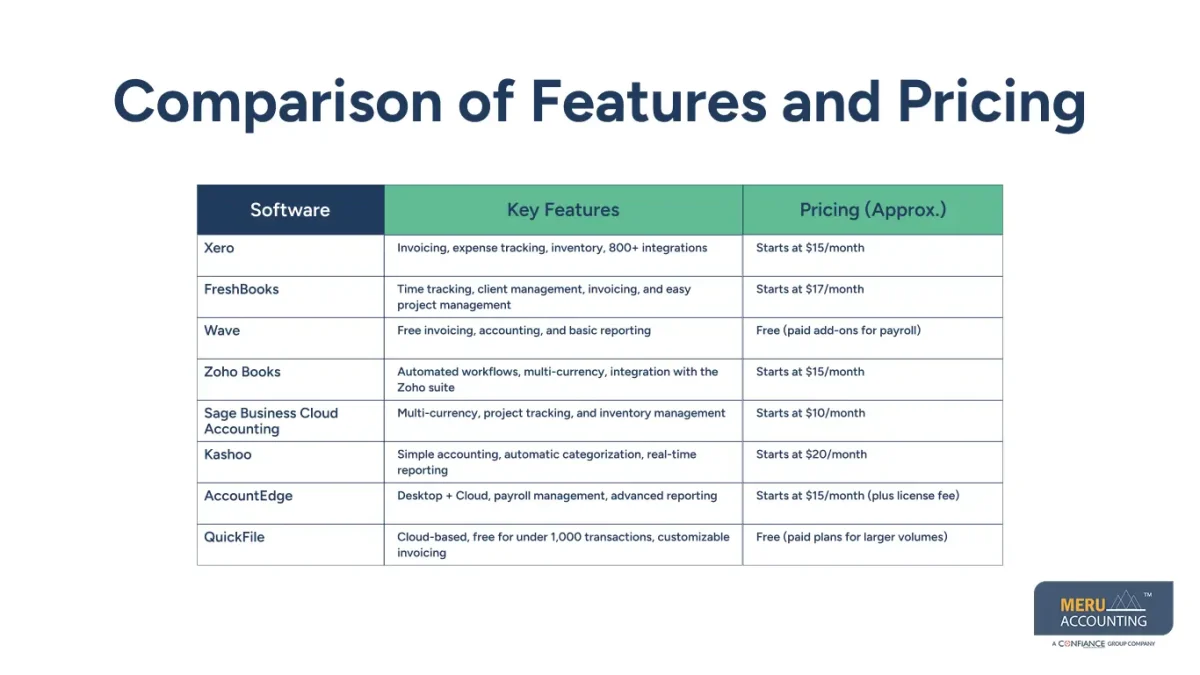
Comparison of Features and Pricing
Software | Key Features | Pricing (Approx.) |
Meru Accounting | Bookkeeping, Payroll, Financial Statements & Tax Returns | $10 Per Hour |
Xero | Invoicing, expense tracking, inventory, 800+ integrations | Starts at $15/month |
FreshBooks | Time tracking, client management, invoicing, and easy project management | Starts at $17/month |
Wave | Free invoicing, accounting, and basic reporting | Free (paid add-ons for payroll) |
Zoho Books | Automated workflows, multi-currency, integration with the Zoho suite | Starts at $15/month |
Sage Business Cloud Accounting | Multi-currency, project tracking, and inventory management | Starts at $10/month |
Kashoo | Simple accounting, automatic categorization, real-time reporting | Starts at $20/month |
AccountEdge | Desktop + Cloud, payroll management, advanced reporting | Starts at $15/month (plus license fee) |
QuickFile | Cloud-based, free for under 1,000 transactions, customizable invoicing | Free (paid plans for larger volumes) |
QuickBooks has been a popular choice for accounting, but it’s not the only option out there. As your business grows and its needs increase, it becomes necessary for you to explore the best alternatives to QuickBooks. You must search for the best alternatives that will best suit your business needs. No matter if you are choosing Xero for scalability, FreshBooks for ease of use, or any other alternative, there are multiple best alternatives that can offer your business the features that your business requires to grow.