




In 2026, growing businesses need accounting systems that support accuracy, control, and steady financial reporting. Many owners compare Zoho vs Xero to decide which tool fits their stage of growth and daily financial work. The choice between Zoho and Xero is not only about features, but also about how each system supports scaling, reporting clarity, and financial control.
Both tools are widely used by small and mid-sized companies across industries. However, the right fit depends on business size, workflow needs, and how much automation is required in daily accounting. In this blog, we break down Zoho vs Xero in a simple and practical way so you can choose with confidence in 2026.
What You Will Learn From This Blog
- Understanding how Zoho Books and Xero support the accounting needs of growing businesses and handle day-to-day financial work
- Key differences between Zoho vs Xero, including features, usability, pricing structure, and reporting approach
- Insights into integration and automation strengths that reduce manual effort and improve financial accuracy
- Clear comparison of scalability for long-term use as business operations and transaction volume increase
- Guidance on selecting the better option based on specific business types, such as startups, service firms, and mid-sized companies
- Knowledge of how receivables can be managed efficiently, including workflows like outsource accounts receivable on Xero for better cash flow control
- Practical understanding of real accounting scenarios and use cases that support better software decision-making
Overview Of Zoho Books
Zoho Books is a cloud-based accounting system designed to help businesses manage income, expenses, invoicing, and tax-related work in one place.
In Zoho vs Xero, Zoho Books is often preferred by companies that already use other Zoho applications because of its connected ecosystem and smooth internal data flow. It also supports structured financial tracking, allowing users to manage invoices, payments, and bank records within a single platform.
This makes it suitable for small teams that want a clear and organized accounting process when comparing Xero vs Zoho Books.
Zoho Books also provides tax and compliance support across multiple regions, which is useful for service and trade-based businesses that need built-in tax handling.
Automation features such as recurring invoices, payment reminders, and bank feeds help reduce manual effort, and in many cases businesses also explore options like outsource accounts receivable on Xero when comparing Zoho vs Xero for improving efficiency.
Due to its affordability and easy setup, Zoho Books is commonly chosen by startups and mid-level companies, and this positioning plays an important role in Zoho vs Xero evaluations for growing businesses.
Overview Of Xero Accounting Software
Xero is a cloud-based accounting platform built for real-time financial tracking, helping businesses stay updated with their financial position at any point in time.
In Xero vs Zoho Books, Xero is widely recognized for its strong reporting system and clean, easy-to-read dashboards that simplify financial review. It is designed to support growing businesses that need accurate and timely financial data without delay, making it a strong option in Zoho vs Xero comparisons focused on reporting quality.
Xero also offers strong bank integration, automatically syncing transactions and supporting daily reconciliation with minimal manual effort.
This feature makes Xero vs Zoho books an important discussion point for businesses that prioritize smooth cash tracking and accuracy. Its user-friendly design allows easy navigation, which is one reason many users prefer Xero over Zoho vs Xero evaluations.
In addition, it provides payroll features in select regions and detailed reporting tools, where reporting strength becomes a key factor in Zoho vs Xero decisions. Due to its focus on financial clarity and collaboration, Xero is commonly used by growing companies and accounting firms.
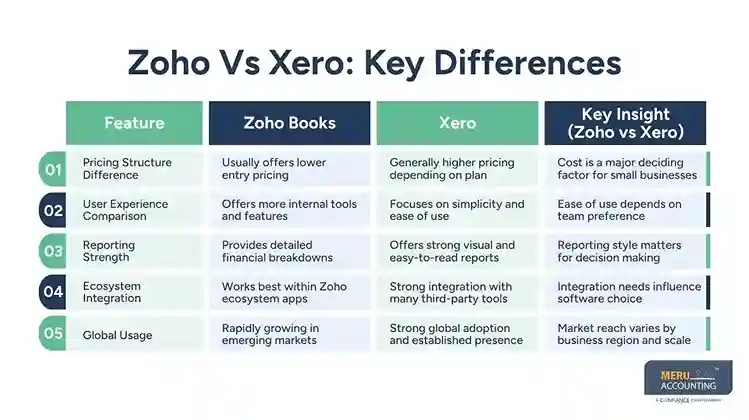
Zoho Vs Xero: Key Differences
Feature | Zoho Books | Xero | Key Insight (Zoho vs Xero) |
Pricing Structure Difference | Usually offers lower entry pricing | Generally higher pricing depending on plan | Cost is a major deciding factor for small businesses |
User Experience Comparison | Offers more internal tools and features | Focuses on simplicity and ease of use | Ease of use depends on team preference |
Reporting Strength | Provides detailed financial breakdowns | Offers strong visual and easy-to-read reports | Reporting style matters for decision making |
Ecosystem Integration | Works best within Zoho ecosystem apps | Strong integration with many third-party tools | Integration needs influence software choice |
Global Usage | Rapidly growing in emerging markets | Strong global adoption and established presence | Market reach varies by business region and scale |
Integrations And Automation In Zoho Vs Xero
App Integration Options
Xero connects with a wide range of third-party applications, including payroll systems, CRM tools, and payment platforms. This flexibility is often highlighted in software comparisons, especially for businesses that rely on multiple systems.
Zoho Ecosystem Advantage
Zoho Books integrates deeply with Zoho CRM, Zoho Inventory, and other Zoho applications, creating a connected internal system. Zoho performs strongly for businesses already using Zoho-based tools.
Automated Reconciliation
Both platforms support bank feeds and automatic transaction matching, which helps reduce manual accounting work. Automation plays a key role in improving accuracy and reducing errors.
Invoice Automation
Recurring invoices, payment reminders, and scheduled billing are available in both systems. This feature supports consistent cash flow tracking and is commonly reviewed in Zoho vs Xero evaluations.
Workflow Efficiency
Automation in both tools reduces time spent on repetitive accounting tasks and improves operational speed. In Zoho vs Xero, this becomes important for growing teams managing increasing transaction volumes.
Scalability For Growing Businesses: Zoho Vs Xero
Business Expansion Support
Xero supports multi-currency transactions and can manage large volumes of financial data as businesses expand. This makes it suitable for companies operating across different regions. Zoho also supports growth, but is often chosen for more structured internal workflows.
Team Collaboration
Xero allows multiple users with role-based access, making it easier for teams to work together on financial data and coordinate processes like outsource accounts receivable on Xero when scaling operations.
Zoho provides similar access control but is more tightly linked with its internal ecosystem of tools.
Data Handling Capacity
Both platforms manage increasing financial data effectively as businesses grow. Xero is often preferred when businesses require more complex reporting and deeper financial analysis. This is an important point in Zoho vs Xero comparisons.
Add-On Features
Zoho Books offers additional modules through the Zoho suite, such as CRM and inventory tools, which expand its functionality. Xero relies more on third-party integrations to extend its capabilities.
Long Term Use
Both systems are suitable for long-term use, depending on business structure and growth direction. The final choice between the platforms often depends on future scalability needs and operational complexity.
Zoho Vs Xero: Which Is Better For Your Business Type?
Startups And Small Firms
Zoho Books is more budget-friendly and easier to set up for new businesses, helping reduce early software costs.
In Zoho vs Xero, startups often prefer Zoho Books for stronger cost control during initial growth stages.
Service Based Businesses
Xero provides clear invoicing, expense tracking, and real-time financial updates for better visibility.
Service firms often choose Xero for simpler reporting and smoother day-to-day accounting.
E Commerce Companies
Zoho Books integrates well with inventory and sales tracking tools, making it useful for online sellers.
Product-based businesses often prefer Zoho Books for better stock and transaction management.
Accounting Firms
Xero is widely used by accounting professionals due to strong collaboration features and client access controls.
Accounting firms often select Xero for better teamwork and structured financial handling, especially when managing client workflows that include outsource accounts receivable on Xero.
Growing Mid Size Companies
Both platforms support growing businesses, depending on reporting needs and operational structure.
Xero is often preferred for deeper financial reporting and analysis requirements.
Managing Receivables: Outsource Accounts Receivable On Xero
Invoice Tracking System
Clear tracking of unpaid invoices helps businesses stay updated on pending payments and avoid delays.
Many firms improve follow-up efficiency by using outsource accounts receivable on Xero for structured management.
Payment Reminder Automation
Automatic reminders reduce late payments and support faster collection cycles.
Outsourcing support is often used to maintain a steady cash flow without internal pressure.
Cash Flow Monitoring
Real-time receivables tracking helps businesses maintain better control over incoming payments, especially when they outsource accounts receivable on Xero for improved cash flow visibility.
Companies using external support often see improved control over overdue accounts.
Credit Control Support
Stronger credit checks reduce risk and improve financial discipline across transactions.
External management helps reduce workload on internal accounting teams.
Reporting And Insights
Aging reports provide clear visibility of pending invoices and payment timelines.
Better reporting helps improve financial planning and decision-making.
Outsourcing Advantage
External teams manage collections, follow-ups, and reconciliation tasks efficiently.
Growing businesses benefit from reduced workload and improved operational focus.
Why Choose Meru Accounting?
Meru Accounting helps businesses manage accounting systems like Zoho Books and Xero with clear processes and structured reporting. Our team supports setup, migration, and daily accounting tasks for growing companies.
We also assist clients who want to outsource accounts receivable on Xero, ensuring timely follow-ups and better cash flow control. Along with this, we guide businesses in choosing between Zoho vs Xero based on their size, industry, and reporting needs. Our experience with global clients helps reduce errors and improve financial clarity.
Our Expert Perspective
From our experience working with growing businesses, financial systems play a major role in how smoothly a company scales. In practical cases, Zoho vs Xero is not only a software selection but also a long-term financial planning decision. Businesses that manage receivables in a structured way and implement outsource accounts receivable on Xero often achieve stronger cash flow control and reduced delays in collections.
Key Takeaways
- Zoho vs Xero is a key choice for growing businesses in 2026
- Zoho Books is cost-friendly and fits Zoho ecosystem users
- Xero offers strong reporting and real-time updates
- Integration and automation are strong in both systems
- Xero is widely used by collaboration and accounting firms
- Using solutions like outsource accounts receivable on Xero can improve cash flow control and reduce overdue payments.
- Choosing between Zoho vs Xero depends on business size and structure
FAQs
Both work well, but Zoho Books is often more cost-friendly for small businesses.
Yes, Xero is widely used by accountants due to its reporting and collaboration features in Zoho vs Xero comparison.
Yes, migration is possible with proper planning and data transfer support.
It means using external experts to manage invoices, reminders, and payments through Xero.
Both offer strong accounting tools, but their features and pricing suit different business needs.


