
Imagine owning several rental properties, dealing with tenants, checking repairs, reviewing leases, and spending hours on property work every month. At tax time, one question can make all those hours matter: Did you actually meet the IRS rules for a real estate professional?
The answer is not based on owning a certain number of homes or collecting a certain amount of rent. A real estate professional must meet specific time and participation tests. The 750-hour test is a key part, but the IRS also looks at how much of the person’s total work time is spent in qualifying real property businesses and whether the person materially participates.
That makes recordkeeping just as important as the hours themselves. A strong record can show what was done, when it was done, and how the work relates to the property. It can also give a clearer base for reviewing possible real estate tax benefits.
What You Will Learn From This Blog
- The meaning of the 750-hour test for a real estate professional and why it matters for rental property owners.
- The reason reaching 750 hours alone may not be enough to meet the IRS requirements.
- The role of material participation in determining how rental real estate activities are treated for tax purposes.
- The types of property-related tasks that may count toward the required 750 hours.
- The records needed to show the work performed, time spent, and activities linked to each property.
- The way these rules may affect rental losses and real estate tax benefits.
What Is The 750-Hour Test For A Real Estate Professional?
The Basic 750-Hour Rule
The first number to remember is 750. A taxpayer must perform more than 750 hours of service during the tax year in qualifying real property trades or businesses in which they materially participate. The count starts again for each tax year.
The More-Than-Half Rule
Here is where many property owners may get caught off guard. More than half of the personal services performed in all trades or businesses must be in qualifying real property trades or businesses in which the taxpayer materially participates.
Qualifying Real Property Work
The IRS includes work such as development, construction, acquisition, conversion, rental, operation, management, leasing, and brokerage. The work must be part of a qualifying real property trade or business under the applicable rules.
Employee Work Has A Special Rule
Employee work does not always count when determining whether someone qualifies as a real estate professional. If the taxpayer performs services as an employee in a real property trade or business, those hours generally do not count unless the taxpayer owns more than 5% of the employer.
Why 750 Hours Alone May Not Be Enough
Consider someone who spends 800 hours managing rentals but also works 2,000 hours at a non-real-estate job. Reaching 750 hours does not settle the issue. The more-than-half test still needs to be met.
How Does The 750-Hour Test Work?
Count Time During The Tax Year
The test looks at services performed during the tax year. That makes it risky to sit down in December and try to guess how many hours were spent on properties. A running record gives a much clearer trail.
Review All Business Work
The IRS looks beyond rental work when applying the more-than-half test. Time spent in other trades or businesses can affect eligibility for real estate tax benefits, so a real estate professional should review their complete work schedule rather than count property hours alone.
Check Material Participation
Material participation adds another layer to the test. The IRS has several tests for material participation, and the correct test depends on the facts of the activity.
Keep Each Activity Clear
Rental activities are generally treated as separate activities when material participation is tested. A taxpayer may elect to treat all interests in rental real estate as one activity when the IRS requirements for that election are met.
Review The Rule Before Filing
A final hour count should be more than a number on a spreadsheet. Review the type of work, the activity involved, the participation level, and the supporting records before claiming real estate tax benefits on a tax return.
How Can A Real Estate Professional Meet The Material Participation Requirements?
Take Part In Actual Property Work
For a real estate professional, material participation comes from actual involvement in the activity. Work such as managing property, handling leases, reviewing repairs, and dealing with property operations may form part of the participation record when it meets the applicable IRS rules.
Keep Work Tied To The Business
A useful test is simple: could you explain why the task was needed for the property business? Emails, lease files, invoices, meeting notes, and work orders can make that connection easier to show.
Apply The Right Activity Test
The IRS provides several material participation tests. Depending on the facts, a taxpayer may qualify through the amount of time spent on the activity or through another test listed in the passive activity rules.
Do Not Count Personal Tasks As Business Time
Driving to buy personal items or dealing with a family matter is not the same as managing a rental property. Keep personal time outside the work log so the final record remains focused on actual business services.
Review Spouse Participation Correctly
A married couple cannot simply combine both spouses’ hours to pass the 750-hour test. One spouse must meet the required 750-hour and more-than-half tests. However, spouse participation can count when testing material participation in an activity.
How To Track And Document 750 Hours As A Real Estate Professional
Use A Daily Time Log
A useful log can be simple. Record the date, property, task, start time, end time, and total hours. “Property A — reviewed lease renewal and spoke with tenant — 2 hours” is far more useful than “real estate work — 2 hours.”
Link Hours To Each Property
Give each property its own name or code in your records. This makes it easier to see where time was spent and can be important because rental activities are generally tested separately under the passive activity rules.
Save Proof Of The Work
Your calendar may tell you that a meeting happened, while an email can show what was discussed. Invoices, repair orders, lease records, property photos, and call records can support the documentation for real estate tax benefits.
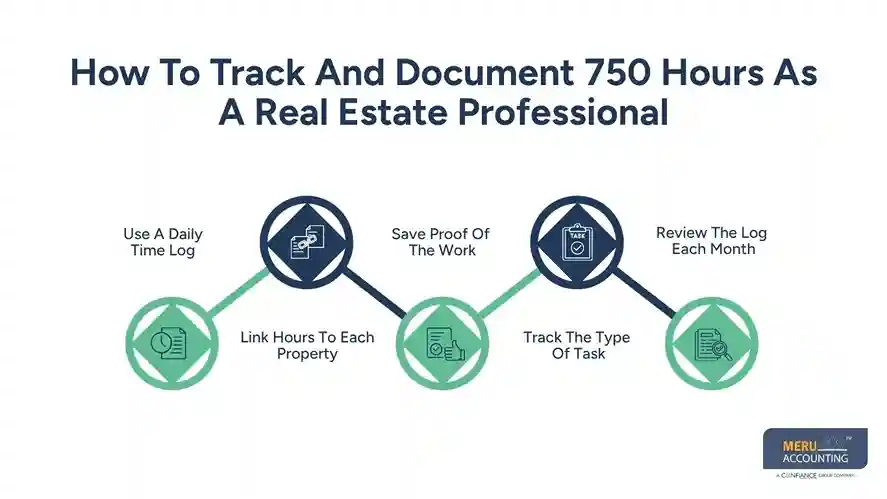
Track The Type Of Task
A good record says what you actually did. Instead of writing “worked on rental,” record “reviewed three tenant applications” or “met contractor to inspect roof repair.” Specific notes create a clearer work trail.
Review The Log Each Month
A monthly check can reveal missing entries before details fade. It also lets a real estate professional see whether the current pace is enough to reach the required hours before the tax year closes.
What Real Estate Activities Can Count Toward The 750-Hour Test?
Property Management
Property management may involve many different tasks, from checking repairs to handling tenant issues. When those services are part of a qualifying real property trade or business, the time may count under the applicable rules.
Leasing And Tenant Work
Showing a property, reviewing lease terms, communicating with tenants, and handling lease matters may form part of qualifying real property work. Keep enough detail to show the business reason for the time spent.
Property Acquisition
For a real estate professional, property acquisition can involve much more than signing closing papers. Reviewing deals, inspecting properties, studying terms, and working on acquisition matters may count when the work falls within a qualifying real property business.
Development And Construction
Development, construction, and reconstruction are among the real property trades or businesses listed by the IRS. Time spent on these activities may count when the taxpayer also meets the required participation rules.
Brokerage And Sales Work
Brokerage is another listed real property trade or business. A real estate professional working in this area should keep records of showings, listings, client work, negotiations, and other qualifying services.
optional anymore
on running the business
How Does Material Participation Affect Real Estate Tax Benefits?
Rental Activity Can Change Its Tax Treatment
Rental activities are generally treated as passive under the passive activity rules. However, rental real estate activities in which a qualifying real estate professional materially participates may be treated as nonpassive.
Loss Rules Can Be Important
Passive activity losses are subject to special limits. A loss that cannot be used in the current year may have to be carried forward. This is one reason the activity’s classification can matter when reviewing real estate tax benefits.
Nonpassive Treatment Is Not An Automatic Deduction
Passing the 750-hour test does not mean every rental loss can be deducted without further review. Basis, at-risk rules, passive activity rules, and other tax limits can still apply.
Net Investment Income Rules May Also Matter
Real estate professional status does not automatically remove rental income from the net investment income tax. The activity must also meet the specific trade-or-business and participation rules that apply to that tax.
Tax Planning Needs Full Records
The amount of real estate tax benefits available to a taxpayer depends on the full tax picture. Income, expenses, ownership, basis, losses, activity type, and participation all matter when the return is prepared.
How Meru Accounting Supports Real Estate Accounting And Tax Records
Clear Books For Each Property
Meru Accounting provides bookkeeping services for real estate businesses and keeps income and expenses organized by property. This gives owners a clearer view of the numbers behind each rental activity.
Bank And Expense Review
At Meru Accounting, we provide bank reconciliation and expense classification services. For a real estate professional, properly classified transactions make it easier to trace property costs and separate business spending from personal transactions.
Support For Time Records
Time records are not created by accounting software alone. We provide organized accounting records that can be reviewed alongside the taxpayer’s activity log and supporting property documents.
Tax-Ready Accounting Data
Meru Accounting provides accounting records that tax professionals can use when preparing and reviewing returns. The final tax position remains based on the taxpayer’s facts and the rules that apply to those facts.
Our Expert Perspective
A 750-hour claim should tell a story that makes sense from start to finish. If the calendar, property records, emails, and books all point to the same work, the record is much easier to review. For a real estate professional, good records are not just about reaching a number; they show how the hours were earned.
Key Takeaways
- A real estate professional must meet both the 750-hour and more-than-half tests.
- The hours must come from qualifying real property trades or businesses.
- Material participation is a separate requirement.
- Employee hours have a special rule based on ownership of the employer.
- Rental activities are generally reviewed separately unless a valid grouping election applies.
- Daily records are more useful than a year-end estimate.
- Property management, leasing, acquisition, development, construction, and brokerage may qualify.
- Passing the test does not make every rental loss deductible.
- Basis, at-risk, passive activity, and other tax rules may still limit deductions.
- Accurate books can make it easier to review real estate tax benefits.
- Taxpayers should review their facts with a qualified tax professional before filing.
FAQs
A real estate professional must perform more than 750 hours of qualifying real property services and meet the more-than-half personal service test.
Qualifying work can include real property development, construction, acquisition, rental, operation, management, leasing, and brokerage.
Yes, rental property management hours may count when the activity qualifies, and the taxpayer meets the applicable material participation rules.
Yes, the taxpayer must materially participate in the relevant real property trades or businesses when meeting the requirements for real estate professional status.
Real estate professionals should keep clear records of dates, tasks, properties, and time spent, along with documents that support the work performed.
optional anymore
on running the business