
Small business accounting 101 begins with one basic rule: every dollar that enters or leaves a business needs the right label. An owner’s money is not always business income, and money taken by an owner is not always a business expense. Knowing the difference keeps the books clear and gives the owner a better view of the firm’s real financial position.
This is an important part of accounting for small businesses, especially when an owner uses personal funds to pay a business bill or takes money from the business bank account for personal use. The IRS states that personal, living, and family costs are generally not deductible business expenses, and it advises owners to keep business and personal accounts separate.
For that reason, small business accounting 101 should cover three areas in detail: owner contributions, owner draws, and owner equity.
What You Will Learn From This Blog
- How small business accounting 101 treats money put into a business by its owner.
- How to record cash and non-cash owner contributions.
- Why owner contributions accounting is different from recording business income.
- How owner draws work and when they should be used.
- Why an owner draw should not be treated as an ordinary business expense.
- How contributions, profits, losses, and draws affect owner equity.
- How accounting for small businesses can keep personal and business transactions apart.
- Which owner transaction errors can make financial reports inaccurate.
- How to review owner activity during a monthly book close.
- When an owner should ask a tax professional to review a transaction.
Small Business Accounting 101: Understanding Owner Equity
What Owner Equity Means
In small business accounting 101, owner equity is the owner’s financial interest in the business after liabilities are taken from assets. A simple formula is assets minus liabilities equals equity.
Equity Is Not The Same As Cash
A business can have strong equity without having much cash in its bank account. For example, funds may be tied up in equipment, inventory, property, or unpaid customer invoices.
Profit Can Change Equity
When a business earns more than it spends, its net profit can increase equity. A loss can reduce equity. This is why profit should not be confused with the owner’s cash balance.
Contributions Can Increase Equity
When an owner adds personal funds as capital, the amount can increase the owner’s equity in the business. The entry should show where the money came from and why it was added.
Draws Can Reduce Equity
Money taken from the business for personal use can reduce the owner’s equity. A separate draw or withdrawal account makes these movements easier to see.
What Are Owner Contributions In Small Business Accounting?
Cash Put Into The Business
An owner contribution happens when an owner puts personal money into the business for business use. For example, an owner may add $8,000 to cover rent, stock, software, or other start-up costs.
Property Added By The Owner
A contribution does not have to be cash. An owner may place equipment, furniture, or another asset into the business. As part of small business accounting 101, owners should distinguish between the asset’s contribution value and its separate tax treatment before recording the entry.
Paying A Business Bill Personally
An owner may use a personal credit card to pay a business bill. Owner contributions accounting should show that the business received the benefit while the owner supplied the funds.
Contribution Or Owner Loan?
An owner can either contribute money or lend money to the business. A contribution becomes part of the owner’s interest, while a genuine loan creates an amount that the business is expected to repay.
Keep Evidence For Each Entry
Accurate owner contributions accounting needs a clear record. Keep the bank transfer, receipt, invoice, loan document, or note that explains the reason for the transaction.
How Owner Contributions Accounting Works
Identify The Source
In small business accounting 101, the first step in owner contributions accounting is to identify where the money came from. A deposit from an owner should not be treated like a customer payment just because both amounts appear in the business bank account.
Confirm The Purpose
Ask whether the money is capital, a loan, reimbursement, or another type of transaction. The purpose determines which account should be used.
Record The Correct Account
For a basic capital contribution, the business bank account may increase while the related owner’s capital or equity account also increases. The exact account names can vary by entity and bookkeeping system.
Keep The Date Clear
The transaction date should match the actual movement of funds. This matters when the books are closed by month, quarter, or year.
Check The Bank Reconciliation
At month-end, compare owner deposits with the general ledger. Small business accounting 101 becomes much easier to maintain when unusual deposits are reviewed before financial statements are issued.
What Are Owner Draws And How Do They Work?
Meaning Of An Owner Draw
An owner draw is money or property taken from a business by its owner for personal use. In small business accounting 101, the main point is to keep this withdrawal separate from normal operating costs.
Cash Taken From The Business
Suppose an owner transfers $2,000 from the business account to a personal account. If the money is for a personal purpose, it should not be posted as office rent, advertising, supplies, or another business expense.
Property Taken For Personal Use
An owner may also remove goods or equipment from the business. This type of transaction needs care because the value and tax effect can depend on the asset and business structure.
Draws Do Not Create Revenue
A withdrawal does not represent money earned from a customer. It is a movement of business funds to the owner, so it should not increase sales or business income. A basic principle of small business accounting 101 is to distinguish owner withdrawals from actual business revenue.
Entity Type Can Change The Treatment
The term “draw” is common for sole proprietors and partners, while corporations often use the term “distribution.” The tax result can vary based on the entity, so the bookkeeping entry should match the firm’s structure.
optional anymore
on running the business
Owner Draws Vs. Business Expenses: What’s The Difference?
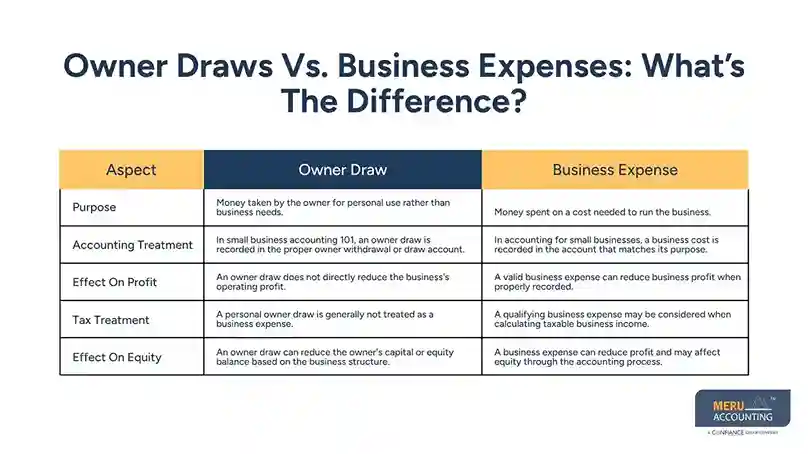
Aspect | Owner Draw | Business Expense |
Purpose | Money taken by the owner for personal use rather than business needs. | Money spent on a cost needed to run the business. |
Accounting Treatment | In small business accounting 101, an owner draw is recorded in the proper owner withdrawal or draw account. | In accounting for small businesses, a business cost is recorded in the account that matches its purpose. |
Effect On Profit | An owner draw does not directly reduce the business’s operating profit. | A valid business expense can reduce business profit when properly recorded. |
Tax Treatment | A personal owner draw is generally not treated as a business expense. | A qualifying business expense may be considered when calculating taxable business income. |
Effect On Equity | An owner draw can reduce the owner’s capital or equity balance based on the business structure. | A business expense can reduce profit and may affect equity through the accounting process. |
Understanding Owner Equity In Small Business Accounting
Start With The Opening Balance
The opening equity balance is a key part of small business accounting 101, reflecting the owner’s position based on prior records. It should agree with the closing records from the prior period unless a valid adjustment was made.
Add New Contributions
When an owner adds capital to the business, equity can increase. Owner contributions accounting makes these additions visible instead of allowing them to blend into ordinary income.
Include Business Results
Profit generally adds to equity, while a loss can reduce it. The effect is reflected through the accounting system when the period is closed.
Subtract Owner Withdrawals
In small business accounting 101, owner draws can reduce the owner’s equity. This is why a draw should not be treated like an ordinary operating cost.
Review Equity Each Month
A monthly review can compare opening equity, new contributions, business results, and withdrawals. This gives the owner a clear record of how the equity balance changed.
Common Owner Contribution And Draw Accounting Mistakes
Recording Owner Money As Sales
A deposit from the owner is not automatically customer income. Small business accounting 101 requires the source of the deposit to be checked before it reaches the income statement.
Recording Draws As Expenses
In small business accounting 101, a personal withdrawal should not be placed under rent, supplies, travel, or other business costs, as this can distort the profit figure.
Mixing Bank Accounts
Using one account for personal and business spending makes transaction review harder. The IRS specifically notes that separate accounts make business records easier to maintain.
Forgetting Owner Loans
For anyone learning small business accounting 101, an important distinction is that an owner loan is not the same as a capital contribution. If the business must repay the owner, the books should show the debt instead of treating the amount as a simple contribution.
Missing Supporting Records
A bank statement can show that money moved, but it may not explain why. Accounting for small businesses is stronger when large owner transactions have notes and supporting documents.
Why Choose Meru Accounting For Small Business Bookkeeping?
Organized Owner Accounts
Meru Accounting provides bookkeeping services that classify owner contributions, draws, loans, income, and business costs in suitable accounts based on the firm’s records.
Regular Book Review
Meru Accounting provides monthly bookkeeping review to compare owner transactions with bank activity, invoices, receipts, and other source records.
Support For US Businesses
Meru Accounting provides accounting and bookkeeping services for US businesses and works with platforms such as QuickBooks, Xero, Zoho Books, NetSuite, and Odoo.
Clear Financial Reports
Meru Accounting provides financial reports that show income, expenses, assets, liabilities, cash, and equity so owners can review the firm’s financial position.
Records For Tax Review
Keeping organized records is another basic principle covered in small business accounting 101 and can make later tax review more efficient.
Meru Accounting provides organized bookkeeping records that give the firm’s tax professional a clearer base for tax preparation and review. Tax treatment remains dependent on the firm’s facts, entity type, and applicable tax rules.
Our Expert Perspective
A sound small business accounting 101 process should review owner deposits, withdrawals, loans, and equity each month, since clear records make errors easier to find and explain.
A bank description alone may not show whether a deposit is customer income, an owner contribution, a loan, or a transfer, so accounting for small businesses should classify each transaction by its actual purpose.
Capital and owner debt should also stay separate when repayment is expected, with clear records kept for each loan. Large withdrawals need extra review because their tax treatment can vary by business structure, and S corporation owners should track stock and debt basis carefully because basis can affect the tax treatment of losses and distributions.
Key Takeaways
- Small business accounting 101 requires a clear record of money entering and leaving the business.
- Owner contributions are funds or assets placed into a business by an owner.
- Owner contributions accounting should identify the source, purpose, date, and amount.
- An owner loan is different from a capital contribution because a loan creates a repayment obligation.
- Owner draws are personal withdrawals and should not be posted as ordinary business expenses.
- Business and personal bank activity should be kept separate where possible.
- Profit and loss can change owner equity over time.
- Contributions can increase equity, while withdrawals can reduce it.
- Accounting for small businesses should classify each transaction based on its real purpose.
- Entity type matters when recording owner payments and distributions.
- Small business accounting 101 also covers the importance of tracking stock and debt basis carefully for S corporation shareholders.
FAQs
In small business accounting 101, an owner contribution should be recorded in the proper capital or equity account instead of business income.
An owner draw used for personal spending is generally not treated as a deductible business expense.
In small business accounting 101, an owner contribution puts money or property into the business, while an owner draw takes money or property out for personal use.
The business should first identify whether the money is a contribution, loan, reimbursement, or another transaction and then use the proper account.
Keeping owner draws separate from business expenses prevents personal spending from being recorded as a business cost and keeps the books clear.
optional anymore
on running the business