A finished product may leave the factory with one price tag, but getting to that cost is a different story. A small change in a material price, a new component, extra scrap, or a change in the number of parts used can shift the cost of every unit made. When those changes are not reflected in the books, manufacturing inventory accounting can quickly become harder to manage.
This is where the bill of materials (BOM) matters. A BOM shows what goes into a product and how much of each item is needed to make it. When the BOM, inventory records, and production costs line up, manufacturers can get a clearer view of what products really cost.
In this blog, we’ll break down how BOM accounting works, what costs should be included, how product costs are calculated, and where manufacturing accountants can help keep cost records accurate as production changes.
What You Will Learn From This Blog
- What manufacturing inventory accounting means
- How a bill of materials works
- What costs can be tied to a BOM
- How to work out product cost
- Common BOM costing methods
- Common inventory accounting issues
- How expert accounting support can help manufacturers
What Is Manufacturing Inventory Accounting?
Manufacturing inventory accounting is the process of recording, tracking, and reporting the costs tied to goods used and made in production. It covers inventory at each stage, from raw materials to work in process and finished goods.
Unlike a simple retail business, a manufacturer may buy materials, change them through production, add labor, and use factory resources before a product is ready to sell. Each step can affect the cost of inventory.
Good manufacturing inventory accounting helps track:
- Raw materials and parts
- Work in process
- Finished goods
- Direct material costs
- Direct labor costs
- Manufacturing overhead
- Scrap and waste
- Production cost changes
The goal is not just to keep an inventory count. The records should also show the cost tied to that inventory. This gives owners and managers a better view of product margins and production costs.
For example, if the price of steel rises, the cost of a product that uses steel may also rise. If the BOM still uses an old material rate, the product cost in the books may no longer reflect the current cost.
What Is a Bill of Materials (BOM) in Manufacturing?
A bill of materials, or BOM, is a list of the materials, parts, and components needed to make a product. It may also show the quantity of each item needed for one unit or a set production run.
A basic BOM may include:
BOM Item | Example |
Part number | MAT-1001 |
Material | Steel sheet |
Quantity | 2 units |
Unit cost | $25 |
Total material cost | $50 |
For more complex products, a BOM may have several levels. A finished product can contain subassemblies, and each subassembly may have its own list of parts.
BOM data is important for manufacturing inventory accounting because it gives the accounting team a way to connect material use with production. When BOM data is wrong or out of date, product costs can also be wrong.
A BOM should match the way the product is made. If a new part is added, a material quantity changes, or a component is replaced, the BOM should be reviewed and updated.
What Costs Are Included in a Manufacturing BOM?
A BOM mainly lists the materials and parts used to make a product. But the full cost of making that product can include more than the items shown on the BOM.
Direct Materials
Direct materials are items that can be tied to a specific product. These may include metal, wood, plastic, fabric, electronic parts, or other key materials.
The amount used and the cost per unit help form the material cost of the product.
Direct Labor
Direct labor is the cost of workers who take part in making the product. Depending on the costing system, labor may be tracked by job, product, production run, or work center.
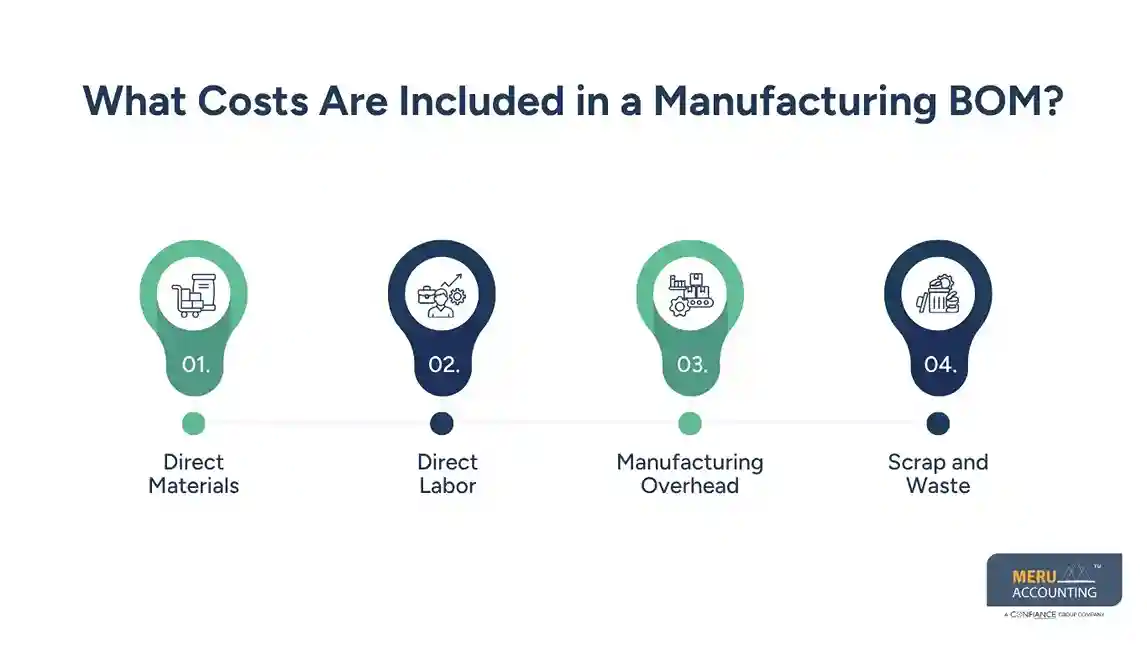
Manufacturing Overhead
Manufacturing overhead includes factory costs that are not easy to tie to one unit. Examples can include factory rent, equipment costs, utilities, repairs, and some indirect labor.
These costs may be assigned to products using a set cost rate or another cost driver.
Scrap and Waste
Some production processes create normal scrap or waste. If these costs are not tracked well, the cost of making a product may look lower than it really is.
This is one reason manufacturing accountants often review material use, production data, and inventory records together rather than looking at each record on its own.
optional anymore
on running the business
How to Calculate Product Cost Using a BOM
The basic idea is to find the cost of the materials listed in the BOM and then add the other production costs used in the chosen costing method.
For example, assume one product needs:
- 2 metal parts at $20 each
- 1 component at $15
- 4 small parts at $3 each
The direct material cost would be:
$40 + $15 + $12 = $67
If direct labor adds $18 and allocated manufacturing overhead adds $10, the total production cost would be:
$67 + $18 + $10 = $95
The exact method can vary by business and accounting system. The key is to use a clear method and apply it in a consistent way.
In manufacturing inventory accounting, product cost should also be reviewed when material prices, labor rates, production steps, or overhead rates change.
BOM Costing Methods Used in Manufacturing
Manufacturers may use different costing methods based on their products, systems, and accounting needs.
Standard Costing
Standard costing uses set costs for materials, labor, and other production inputs. The business then compares actual results with those standard costs.
This can help highlight variances. For example, if a material costs more than the standard rate, the difference can be reviewed as a material cost variance.
Actual Costing
Actual costing uses the real costs incurred in production. This can give a more direct view of what a product costs, though it may require more detailed tracking.
Actual costs can change often when material prices, labor rates, or other production costs move.
Average Costing
Average costing uses an average cost for certain inventory items. This can help smooth changes in unit costs when the same material is bought at different prices.
The right method depends on the manufacturer’s products, inventory system, reporting needs, and accounting policy. Manufacturing accountants can help review whether the costing method fits the way the business buys, stores, and uses inventory.
Common Manufacturing Inventory Accounting Challenges
Manufacturers often face inventory issues that go beyond simple stock counts. Some of the most common problems include:
Outdated BOMs
A BOM may still show an old part, old quantity, or old cost after production changes. This can lead to inaccurate product costs.
Changing Material Prices
Supplier prices can change due to market conditions, order size, freight, or other factors. If cost records are not updated, inventory values may not reflect current data.
Inventory Count Differences
Physical inventory may not always match the accounting records. Differences can come from waste, damage, timing issues, data entry errors, or unrecorded usage.
Scrap and Waste
If scrap is not tracked, the business may understate the real amount of material needed to make a product.
Production Variances
Actual material or labor use may differ from the amount expected under the BOM or standard cost. These differences should be reviewed instead of being left unexplained.
Poor Data Flow
Production, purchasing, warehouse, and accounting records need to work together. When one system has different data from another, it becomes harder to maintain accurate manufacturing inventory accounting.
Regular review can help find these issues before they affect monthly reports or year-end records.
Meru Accounting’s Manufacturing Inventory Accounting Services
Manufacturing businesses need more than basic transaction entry. Inventory, production costs, vendor bills, and financial reports all need to tie together.
At Meru Accounting, we support manufacturers with accounting and bookkeeping work designed around their existing processes and systems. Our goal is to keep financial records current, organized, and ready for review.
Our manufacturing inventory accounting services include:
- Inventory transaction and cost tracking
- Bank and credit card reconciliation
- Accounts payable and vendor bill support
- Accounts receivable support
- Production-related bookkeeping
- Inventory and cost record review
- Monthly financial reporting
- Catch-up and cleanup bookkeeping
- Tax-ready financial records
Our team can also work with the systems and workflows already used by your business. This can help reduce gaps between day-to-day transactions, inventory records, and financial reports.
For manufacturers that need ongoing support, working with experienced manufacturing accountants can also give owners more time to focus on production, sales, and growth while keeping the books in order.
Our Expert Insight
A BOM should be reviewed when actual production costs start moving away from expected costs. For example, if a product’s unit cost keeps rising, check whether material prices changed, more material was used, or labor hours increased.
We also recommend looking at these differences by product, not just at total inventory. This can help manufacturing accountants spot outdated BOM costs, unusual material use, or production issues before they affect margins and financial reports.
Key Takeaways
- Manufacturing inventory accounting tracks the cost of inventory through the production cycle.
- A BOM lists the parts and materials needed to make a product.
- Product cost can include materials, labor, and manufacturing overhead.
- BOMs should be reviewed when products, materials, suppliers, or production steps change.
- Standard, actual, and average costing can be used for different manufacturing needs.
- Regular inventory and cost reviews can help find errors and production variances.
- Manufacturing accountants can help connect inventory, production, and financial records.
FAQs
A BOM should be updated whenever materials, quantities, components, or production steps change. It should also be reviewed when actual product costs start to differ from expected costs.
An incorrect BOM can cause material usage and product costs to be overstated or understated. It may also create larger variances between expected and actual production costs.
The accounting impact depends on the costing method and the type of change. A material cost or quantity change may affect standard costs, inventory values, or production variances.
Differences can come from supplier price changes, excess material use, scrap, labor time, production waste, or outdated standard costs. Reviewing the variance can help identify the cause.
Yes. If BOM data leads to incorrect inventory or production costs, it can affect inventory valuation, cost of goods sold, gross profit, and other financial reports.
optional anymore
on running the business